Three Key Features of Triathlon Running Shoes: Elastic Laces, Sockless Wear, and Drainage Hole Design Details
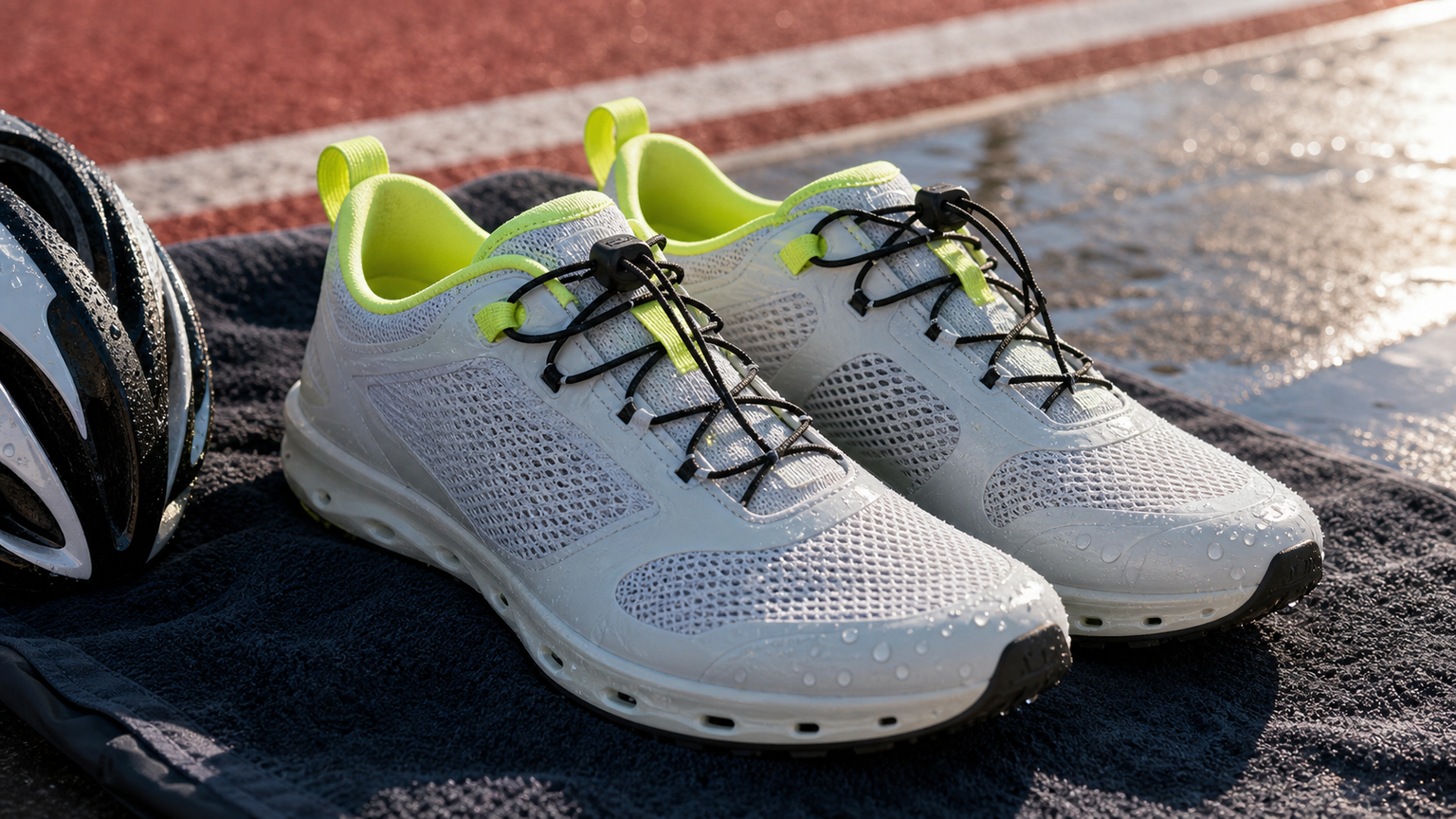
Differences Between Triathlon Running Shoes and Regular Running Shoes
Regular running shoes are designed with assumptions: wearing socks, tying laces with both hands, dry conditions, and long-term comfort. But the triathlon T2 scenario is the complete opposite:
- Worn sockless: Saves time putting on socks
- Quick single-hand on/off: Must be completed within 5 seconds
- Put on with wet feet: Just off the bike leg, socks already removed, feet are sweaty
- Long-duration use: 21K or 42K with zero friction points
Triathlon running shoes therefore feature three unique characteristics.
Characteristic 1: Elastic Lace System
Speed Lace
The most common triathlon running shoe design. Consists of an elastic cord + locking mechanism + lace stopper.
Wearing process:
- Adjust the lock to the right tightness at home before the race
- Finish with the lace stopper and trim off excess length
- At T2, just slip your foot in—the laces automatically conform with elasticity
- No tying, no buckling—just run
Compared to Regular Laces
| Item | Regular Laces | Speed Lace |
|---|---|---|
| T2 wearing time | 25-40 seconds | 5-8 seconds |
| Fit uniformity | Each eyelet adjustable independently | Uniform overall |
| Long-distance comfort | High | Medium-high (may be tight in spots) |
| Loosening risk | Medium (can come undone if not tied well) | Low |
| Weight | Standard | 5-10g lighter |
Advanced Adjustment Tips
- Do a 5K test run before the race to confirm elastic lace tightness
- Tuck the lock under the tongue to avoid it tapping the top of your foot while running
- Secure excess lace with the stopper to prevent flapping and interference
Characteristic 2: Sockless Wear Design
Inner Lining Material
Triathlon running shoes typically use special anti-friction lining materials:
- Seamless stitching
- Fine-mesh quick-dry fabric
- Some models feature an antimicrobial coating on the lining
Tongue and Collar Design
- Burrito Tongue: The tongue is attached to the upper, eliminating the need for hand adjustment
- Raised collar: The rear ankle area is raised to reduce friction
- Pull loop: A large fabric loop at the back of the tongue for easy one-hand entry
Pre-Race Preparation for Sockless Wear
- Vaseline application points: Achilles heel, big toe, outside of the pinky toe, and the forefoot
- Talcum powder inside the shoe: Absorbs moisture and reduces friction
- Toenail trimming: Keep toenails short to avoid bruising from pushing against the toe box
“Can I Really Go Sockless?” Common Questions
- Sprint / Olympic: Perfectly feasible, almost no risk
- 70.3: Recommended to test with an actual 20K+ training run
- IRONMAN: Strongly recommended to wear thin socks—otherwise, the chance of blisters after 30K exceeds 60%
If you’re unsure, keep a pair of thin socks (seamless) near T2—spending an extra 10 seconds buys you 90 minutes of comfort later.
Characteristic 3: Outsole Drainage Holes
Triathlon running shoes typically have 2-4 drainage holes of 3-5mm diameter on each side of the forefoot outsole.
Why Is Drainage Needed?
Coming out of the swim at T1, your feet are guaranteed to be soaked. Even by T2, socks are often drenched with sweat. Without drainage holes, water accumulates inside the shoe:
- Increases shoe weight (a wet shoe gains about 50-80g)
- Greatly increases friction (water + friction = blisters)
- Raises the temperature inside the shoe (evaporation effect)
Drainage holes allow water to be squeezed out downward with each footstrike, and the shoe interior can return to a dry state within 5-10 minutes.
Drawbacks of Drainage Holes
- In puddles or rainy conditions, water can flow in from the bottom
- Sand or small stones may enter through the holes
- Outsole rigidity is slightly compromised
Midsole Cushioning and Propulsion Technology
Triathlon running shoe midsoles typically feature:
- Carbon plate (high-end models, providing propulsion)
- PEBA or EVA high-rebound foam (cushioning)
- Thinner midsole (unlike the thick soles of ultra-distance running shoes, triathlon shoes lean toward a “speed-oriented” design)
Ultra-long distances (IRONMAN 42K) require a thicker midsole + higher durability; short distances (Sprint 5K) allow for thin, fast models.
Shoe Type Selection
| Triathlon Distance | Shoe Type | Recommended Weight |
|---|---|---|
| Sprint (5K) | Speed / racing carbon plate | 180-220g |
| Olympic (10K) | Speed-oriented | 220-260g |
| 70.3 (21K) | Balanced | 240-280g |
| IRONMAN (42K) | Cushioned + speed elements | 270-310g |
Pre-Race Testing Checklist
- [ ] Sockless 5K test run to confirm no blister points
- [ ] Simulate T2 movements (sit, put on shoes, stand up) to test elastic lace tightness
- [ ] Water test (run with soaking wet feet) to observe drainage efficiency
- [ ] Confirm the tongue doesn’t slide into the shoe
- [ ] Confirm the lace lock doesn’t press against the top of the foot
Price Ranges (Anonymous Examples)
| Tier | Price | Features |
|---|---|---|
| Entry | NT$ 3,000-4,500 | Basic Speed Lace, no drainage holes |
| Mid-range | NT$ 5,000-7,500 | Full triathlon features, PEBA midsole |
| High-end | NT$ 8,500-12,000 | Carbon plate, lightweight, seamless upper |
| Race-grade | NT$ 13,000-18,000 | Racing carbon plate, ultra-lightweight, elite version |
Conclusion
The value of triathlon running shoes isn’t about “how fast you can run,” but rather “saving time at T2 + not falling apart in the second half.” A well-fitted pair of triathlon shoes can save 30 seconds in transition and prevent the disaster of limping through the final 21K due to blisters. For your first pair, we recommend a mid-range speed-oriented model—confirm your foot shape and tolerance before upgrading.
Related Reading
- Triathlon-Specific Cycling Shoe Buying Guide: The Speed Code of Single-Strap Design
- Quick On/Off Design in Triathlon Cycling Shoes: The Trade-off Between Velcro and Boa Systems
- Triathlon Race Belt Selection Guide: Integrated Configuration for Bib Numbers, Gel Carrying, and Hydration
- Trisuit Selection Guide: The Trade-off Between Aero Performance and Comfort
3D 列印車褲墊 / 舒適改善? / 無痕 x 分區壓縮 / ATK & Decider系列 / JE22黑科技 / #公路車 #CTYEH
11 個月前
#公路車 #Fitting 靠人工智慧APP 幫你調整單車
6 年前
類空拍神器 Feiyu Pocket 2s (有優惠連結)三軸穩定 運動攝影機 開箱!比GoPro 還強的滑順視角!三小時長時間錄影 行車記錄器 | 環花東365實測 | 公路車 CT Yeh
4 年前
Live) 備戰2019彰化經典百K 賽前攻略 (已完賽請看新影片
7 年前
車錶新黑馬? / 超狂續航 / 超好用錶冠 / 無敵準定位 / Dash圖表合成!?/ COROS DURA 評測!/ 公路車 / CT Yeh
2 年前
多到選擇障礙... 換個單車把帶想一個小時 / BTP / 編織&軟木特有材質超吸睛! / 公路車 / CT Yeh
1 年前
新玩具!Feiyu Pocket 3 無線三軸 運動攝影機 開箱!/ GoPro拍不出來的震撼視角? / 完全沒殘影的神夜拍效果 (內有專屬優惠!) / 公路車 / CT Yeh
2 年前
多機位拍片神器 DJI Action 2 拍出速度張力感 | 類空拍機視角 4陣列麥克風超強降風噪 實測! | 公路車 | CT Yeh
3 年前