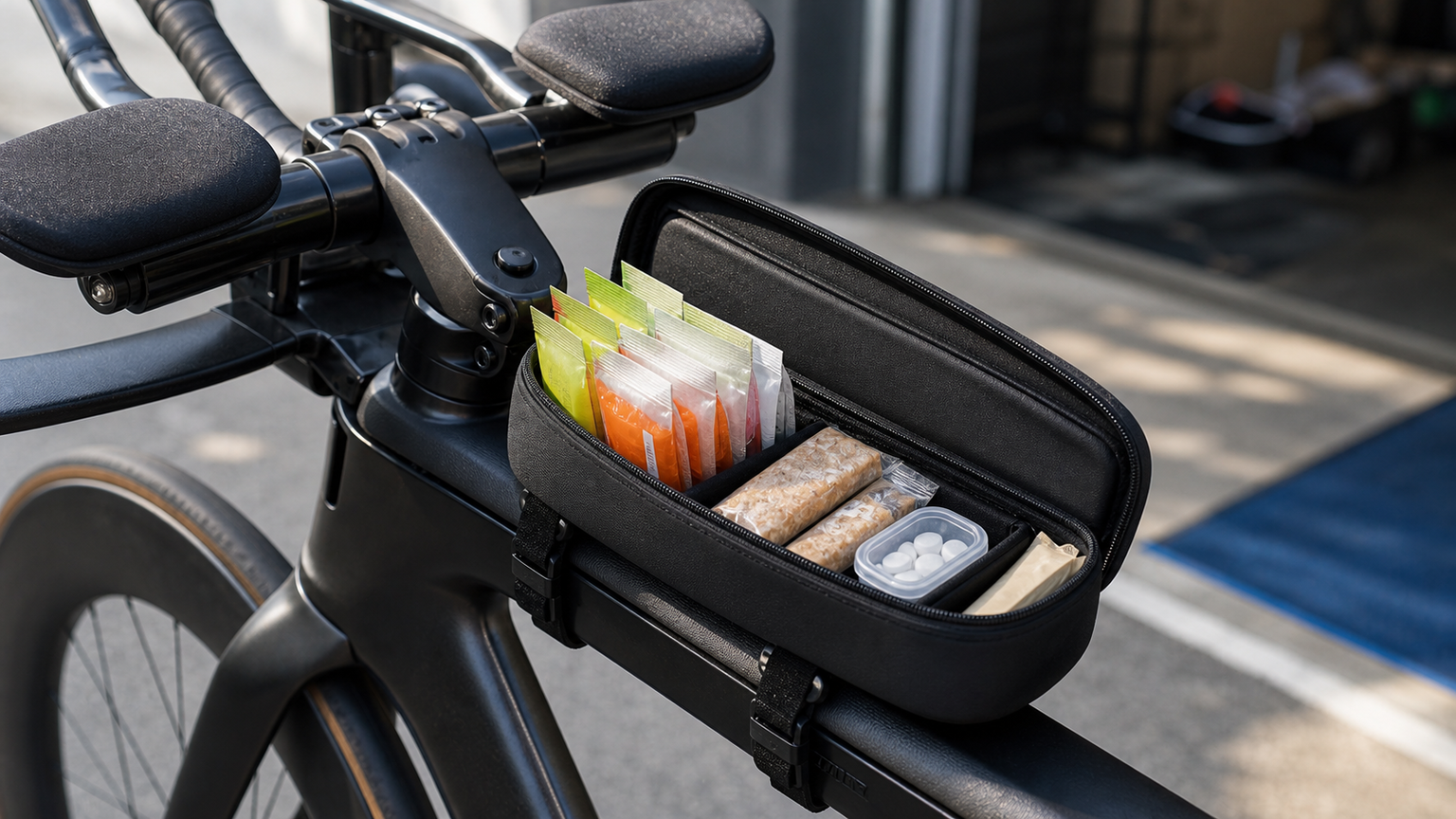
The Evolution of Bento Box Design
Fueling challenges during the bike leg of a triathlon:
- Riding on TT bars makes it difficult to take your hands off the bars
- Aid stations are 15-25 km apart, so you need to carry enough energy
- You need to grab food with one hand at speeds of 35+ km/h
The top tube bag (Bento Box / Top Tube Bag) solves the “accessibility of fuel” problem. Positioned right behind the TT bars, at the junction of the top tube and head tube, it’s visible at a glance and reachable right next to your elbow.
Three Shapes of Top Tube Bags
1. Standard Box Type
The most common design, a box-shaped structure of approximately 12 × 8 × 6 cm.
Pros:
- Largest capacity (can hold 6-10 gels)
- Can fit a phone, cash, and timing chip
- Multiple internal compartments
Cons:
- Highest aerodynamic drag
- Higher center of gravity (affects handling)
2. Aero Type
An elongated top tube bag designed for aerodynamics, stretched front-to-back and narrowed side-to-side.
Pros:
- Aerodynamic drag close to the bare frame
- Matches the aesthetics of TT bikes
Cons:
- Smaller capacity (4-6 gels)
- Narrower opening, harder to access with gloves on
3. Integrated
Some high-end TT bikes (such as the Cervélo P5, Trek Speed Concept) come with built-in integrated storage from the factory.
Pros:
- Perfect aerodynamics
- No additional straps needed
Cons:
- Capacity limited by the frame
- Cannot be used across different bikes
Attachment Methods
Velcro Strap
The most common method, with 2-3 Velcro straps wrapped around the top tube and head tube.
Pros: Simple, inexpensive, fits various bike models
Cons: Velcro loosens over time; may scratch the top tube paint
Bolt-On Mounts
Some newer TT bikes have 2 pre-drilled screw holes on the top tube (Storage Mounts).
Pros: 100% secure, no frame scratches
Cons: Only compatible with specific top tube bags
Magnetic Quick-Release
A few high-end models use magnets plus a double safety strap.
Pros: Can be removed after fueling to shed weight
Cons: Higher price, safety concerns
Capacity Planning: Matching Race Distance
Sprint / Olympic Races
Bike leg of 20-40 km, low fueling needs. A top tube bag is actually a burden. Recommendations:
- A fuel belt + rear water bottle is sufficient
- If you must use one, choose the smallest aero type
70.3 Half Ironman
Bike leg of 90 km, requiring 4-6 gels + 1-2 packs of salt tablets.
- A medium aero top tube bag is just right
- Contents: 4 gels + 1 pack of salt tablets + race timing chip + emergency cash
Full IRONMAN
Bike leg of 180 km, requiring 8-12 gels + multiple packs of salt tablets + possible solid food.
- Large box-type top tube bag + fuel belt + Aero Bottle for dual fueling
- Contents organized by zone: front gels, rear gels, salt tablet section, emergency food (such as energy bars)
Arrangement Order Inside the Fuel Bag
The “First In, First Out” Principle
Top tube bags are typically accessed from the front opening. Place the fuel you’ll consume first at the front, arranged in chronological order:
Example: IRONMAN bike leg (estimated 5.5 hours) fueling plan
| Time Point | Fuel Item | Placement |
|---|---|---|
| 30 minutes | First gel | Very front |
| 1 hour | Second gel + salt tablets | Second position |
| 1.5 hours | Third gel | Third position |
| 2 hours | Energy bar | Compartment |
| … | … | … |
| 5 hours | Last gel | Very back |
Advanced Fueling Techniques
Pre-Cut Gel Tops
It’s difficult to tear gel tops with your teeth from a top tube bag (one hand + bumpy roads). Before the race, use scissors to cut a 5mm opening at the top of the gel (without cutting all the way through), so you can squeeze it out directly once on the bike.
Gel Flask Method
Advanced athletes squeeze multiple gels into a single flask and store the whole flask in the top tube bag. Pros:
- Faster to consume (squeeze out in one motion)
- No empty wrappers flying around (eco-friendly)
- Can mix flavors to avoid palate fatigue
Cons:
- Longer pre-race preparation time
- Cannot precisely control intake per serving
Separating Salt Tablets
Don’t store salt tablets in the same bag as gels, to prevent gels from leaking and causing the salt tablets to melt and clump. Recommendations:
- Pack salt tablets in a small compression bag
- Place them in a separate compartment of the top tube bag
- Or attach them directly to the fuel belt
Complementary Fueling Systems Beyond the Top Tube Bag
A complete fueling system for IRONMAN level:
- Aero Bottle on TT bars: Primary hydration, mixed with electrolyte powder
- Rear water bottle: Backup water, replaced at aid stations mid-race
- Top tube bag: Solid / gel fuel
- Fuel belt (worn before the race): For the T2 run segment
- Special Needs Bag: Prepared before the race, picked up mid-race
Buying Recommendations
| Tier | Price Range | Suitable For |
|---|---|---|
| Entry | NT$ 600-1,200 | Sprint / Olympic |
| Mid-range | NT$ 1,500-2,800 | 70.3 |
| High-end | NT$ 3,500-5,500 | Full IRONMAN |
| Integrated (with frame) | Built-in | High-end TT bikes from factory |
Conclusion
The top tube bag is a “small tool worth 30 minutes of race value”: fueling smoothness determines late-race performance. For athletes racing 70.3 and above, this NT$ 1,500 investment has an extremely high ROI. It’s recommended to simulate your fueling rhythm during pre-race training to confirm the arrangement order inside the bag and your retrieval habits, so race day doesn’t become a scramble.
Related Reading
- Cycling Fuel Bag Buying Guide: Top Tube Bag vs Stem Bag vs Seatpost Bag Capacity and Weight
- Complete Review of Cycling Fuel Bag Types: Comparing Wedge Packs, Saddle Bags, and Top Tube Bags for Capacity and Accessibility
- Triathlon Bike Hydration Systems: Optimal Setup of Front Aero Bottle and Rear Water Bottle
- Fuel Bag and Bike Bag Design: Hip Packs, Seatpost Bags, Top Tube Bags, and Frame Bags
多到選擇障礙... 換個單車把帶想一個小時 / BTP / 編織&軟木特有材質超吸睛! / 公路車 / CT Yeh
1 年前
單車 一日北高 ( 雙城 ) 肥宅雙人瘋狂行 紀錄片 REACTO
10 年前
一日北高前的高裝檢 | 北高 360 | 挑戰11小時的裝備 | 一日雙塔 | 補給
6 年前
公路車 BB培林大升級! / 備戰海鷗繞圈賽 Canyon Aerod & TIME 一起改 / MIT大廠 CEMA對鎖式陶瓷培林BB & 導輪 / 公路車 / CT Yeh
2 年前
#公路車 #Fitting 靠人工智慧APP 幫你調整單車
6 年前
3D 列印車褲墊 / 舒適改善? / 無痕 x 分區壓縮 / ATK & Decider系列 / JE22黑科技 / #公路車 #CTYEH
11 個月前
一日北高/長距離團騎 常見問題補充篇 / 組團或跟團的眉角 / 壯車友容易被瘦車友慢性拉爆 / 原來屁股痛可能是這個原因...? / 風場配速法 / 公路車 / CT Yeh
2 年前
iPhone內建一秒變長腿🤣 車友必備#cycling
2 年前