Triathlon Goggle Selection: Differences in Field of View and Sealing Between Open Water and Pool Goggles
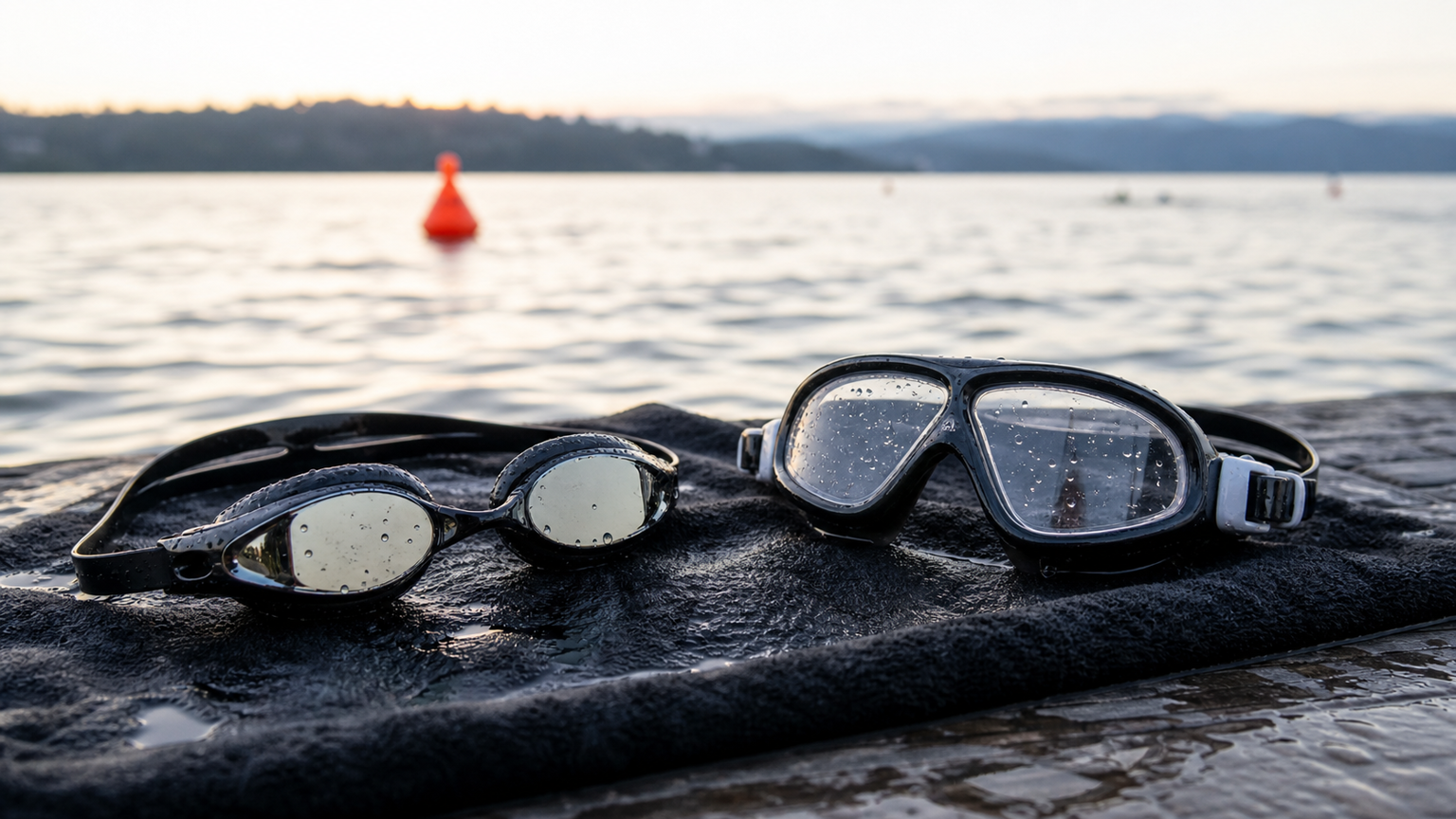
Why Do Triathlons Require Specialized Goggles?
The environment of the triathlon swim leg is completely different from a pool:
- Restricted visibility: 500+ athletes entering the water simultaneously, surrounded by splashes and other competitors
- Navigation: Must frequently lift your head to sight the buoys and confirm direction
- Changing light conditions: Low light at dawn, intense light at noon, glare from clouds and fog
- Collision risk: Arms and feet constantly coming at you from all directions
Pool goggles are designed for “swimming in a straight line with a fixed gaze,” and applying them to open water becomes a disaster.
The Core Differences Between the Two Types of Goggles
Frame Size
Pool goggles: Small frames (fitting within the eye socket)
- Streamlined, low drag
- Emphasize precise vision
- Suitable for racing turns and breathing
Open water goggles: Large frames (covering beyond the eye socket)
- Wide field of view (up to 180°+)
- Easier to spot buoys when lifting your head
- Suitable for prolonged wear
Field of View
| Goggle Type | Field of View | Best For |
|---|---|---|
| Competition pool goggles | 90-110° | 50m / 100m sprints |
| Training pool goggles | 130-150° | 1km+ pool sessions |
| Open water goggles | 160-180° | Triathlon swimming |
| Dive mask style | 200°+ (including downward) | Open sea / snorkeling |
Lens Tint and Purpose
| Lens Color | Suitable Conditions | Characteristics |
|---|---|---|
| Clear | Indoor / Low light / Night | Maximum clarity |
| Light Blue / Light Grey | Cloudy / Dusk | Neutral light reduction |
| Polarized | Bright light / Outdoor | Anti-glare, can see through the water surface |
| Mirror | Blazing sun / Beach | Strong light reduction, but more internal reflection |
| Red / Orange | Cloudy / Low contrast | Enhances contrast, clearer buoy visibility |
Triathlon-specific recommendation: Races often start at dawn, so pack one pair of light blue polarized + one pair of clear goggles in your transition bag, and choose based on the day’s weather.
Seal Testing
The “Suction Test”
Standard fitting method:
- Without the strap, gently press the goggles against your eye sockets
- Inhale through your nose to create negative pressure
- Release your hands; the goggles should “suck” onto your eye sockets without falling off
- Holding for at least 5 seconds without falling off = seal passes
If the goggles won’t suction on, the frame shape doesn’t fit your face. Nose bridge height and eye socket depth are the two key variables.
Different Nose Bridge Designs
Most goggles offer interchangeable nose bridges:
- S (Narrow): Suitable for flat noses, women
- M (Standard): Suitable for most people
- L (Wide): Suitable for high nose bridges, Western facial features
When buying goggles, shops usually include 3 sizes to try on. Test to confirm which nose bridge is most comfortable.
Anti-Fog Coating
Why Does Fogging Occur?
There’s a temperature difference between the air inside the goggles (close to body temperature, 35°C) and the outside water temperature (often 20-26°C). Water vapor from around your eyes condenses on contact = fog.
Anti-Fog Solutions
- Factory anti-fog coating: High-end goggles have an Anti-Fog coating on the inside, lasting 6-12 months
- Manual anti-fog spray: Spray the inside before the race, required before every race
- Saliva method: Traditional method, spit, spread it, and rinse; free but limited effectiveness
- Baby shampoo: Diluted and applied to the inside; doesn’t damage the coating
Absolute taboo: Rubbing the inside with your fingers! It will scratch the anti-fog coating, and it will never be anti-fog again.
Straps and Fitting Techniques
Double Strap vs. Single Strap
- Single strap: Simple, but easily knocked completely off by a kick
- Double strap: Two straps, one upper and one lower, much more stable
Triathletes are strongly advised to use double straps.
Under or Over the Swim Cap?
Under the swim cap:
- Goggles are less likely to be kicked off
- But very difficult to refit if they do come off
Over the swim cap:
- Easy to refit if knocked off
- But the whole pair can easily be kicked away
Pro athletes often use a “belt and suspenders” approach: two pairs of goggles, with a spare stored inside. But this is usually for elite-level competition; for amateur races, wearing one pair under the swim cap is sufficient.
Strap Tension Adjustment
- Too tight: Leaves red marks around the eyes, causes headaches over time
- Too loose: Falls off when kicked, lets water in
- Standard: You can slide two fingers between the goggles and your cheeks, but they won’t come off easily
Dealing with Water Ingress
Water getting into your goggles during a race is common (about a 40% chance during the triathlon swim leg). How to handle it:
- Small amount of water: Keep swimming; the water will pool at the bottom without affecting vision
- Large amount of water: Flip onto your back and float for 5 seconds, slightly lift the goggles off your face to let the water drain
- Completely knocked off: Flip onto your back, refit, take deep breaths and stay calm
- Lens shattered: Exit the water and abandon the race (extremely rare)
Prescription Goggles
Athletes with myopia / astigmatism have two options:
1. Prescription Goggles
- Purchase lenses with your prescription directly (-1.5 ~ -8.0 common)
- Each eye can be adjusted independently
- Drawback: Astigmatism and precise prescriptions may not be perfectly matched
2. Contact Lenses + Regular Goggles
- Most accurate vision
- Drawback: Contacts may come out if pool water gets in (daily disposables recommended)
- Not recommended for open water (risk of infection)
Price Ranges (Anonymous Examples)
| Tier | Price | Features |
|---|---|---|
| Entry | NT$ 600-1,200 | Basic wide-angle, no polarization |
| Mid-range | NT$ 1,500-2,800 | Polarized lenses + interchangeable nose bridge |
| High-end | NT$ 3,500-5,500 | Full UV protection + scratch-resistant coating + premium anti-fog |
| Competition | NT$ 6,000-9,000 | Customization + multiple lens sets |
Pre-Race Preparation Checklist
- [ ] Primary goggles + spare goggles (different lens tints)
- [ ] Anti-fog spray (spray once 30 minutes before the race)
- [ ] Confirm lenses are scratch-free
- [ ] Try on and perform the suction test
- [ ] Nose bridge swapped to the most comfortable size
- [ ] Swim at least 2 times with the same goggles in the week before the race (to identify any issues)
Conclusion
Goggles are the “cheapest critical gear”: a mid-range open water goggle at NT$ 2,000-3,000 can have a bigger impact than a NT$ 30,000 high-end TT helmet. Choosing the wrong goggles could make your 1500m swim leg 5 minutes slower and give you a headache for half the day. It’s recommended to have two pairs with different lens tints, test them before the race, and choose the pair best suited for that day’s weather.
Related Reading
- Polarized Sunglasses Selection and Care: Visibility Management in Open Water
- The Unique Challenges of the Triathlon Swim Leg: Technical Differences Between Open Water and Pool
- Swim Goggle Buying Guide: Field of View and Seal Differences Between Wide-Angle vs. Racing Goggles
- Triathlon Swim Training: Overcoming Open Water Fear and Improving Efficiency
[防寒衣體驗] 鐵人魂 三鐵 防寒衣試穿會 於松運 深水游泳池 鯨魚池
8 年前
近視雷射三個月後悔嗎?單車族/工程師必看,Smart TransPRK 術後血淚史與後遺症全公開 / CT Yeh
4 個月前
類空拍神器 Feiyu Pocket 2s (有優惠連結)三軸穩定 運動攝影機 開箱!比GoPro 還強的滑順視角!三小時長時間錄影 行車記錄器 | 環花東365實測 | 公路車 CT Yeh
4 年前
[教學] Premiere 影片 手震 修正 教學 防抖 單眼 影像 GoPro 穩定 Video Stabilization
8 年前
新玩具!Feiyu Pocket 3 無線三軸 運動攝影機 開箱!/ GoPro拍不出來的震撼視角? / 完全沒殘影的神夜拍效果 (內有專屬優惠!) / 公路車 / CT Yeh
2 年前
單車 梅山36灣 坡度介紹 路段介紹 空拍 (相關遊記影片,請參考說明或我的頻道喔,歡迎訂閱)
6 年前
live) 超越北高 之一日北高12小時 策略
7 年前
2023桃園團體繞圈賽 / 海鷗繞圈賽 | 全程空拍數據版 | 公路車 | CT Yeh
2 年前