Plyometric Training for Runners: How Box Jumps, Jump Rope, and Single-Leg Hops Improve Running Efficiency
Why Do Runners Need Plyometric Training?
Many runners devote all their training time to long runs and pace work, overlooking a critical component: neuromuscular efficiency. Plyometric training is precisely the tool to fill this gap. It trains muscles to produce maximal force in the shortest possible time—the so-called “Stretch-Shortening Cycle” (SSC).
The moment the foot strikes the ground (approximately 150–250 milliseconds), the Achilles tendon and gastrocnemius store elastic potential energy. If released in the shortest time possible, propulsion efficiency improves significantly. Research shows that adding plyometric training twice per week can improve Running Economy by 3–8% after 8 weeks.
Detailed Breakdown of the Three Core Movements
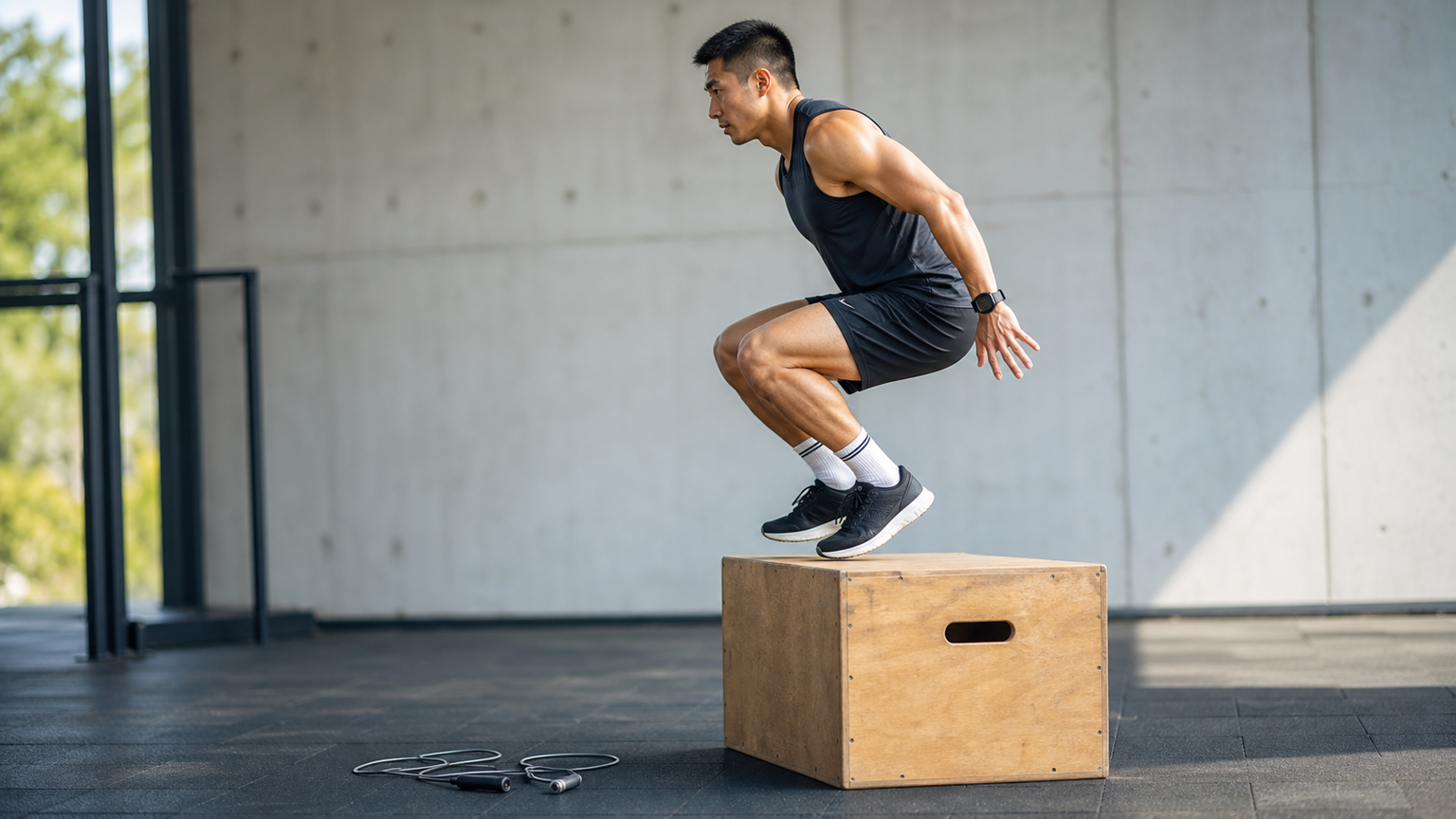
1. Box Jump
Box jump training emphasizes not just jumping high, but more importantly the rebound speed upon landing—that is, Ground Contact Time (GCT).
Standard Form:
- Stand about 30 cm from the box, feet shoulder-width apart
- Quickly bend the knees into a squat (about 90 degrees), swinging arms back to load
- Explode upward, landing with both feet on the box, striking with the forefoot
- Land softly, keeping knees aligned with toes
Training Recommendations:
- Beginners: box height 30–40 cm, 3 sets × 6 reps
- Advanced: box height 50–60 cm, 4 sets × 8 reps, 90 seconds rest between sets
2. Jump Rope
Jump rope is the most underrated training tool for runners. It develops ankle stiffness with very low injury risk—a quality highly correlated with running speed.
Training Modes:
- Two-foot continuous jumps: for warm-up, steady rhythm, 3 minutes per session
- Alternating single-leg hops: mimics running gait, 30 seconds per side × 4 sets
- High-speed double unders: explosive stimulus, 20 reps per set
When jumping rope at 120+ revolutions per minute, ground contact time is approximately 150 milliseconds—similar to elite runners’ GCT—making it an excellent neuromuscular training stimulus.
3. Single-Leg Hop
Running is a single-leg support activity, so single-leg hops more closely match the functional demands of running than bilateral movements. Single-leg hops simultaneously train power, balance, and landing stability.
Movement Variations:
- In-place single-leg hops: 3 sets × 10 reps per leg, emphasizing quick takeoff
- Forward bounding: 5 steps × 3 sets, focusing on stride length and airtime
- Lateral single-leg hops: 2 sets × 8 reps per side, strengthening adductor stability
Benefits of Plyometric Training for Running Efficiency
| Movement | Primary Training Quality | Running Benefit | Suitable For |
|---|---|---|---|
| Box Jump | Vertical power, landing absorption | Increased propulsion, stride length | 5K–Marathon |
| Jump Rope | Ankle stiffness, rhythm | Shorter GCT, improved cadence | All distances |
| Single-Leg Hop | Single-leg stability, functional power | Reduced energy leakage | Half marathon and beyond |
How to Integrate into Your Weekly Training Plan?
Plyometric training should be scheduled early on non-long-run days, and separated from strength training days by at least 24 hours. Here is a sample weekly schedule:
- Monday: Easy run + 10 minutes of jump rope (after warm-up)
- Wednesday: Interval run day (no plyometrics)
- Friday: Box jumps 3 sets + single-leg hops 2 sets (at the end of pre-run warm-up)
- Saturday: Long run
Key Principles:
- Keep total volume under 80 “contacts” (impact repetitions) per session
- Prioritize quality; stop when fatigued
- The first 2 weeks are an adaptation period; reduce volume by 30%
Common Mistakes and How to Avoid Them
- Knee valgus collapse: Forcefully abduct the knees upon landing; first strengthen the gluteus medius with single-leg squats
- Heel striking: Re-practice forefoot landing; can be done barefoot on grass
- Chasing height excessively: Power training focuses on “speed,” not “height”—shortening ground contact time matters more
Conclusion
Box jumps, jump rope, and single-leg hops may look simple, but they are among the most cost-effective training methods for improving running efficiency. Schedule them twice per week, 15–20 minutes per session, and you can feel noticeable changes within 6–8 weeks. Remember: explosive power isn’t just for sprinters—every runner needs it.
Related Reading
實景訓練台) 彰化經典百K 高強度喵團 90分鐘 跟著一起練功 2019 Indoor workout Changhua Classic 100 Taiwan
7 年前
西進武嶺 免費訓練分析服務 Intervals | 練不夠還是練過頭?你哪一種類型選手?AI模型告訴你! | 備戰神器 | 公路車 訓練 | CT Yeh
4 年前
一日北高前的高裝檢 | 北高 360 | 挑戰11小時的裝備 | 一日雙塔 | 補給
6 年前
#公路車 #Fitting 靠人工智慧APP 幫你調整單車
6 年前
沉浸室內單車練功房開箱! 100吋大畫面,最便宜的花費? 居然還能K歌!? | 公路車 | CT Yeh
3 年前
白沙屯媽祖進香在家走!UREVO 坡度自調走步機 / 可連接訓練遊戲APP MyWhoosh / 邊看直播邊走起來 / CT Yeh
11 個月前
Live) 備戰2019彰化經典百K 賽前攻略 (已完賽請看新影片
7 年前
一日北高/長距離團騎 常見問題補充篇 / 組團或跟團的眉角 / 壯車友容易被瘦車友慢性拉爆 / 原來屁股痛可能是這個原因...? / 風場配速法 / 公路車 / CT Yeh
2 年前