Runner's Reaction Training: How Agility from Ladder Drills and Side Shuffles Transfers to Running Performance
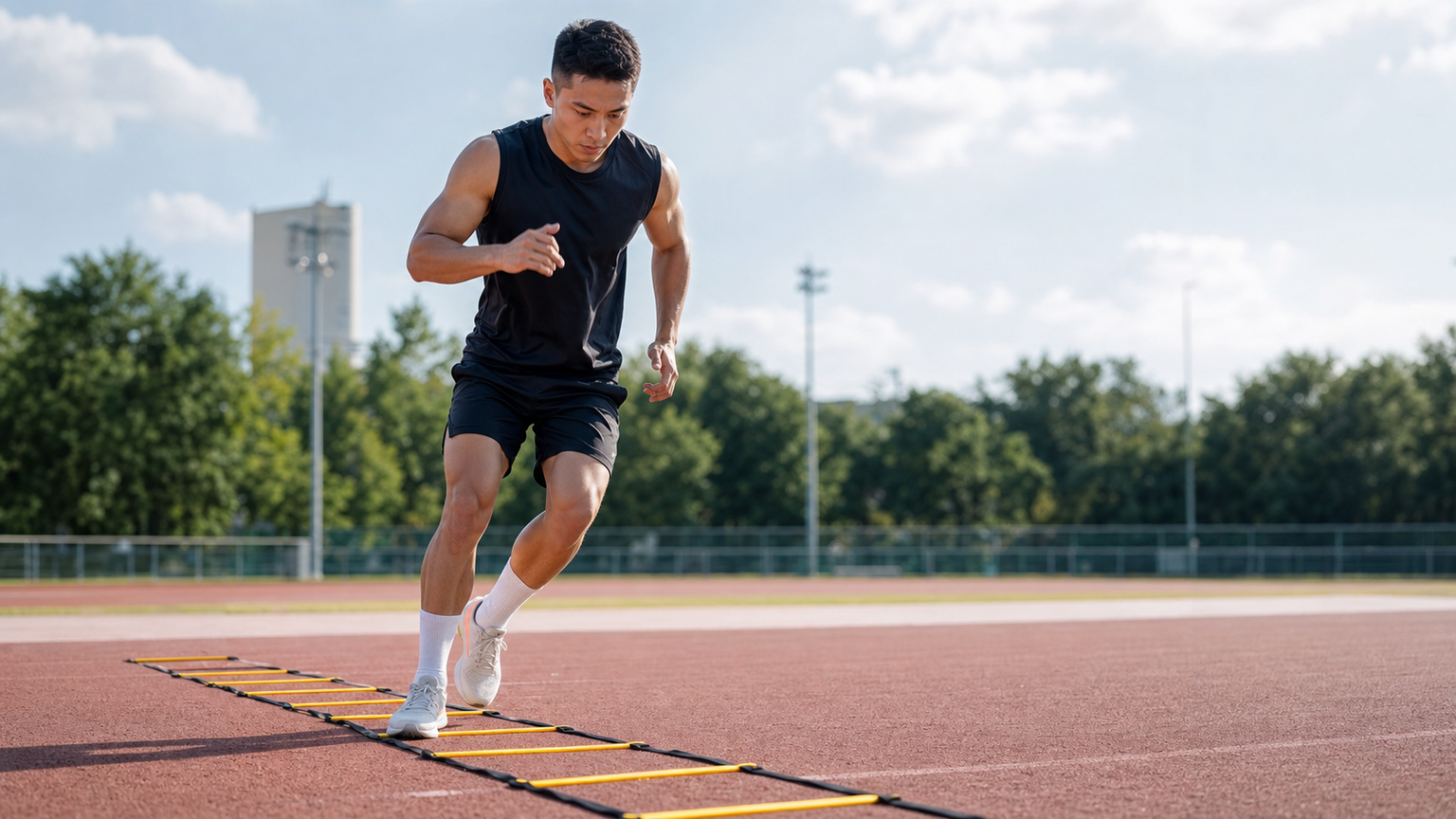
Agility and Running: An Unexpected Connection
Traditional thinking holds that agility training is reserved for basketball, soccer, and badminton players, and that runners only need to “run more” to get faster. However, recent sports science research has identified three clear mechanisms through which agility training improves running economy:
- Cadence Neural Adaptation: Ladder drills require the brain to send commands to the legs at extremely high frequency. This high-frequency neural training directly raises the upper limit of running cadence.
- Muscle Pre-Activation: Rapid lateral movement requires muscles to activate 50 milliseconds before ground contact—precisely the key mechanism for reducing ground contact time.
- Proprioception Enhancement: Fast movement in unpredictable directions trains the proprioceptors in the ankles and knees, reducing energy leakage during running.
Ladder Drills Explained
The agility ladder is the most common agility tool, with rung spacing typically set at 45 cm. Here are the three patterns runners need most:
1. One-In Drill
- Step into each rung with one foot while the other foot stays outside
- Focus: Maximizing cadence and minimizing ground contact time
- Runner benefit: Trains the “strike-and-spring” neural reflex
- Suggested tempo: As fast as possible, but every rung must be clearly stepped into
2. Two-In Drill
- Step both feet sequentially into each rung, like a light jog
- Focus: Cadence coordination + ankle elasticity in both feet
- Runner benefit: Strengthens cadence rhythm, directly aiding “pace maintenance” in the latter half of a marathon
3. Lateral Shuffle Drill
- Move sideways, alternating feet into each rung
- Focus: Adductor-abductor coordination + lateral balance
- Runner benefit: Enhances lateral stability and sharp cornering ability on trail running
Lateral Slide Training
Lateral slides require no equipment—just a flat surface. For runners, the primary purpose of lateral movement training is to strengthen “frontal plane stability,” which directly corresponds to the ability to prevent pelvic drop during the stance phase of running.
Standard Lateral Slide Execution Points
- Assume a half-squat position, keeping the lower back neutral
- Push off with the driving foot; the moving foot does not cross over
- Keep stride length between 60–90 cm
- Let arms swing naturally, avoiding excessive rigidity
Progressive Program
| Week | Volume | Description |
|---|---|---|
| Weeks 1–2 | 5 sets × 10 m, slow pace | Establish movement patterns |
| Weeks 3–4 | 5 sets × 15 m, moderate pace | Introduce cadence awareness |
| Weeks 5–6 | 4 sets × 20 m, maximum speed | Reinforce neural adaptation |
Research on the Running Benefits of Agility Training
Multiple studies provide concrete data supporting these benefits:
- After 8 weeks of ladder drill training, 5K runners increased average cadence by 3–5 steps/min
- The lateral slide training group reduced pelvic sway during running by approximately 18%
- Agility training enhances neural conduction velocity, which is directly correlated with “earlier recruitment of fast-twitch muscle fibers”
Notably, these benefits are even more pronounced in trail runners, as uneven terrain inherently demands multi-directional reaction capability.
Practical Ways to Integrate into Your Training Plan
Option A: Pre-Run Warm-Up Integration
Perform 5–8 minutes of agility training as a dynamic warm-up before every run:
- Ladder drills (forward) × 2 sets
- Ladder drills (lateral) × 2 sets per side
- Lateral slides × 20 m × 2 sets per side
- Fast high knees (accelerated version) × 20 seconds
This arrangement both completes the warm-up and adds weekly neuromuscular stimulation volume.
Option B: Dedicated Training Day
Once per week, scheduled on an easy recovery day or the day after a long run:
- Total time: 20 minutes
- 6 ladder drill patterns × 3 sets each
- Lateral slides 4 sets × 20 m
- Reaction ball training (if equipment is available): 10 minutes
Frequently Asked Questions
Q: Will agility training fatigue my legs faster?
A: In the short term, yes—because the nervous system is being asked to operate at higher intensity. But after 3–4 weeks, once the nervous system adapts, the fatigue will noticeably decrease.
Q: Which runners benefit most from agility training?
A: Runners with a cadence below 170 steps/min gain the most from ladder drills; runners with pelvic drop issues improve the most from lateral slide training.
Conclusion
Ladder drills and lateral slides are not just warm-up games—they are precision training tools for running economy. Two sessions per week of 15 minutes of agility training is one of the most efficient ways to improve cadence and running stability. Teach your nervous system to “react fast,” and your running speed will naturally follow.
Related Reading
- Runner’s Power Training: How Jump Training Improves Cadence and Stride Length
- Runner’s Power Training: The Impact of Jump Rope and Bounding on Pace
- Downhill Running Training: Using Descents to Improve Cadence and Leg Turnover
- Neural Adaptation in Road Running: How Coordination and Movement Patterns Are Refined Through Training
白沙屯媽祖進香在家走!UREVO 坡度自調走步機 / 可連接訓練遊戲APP MyWhoosh / 邊看直播邊走起來 / CT Yeh
11 個月前
西進武嶺 免費訓練分析服務 Intervals | 練不夠還是練過頭?你哪一種類型選手?AI模型告訴你! | 備戰神器 | 公路車 訓練 | CT Yeh
4 年前
#公路車 #Fitting 靠人工智慧APP 幫你調整單車
6 年前
FTL 與 SYB 車隊專訪 西進武嶺 實用攻略分享! 2小時 如何練?!你不知道的眉角!新手準備武嶺必看 EP1 | 實力派女車友 | 精華版 | 公路車 | CTYeh
4 年前
[教學] Premiere 影片 手震 修正 教學 防抖 單眼 影像 GoPro 穩定 Video Stabilization
8 年前
iPhone內建一秒變長腿🤣 車友必備#cycling
2 年前
戰略) Zwift Race 如何咬在第一集團 如何評估自己要開多少推力 (請開1.5倍速看)
7 年前
多機位拍片神器 DJI Action 2 拍出速度張力感 | 類空拍機視角 4陣列麥克風超強降風噪 實測! | 公路車 | CT Yeh
3 年前