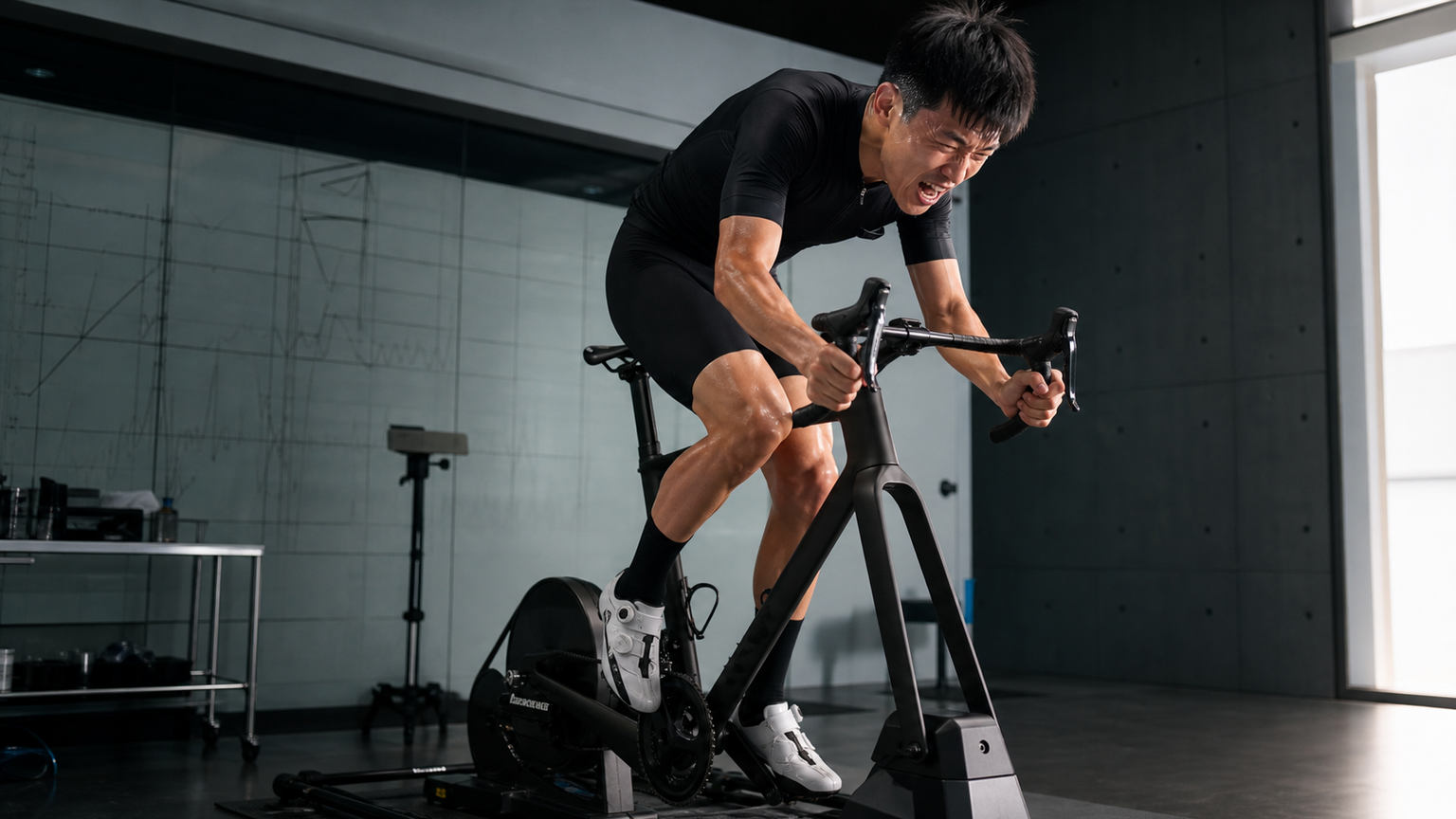
What is the Wingate Test?
The Wingate Anaerobic Test (WAnT) is an assessment tool developed by the Wingate Institute in Israel in the 1970s, and is currently the standard method used in sports science laboratories worldwide to test anaerobic power.
Test protocol: On a stationary bike, the subject pedals at maximal effort for 30 seconds, with resistance set at 7.5% of body weight (standard) or 9% (for competitive athletes).
The test produces four key metrics:
| Metric | Description | Application Significance |
|---|---|---|
| Peak Power (PP) | Highest power in the first 5 seconds | Sprint capacity, upper limit of explosive power |
| Mean Power (MP) | Average power over 30 seconds | Anaerobic endurance, lactate clearance capacity |
| Minimum Power | Power in the final 5 seconds | Fatigue resistance |
| Fatigue Index | (PP - Minimum Power)/PP × 100% | Rate of power decline, the lower the better |
For amateur cyclists, peak power typically ranges between 10–15 W/kg; competitive athletes can reach 18–22 W/kg.
Why Should Endurance Riders Care About Wingate Metrics?
Many long-distance riders believe the Wingate Test is only relevant to short sprints, but this is not the case:
The Fatigue Index reflects a rider’s ability to sustain power after accumulating lactate. This is highly correlated with “residual leg strength” in the latter stages of marathon-style rides. Riders with a low Fatigue Index can still maintain higher pedaling force on the final climb after completing 100 kilometers.
Additionally, a high peak power also represents relatively greater neuromuscular reserve, allowing the rider to use a lower “effort ratio” at normal pacing—meaning relatively less energy expenditure.
10-Second Max Power Intervals
While a full Wingate Test requires laboratory equipment, 10-second max power intervals are its training application version, requiring only a power meter or a smart trainer.
Why 10 Seconds?
Ten seconds is the primary working window of the ATP-PCr system (phosphocreatine energy system), which barely engages the glycolytic system. Therefore, it does not accumulate significant lactate and can be repeated in multiple sets within a single training session.
Standard Workout
Training Goal: Improve peak power and neuromuscular recruitment efficiency
- Warm-up: 20 minutes of progressive riding, including 3 × 5-second accelerations
- Main set: 8 × 10-second all-out pedaling (target power: 200–300% of FTP)
- Recovery between sets: 2 minutes 30 seconds of easy riding (power < 100W or < 50% FTP)
- Cool-down: 15 minutes of easy riding
Execution Key Points:
- First 3 seconds of each set: explosive acceleration (reaching maximum cadence)
- Seconds 4–10: maintain maximum output, power must not drop more than 15%
- Record peak power for each set, with the goal of no more than 10% decline across the first 6 sets
Advanced Workout: Power Decline Training
This version specifically targets improving the Fatigue Index (reducing the magnitude of power decline):
- Round 1: 5 × 10 seconds, 2 minutes recovery
- 10 minutes of easy riding rest
- Round 2: 5 × 10 seconds, 90 seconds recovery (shortened recovery time)
Shortening recovery time progressively accumulates lactate, training the body’s ability to output high power even under mild fatigue.
Testing Your Own Wingate Proxy Metrics
If laboratory equipment is unavailable, the following method can be used to estimate individual anaerobic power capacity:
30-Second All-Out Test (Field Wingate):
- On a power-meter-equipped trainer, start from a rolling start and pedal all-out for 30 seconds
- Record the average power of the first 5 seconds = estimated peak power
- Record the average power of the final 5 seconds = estimated minimum power
- Calculate Fatigue Index = (PP - Minimum Power) / PP × 100%
Self-Assessment Reference:
| Fatigue Index | Assessment Result | Recommendation |
|---|---|---|
| < 30% | Excellent | Maintain current training, focus on enhancing PP |
| 30–45% | Good | Add power decline training |
| 45–60% | Fair | Focus on phosphocreatine system recovery training |
| > 60% | Needs Improvement | Start with the basic version of 6 × 8 seconds |
Training Frequency and Periodization Recommendations
Periodization Plan:
- Base Phase: 1 session per week, 6 × 10 seconds, focusing on pedaling technique
- Build Phase (6–12 weeks out): 2 sessions per week, 8 × 10–15 seconds
- Pre-Race Phase (2 weeks out): Reduce to 1 session per week, 6 sets, maintaining neuromuscular stimulation
Conclusion
The Wingate Test provides cyclists with a scientific framework for quantifying anaerobic explosive power. Even outside the laboratory, through 10-second max power intervals, every rider can systematically improve sprint peak power and lower their Fatigue Index. Remember: each 10-second all-out effort accumulates neuromuscular adaptations that will play a crucial role the next time you sprint for the line in a group finish.
Related Reading
- Bike Power Sprint Training: Workout Design from 5-Second to 30-Second Max Power
- Sprint Power Development Training: A Complete Workout from Neuromuscular to Anaerobic Explosiveness
- Validity and Reliability of the Wingate Test in Training Monitoring
- High Power Output Training: Improving Sprint Strength and Anaerobic Capacity
全台首發!邁金P715踏板功率計!市場價格撼動者再出招 / 功率對比實測 / FAVERO ASSIOMA 可參考! / 公路車 / CT Yeh
1 年前
RAMP FTP Test 直播 究竟能撐到幾瓦 訓練台 Gravat Zwift
6 年前
西進武嶺 8000名單車友數據分析 PART1 | 從新手到高手數量/瓦數/推力比/FTP推力比/功率計使用率 大解析 | 公路車 | CTYeh
5 年前
#公路車 #Vo2Max #最大攝氧量 測驗 體驗 | 心肺測試
6 年前
西進武嶺 免費訓練分析服務 Intervals | 練不夠還是練過頭?你哪一種類型選手?AI模型告訴你! | 備戰神器 | 公路車 訓練 | CT Yeh
4 年前
#公路車 #西進武嶺 配速配瓦實驗 坡度分析 四小時內攻略 建大盃 NeverStop #西進武嶺攻略
6 年前
ThinkRider 智騎 XXPRO 訓練台,高階機種功能 只要 1/3價格!? 實測功率對比、噪音實測 / 公路車 / CT Yeh
1 年前
Fitting訓練兩用功率車 ! Thinkrider ST900 完整實測!/ 坡度升降 / 鄰居測試/ smart bike/公路車/ CT Yeh
2 年前