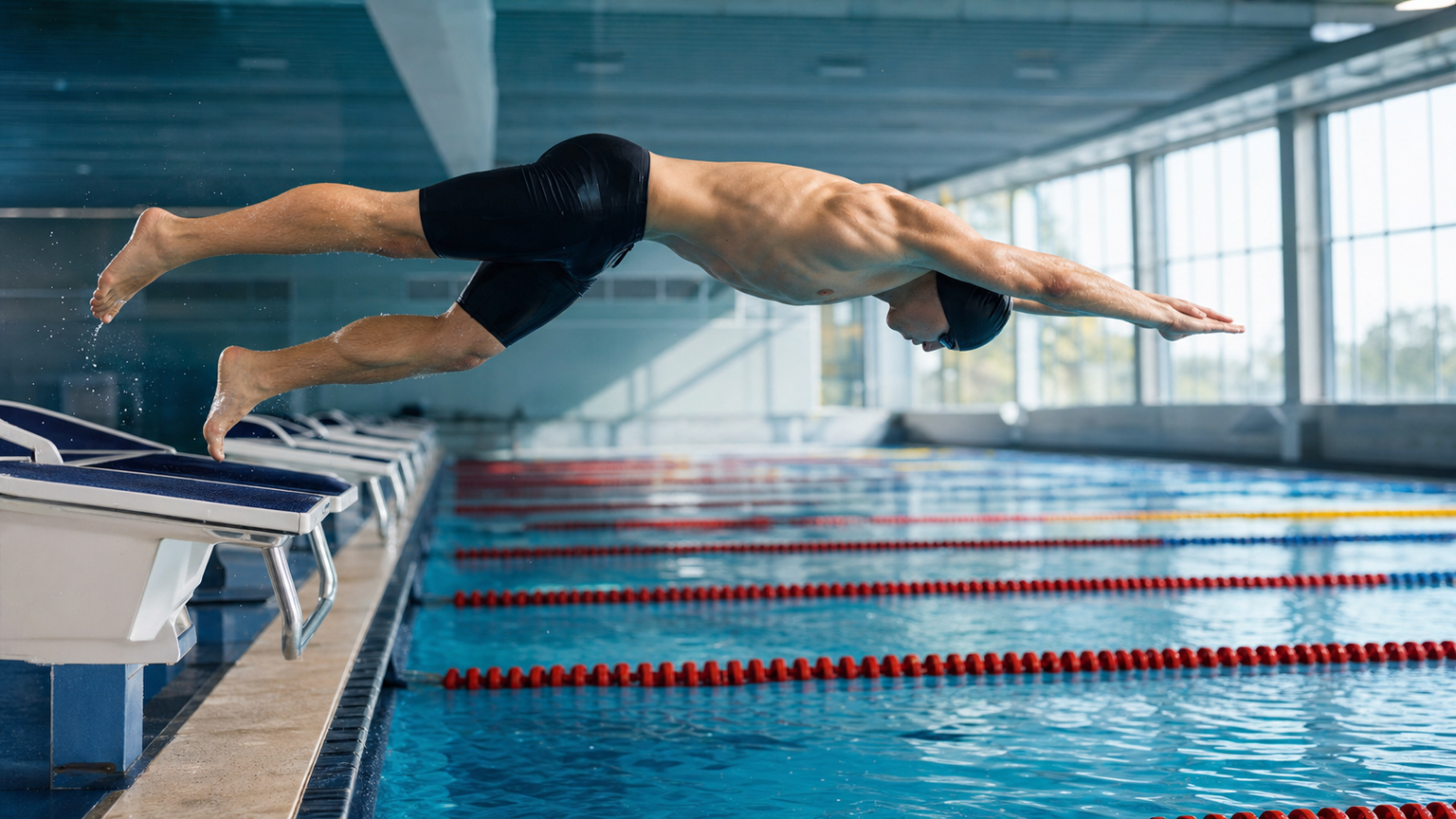
Why Is Start Performance Worth Dedicated Training?
In a 100-meter freestyle race, the start combined with the first underwater phase covers approximately 15–20 meters, accounting for 15–20% of the total distance. Research shows that elite swimmers reach the 15-meter mark (T15) 0.3–0.8 seconds faster than amateur swimmers. In a sport where races are decided by fractions of a second, this is a gap that cannot be ignored.
The explosive power required for a block start comes from three sequential actions:
- Grab Phase: Bending the knees into a squat, gripping the block with both hands, and storing elastic potential energy
- Drive Phase: Leg extension producing maximal ground reaction force
- Entry Phase: The body assumes a streamlined position, with the core and shoulders locked at the correct angle
Each phase has corresponding sport-specific training demands.
Biomechanical Analysis of the Block Start
Research uses force plates to analyze kinetic data during swim starts:
| Phase | Time | Key Mechanical Metric |
|---|---|---|
| Grab to takeoff | 0.4–0.7 s | Peak ground reaction force (Peak Force) |
| Flight time | 0.3–0.5 s | Takeoff velocity |
| Entry to 15m | 1.8–2.5 s | Underwater velocity maintenance |
Elite athletes typically achieve takeoff velocities exceeding 4.5 m/s, while amateurs usually range between 3.5–4.0 m/s. This 0.5–1.0 m/s difference primarily stems from leg power and core transfer efficiency.
Dry-Land Explosive Power Training Program
Program A: Leg Power (2 sessions per week)
Goal: Strengthen maximal ground reaction force during the drive phase
Exercise 1: Countermovement Jump (CMJ)
- Mimics the grab-to-takeoff movement pattern
- Execution: Quick squat (no pause) → explosive jump with arms swinging upward
- Sets: 5 sets × 5 reps, 90 seconds rest between sets
- Focus: Measure jump height and track progress
Exercise 2: Loaded Squat Jump
- Use light load (10–15% of body weight)
- Execution: Squat to parallel, no rebound, explode directly into the jump
- Sets: 4 sets × 6 reps
Exercise 3: Single-Leg Landing Control
- Strengthens single-leg support during the underwater roll and wall push-off (when one foot contacts the wall)
- Execution: Jump down from a 40 cm platform on one leg, hold the landing statically for 2 seconds
- Sets: 3 sets × 8 reps per leg
Program B: Core and Shoulder Streamline Locking (2 sessions per week)
Goal: Strengthen body control during flight to ensure precise entry angle
Exercise 1: Hanging Pike
- Hang from a pull-up bar with both hands, raise legs to horizontal
- Mimics the “core bracing” action during flight
- Sets: 4 sets × 8 reps, slow tempo of 2 seconds up, 1 second down
Exercise 2: Overhead Medicine Ball Slam
- Use a 1–2 kg medicine ball, raise overhead with both arms, then slam down explosively
- Mimics the explosive acceleration of the arm swing during the start
- Sets: 4 sets × 8 reps
Exercise 3: Superman Hold with Shoulder Press
- Prone position, arms extended forward, mimicking the streamlined entry position
- Add scapular depression to lock the position
- Sets: 3 sets, hold for 10 seconds each
Dry-Land Simulation Drills for Start Technique
In addition to strength training, the following dry-land simulations can directly enhance start technique awareness:
Wall Start Drill:
- Face a wall, place both hands on it, mimicking the grab position
- Push off the wall backward with maximal effort
- Purpose: Feel the direction of explosive push-off force (45-degree angle)
Banded Start:
- Attach a resistance band to the waist to provide backward pull
- Practice fast starts against resistance
- After removing the band, athletes feel lighter and the acceleration effect is noticeable
Common Start Errors and Corrections
- Head lifting too early: Causes an excessively steep entry angle and increased drag. Train the habit of “keeping eyes on the starting block until entry”
- Uncoordinated arm swing: Arm swing timing does not match the takeoff rhythm. Use a mirror or video to confirm synchronization
- Incomplete leg extension: The ankle joint does not fully extend. Strengthen explosive training for the soleus and gastrocnemius muscles
Conclusion
Every millisecond in a swim start is accumulated through systematic training. Through sport-specific training in leg power, core locking, and shoulder coordination, amateur swimmers can typically reduce T15 by 0.1–0.3 seconds after 8–12 weeks. This seemingly small improvement can mean the difference of one place in a 100-meter race.
Related Reading
- The Science of Swim Start Technique: Optimizing Reaction Time and Entry Angle
- Swim Race Start Technique: Details and Improvements for the Grab Start
- Swim Dive Reaction Time Analysis: The Critical Impact of Block Technique on Performance
- Start Dive Technique Explained: The Physics and Selection of Track Start vs. Grab Start
戰略) Zwift Race 如何咬在第一集團 如何評估自己要開多少推力 (請開1.5倍速看)
7 年前
西進武嶺 8000名單車友數據分析 PART1 | 從新手到高手數量/瓦數/推力比/FTP推力比/功率計使用率 大解析 | 公路車 | CTYeh
5 年前
滑雪新手們慘摔學習全紀錄(請開字幕),滑雪好好玩 | Snowboard + Ski | 岩原 スキー場 | 滑雪APP使用 | GoPro Max
6 年前
Live) 備戰2019彰化經典百K 賽前攻略 (已完賽請看新影片
7 年前
CT 喇低賽) 武嶺牽車 才是王道 西進牽車四小時內秘訣 攝手位置 如何判斷 防抽筋小秘訣
7 年前
西進武嶺 免費訓練分析服務 Intervals | 練不夠還是練過頭?你哪一種類型選手?AI模型告訴你! | 備戰神器 | 公路車 訓練 | CT Yeh
4 年前
實景訓練台) 彰化經典百K 高強度喵團 90分鐘 跟著一起練功 2019 Indoor workout Changhua Classic 100 Taiwan
7 年前
FTL 與 SYB 車隊專訪 西進武嶺 實用攻略分享! 2小時 如何練?!你不知道的眉角!新手準備武嶺必看 EP1 | 實力派女車友 | 精華版 | 公路車 | CTYeh
4 年前