Gravel Long-Distance Touring: Bikepacking Strategies for Bag System Selection and Weight Distribution
Gravel Long-Distance Touring: Bikepacking Strategies for Bag System Selection and Weight Distribution
Bikepacking is one of the fastest-growing forms of cycling in Taiwan in recent years. From the gravel industrial roads of the Northern Cross-Island Highway to the primitive forest trails of the Southern Cross-Island ancient path, Taiwan’s diverse terrain offers nearly endless route variety for Gravel Bikepacking. But taking full gear onto gravel surfaces isn’t just about carrying more equipment—it’s an entirely different riding challenge: the bike is heavier, the handling changes, and climbing becomes harder. A properly designed gear system is the key factor that determines whether a long-distance tour succeeds or fails.
The Five Positions of a Bikepacking Bag System
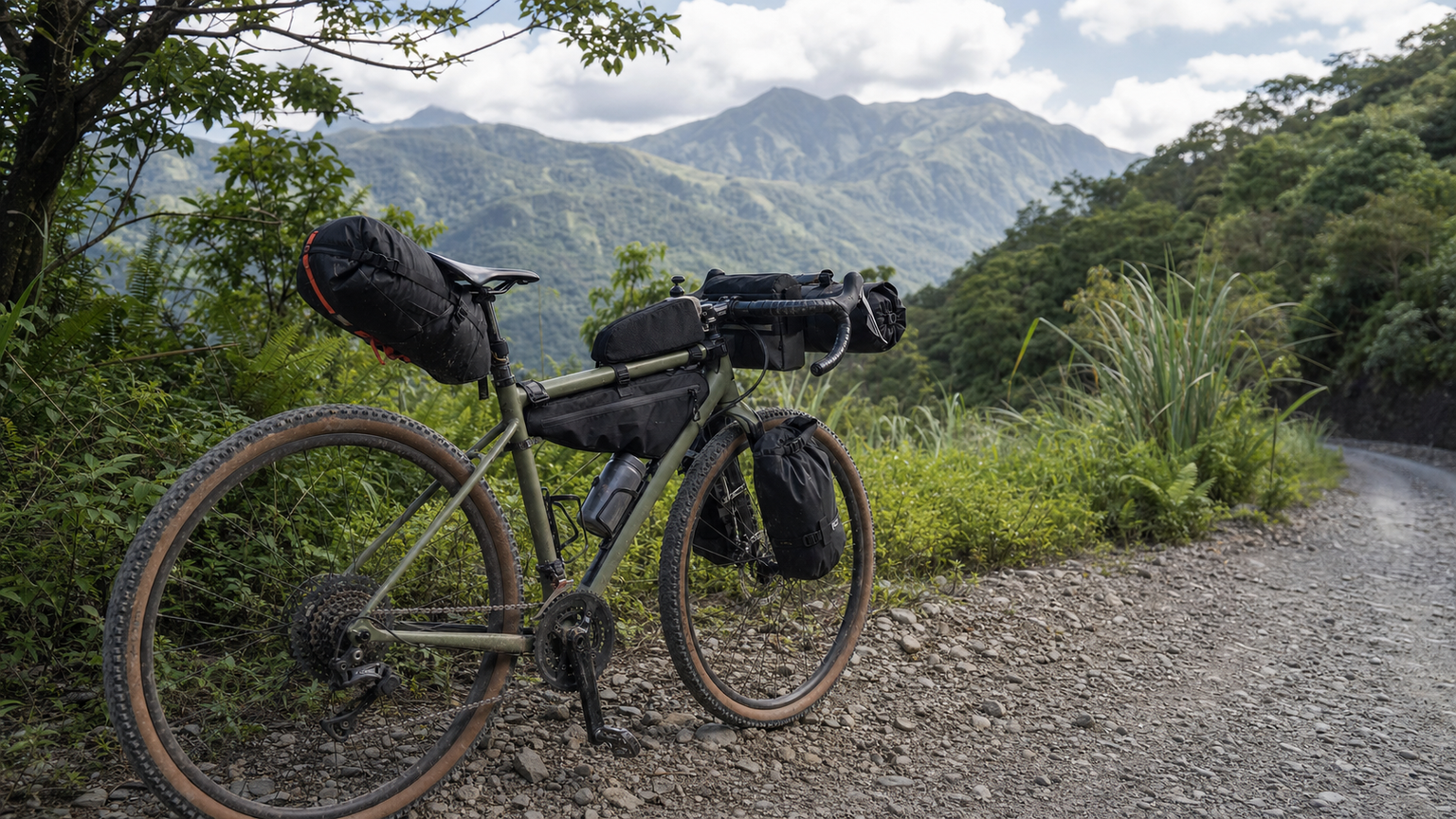
Modern Bikepacking gear systems distribute load across five primary positions on the bike:
| Bag Position | Chinese Name | Typical Capacity | Suitable Items |
|---|---|---|---|
| Frame Bag | 三角包 | 4–10L | Tools, supplies, lightweight technical gear |
| Handlebar Bag | 車頭包 | 10–20L | Sleeping bag, tent, clothing |
| Saddle Bag | 坐墊包 | 8–16L | Clothing, cookware, lightweight tent |
| Top Tube Bag | 上管包 | 0.5–2L | Phone, food supplies, small tools |
| Fork Bags | 前叉包 | 2–4L per side | Water, heavy items, tent poles |
The Physics of Weight Distribution
The handling of a loaded Gravel bike depends entirely on where the weight is placed. Understanding the physical effects of weight distribution is essential to designing a sensible gear setup.
Low Center of Gravity vs. High Center of Gravity:
The lower the weight, the lower the bike’s center of gravity, and the more stable the handling. This is why fork bags are better suited for heavy items than handlebar bags: fork bags keep weight near the axle line, while handlebar bag weight sits high and far from the wheel axle, significantly affecting steering responsiveness.
Front-to-Rear Weight Ratio:
The ideal front-to-rear weight ratio for Gravel Bikepacking is approximately 40:60 (40% front / 60% rear). Too much weight on the front wheel (over 45%) makes steering sluggish and increases the risk of front-wheel washout on gravel descents; too much weight on the rear (over 65%) leaves the front wheel too light, resulting in insufficient steering response on descents.
Bag Strategies for Different Route Characteristics
Taiwan’s Gravel Bikepacking routes vary greatly in character, and gear strategies should differ accordingly:
Technically Demanding Sections (e.g., Central Mountain Range forest road types):
- Keep total weight under 8kg (excluding food and water)
- Prioritize low-center-of-gravity setups: fork bags + frame bag as the primary configuration
- Reduce saddle bag capacity to keep the area above the rear wheel light
- Use lightweight tents (under 500g) and sleeping bags (under 800g)
Long, Gentle Gravel Surfaces (e.g., Southern Cross-Island Highway, Northern Cross-Island Highway types):
- Can accommodate greater total weight (10–12kg)
- Handlebar bags can carry more volume, taking advantage of the margin for error on gentler terrain
- Saddle bags can use larger-capacity models (12–16L)
- More space for carrying food and water (gravel routes have scarce resupply points)
Bag and Frame Compatibility
Gravel bikes have better bag compatibility than traditional road bikes, but there are still several points to watch:
Frame Bag Installation:
Check whether the frame bag is compatible with your bottle cage positions. Many frame designs make bottle cages unusable once a frame bag is installed, requiring a switch to magnetic hydration systems or additional fork-mounted bottle cages.
Saddle Bag Stability:
On gravel surfaces, saddle bag sway is far more severe than on pavement. Choose saddle bags with anti-sway systems (usually a stabilizing strap extending from the seatpost), or opt for hard-shell saddle bags—sway amplitude can be reduced by 50–70% when riding on gravel.
Handlebar Bag Steering Interference:
After installing a large handlebar bag, always test whether steering is interfered with (the bag touching the fork or tire). Especially on Taiwan’s mountainous switchback sections, steering interference can be fatal in emergency situations. After installation, perform a full steering test to ensure both directions can be turned completely to the stops.
The Importance of a Gear List
Serious bikepackers all maintain a detailed gear list. For gravel Bikepacking in Taiwan, the recommended weight distribution targets (for 3–5 day trips) are:
- Sleep system (tent/sleeping bag/sleeping pad): 1,500–2,000g
- Clothing: 800–1,200g
- Cookware (if needed): 400–600g
- Tools and spares: 300–500g
- Electronics: 300–500g
- Food (per day): 500–700g
- Water (at departure): 1,000–2,000g
Target total weight (excluding water and food): Under 5kg is ultralight, under 8kg is standard, and over 10kg will significantly compromise safety on technical sections.
Resupply Planning for Taiwan Gravel Bikepacking
One of the biggest challenges on Taiwan’s mountain forest roads is the scarcity of resupply points. Here are some practical tips:
- Plan a resupply point every 50–60km of gravel sections (tribal village shops, convenience stores at industrial road entrances)
- Water source verification: Taiwan’s mountain streams are abundant, but confirm water filtration equipment (SteriPen, Sawyer filters)
- Emergency food: carry an extra day’s worth of emergency backup rations
- Offline maps: use Gaia GPS or OsmAnd to download offline map layers for Taiwan’s mountain areas
Conclusion
The joy of Gravel Bikepacking lies in completing the most challenging journeys with the most minimal gear. Every gram of weight deserves serious consideration, and every configuration decision affects the riding experience. On Taiwan’s abundant gravel routes, a proper gear system lets you focus on the road and the scenery—rather than constantly fighting an out-of-control bike.
Related Reading
- Gravel Bikepacking Gear List: Lightweight Packing Techniques and Essential Gear Recommendations
- Bicycle Touring Gear List: The Packing Philosophy for a Week of Bikepacking Luggage
- Bicycle Camping for Beginners: Bikepacking Gear List and Recommended Routes in Taiwan
- Bicycle Touring Luggage Packing: Lightweight Techniques for Long-Distance Bike Travel
單車 一日北高 ( 雙城 ) 肥宅雙人瘋狂行 紀錄片 REACTO
10 年前
#公路車 #Fitting 靠人工智慧APP 幫你調整單車
6 年前
多到選擇障礙... 換個單車把帶想一個小時 / BTP / 編織&軟木特有材質超吸睛! / 公路車 / CT Yeh
1 年前
元宇宙運動 ! RouvyAR 虛擬實境約騎! 台灣路段開箱 帶你日月潭環潭一圈 | 團騎競賽參加教學 | 常見小問題整理 三人共享一年不用一千 | 公路車 | 訓練台 | CTYeh
5 年前
北宜騎車⋯好刺激 差點被🐒尻 / 露營單車旅 / 公路車後背攜車架開箱!/ 百人大團露 / YAKIMA 設備開箱儀式感都來了 / 公路車 / CT Yeh
12 個月前
2022台北國際自行車展 訓練台 試騎心得大全 差點腿軟走出! 元宇宙武嶺!| Garmin Tacx Oreka Xpedo Wahoo | 公路車 | CT Yeh
4 年前
單車元宇宙新霸主?TrainingPeaks Virtual 實測 / Zwift 完美平替? 還是超越?/ 有台灣國旗!前身 indieVelo / 公路車 / CT Yeh
1 年前
高雄綠園道鐵路自行車道 / 外地人能輕鬆駕馭 還是整路崩潰? / 2025 全線開通 春節實地探索一次!(附GPS連結)/ 公路車 / CT Yeh
1 年前