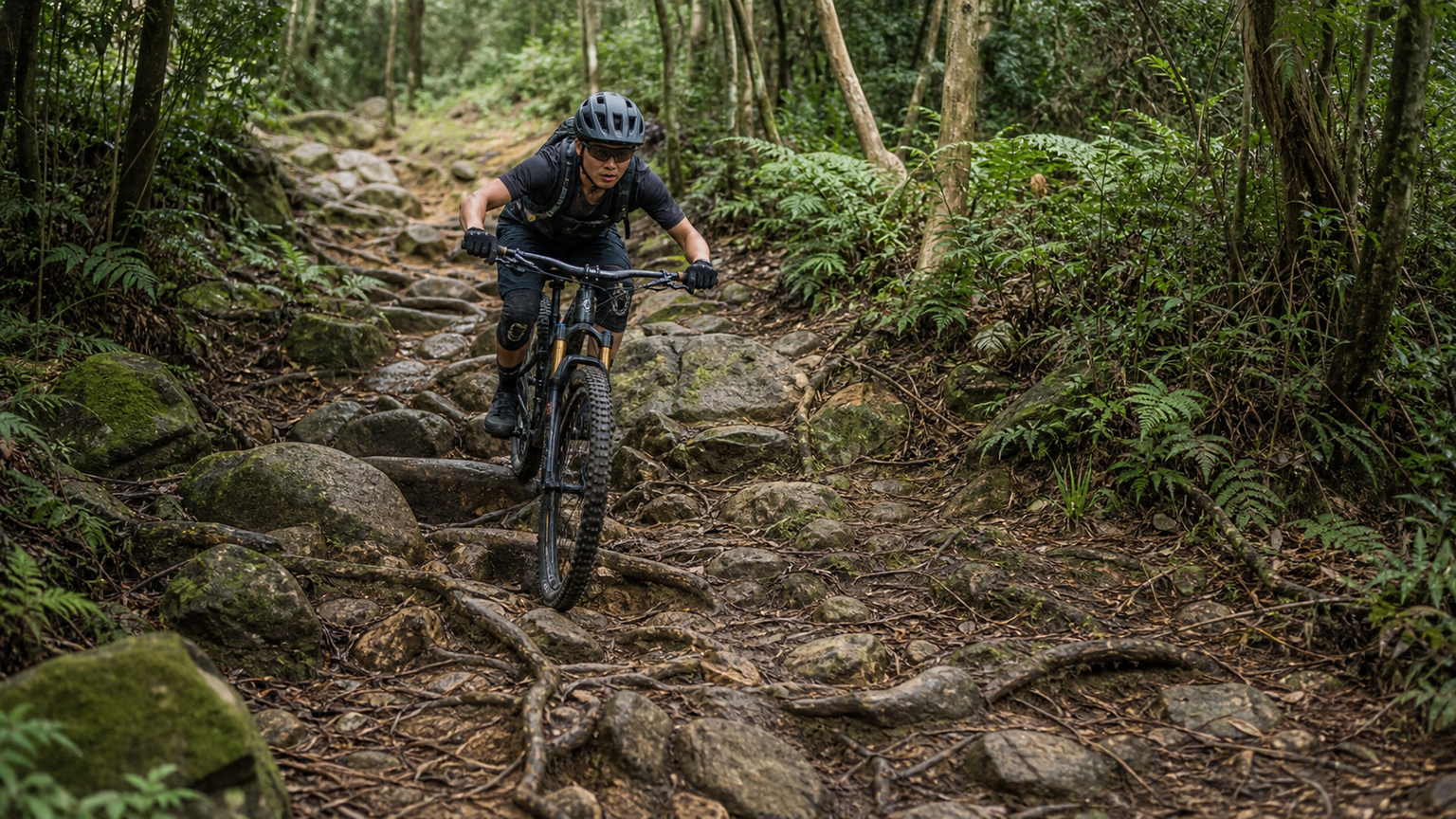
MTB Technical Terrain: Speed Selection and Line Reading on Rocky and Rooty Sections
Taiwan’s mountain trail systems preserve many unmaintained, raw surfaces where exposed rocks and interlaced tree roots are the norm on MTB routes in the northeastern and central mountain regions. When riders first encounter such terrain, their instinctive reaction is often to slow down dramatically or even dismount and push—this is certainly a safe choice, but it also causes them to miss the most enjoyable part of technical MTB riding.
The truth is: on technical terrain, an “appropriate speed” is often safer than a “low speed.” Understanding this counterintuitive fact is the first step toward breaking through on technical sections.
The Counterintuitive Relationship Between Speed and Stability
Why does speed improve stability? The reason is the gyroscopic effect: a spinning tire tends to maintain the direction of its rotational axis, and the faster it spins, the stronger this effect. At low speeds, the tire’s gyroscopic effect is weak, and the bike has very little resistance to lateral disturbances (such as roots striking the side of the tire), making it easier to get bounced off the line.
Of course, going too fast on technical terrain is also unsafe—the problem is insufficient reaction time. The optimal speed lies between these two extremes—fast enough to use the gyroscopic effect for stability, yet slow enough to react to trail conditions.
A practical speed reference:
- Rooty sections (evenly distributed): 12–18 km/h
- Rocky areas (large irregular rocks): 8–15 km/h
- Mixed technical terrain (rocks + roots + tight corners): 6–12 km/h
Line Reading: Seeing Matters More Than Riding
Line reading on technical terrain is a learnable skill, not a talent. The core principle is: stopping to look is far more efficient than riding in wrong and having to retry.
A step-by-step line reading process:
-
Stand at the start of the section and walk through it once (if the section length allows). Observe:
- Rock height differences (drops over 20 cm require special planning)
- The orientation of root distribution (roots perpendicular to the direction of travel are more likely to deflect tires than parallel ones)
- Wet or dry conditions (wet rocks have a friction coefficient roughly 30–40% lower than dry ones)
-
Identify key decision points: Throughout the section, there are usually 2–4 “decision points” that determine the success of the entire line—typically the direction around a large rock, the entry choice for a narrow slot, or the braking point on a steep descent.
-
Plan a primary line and a backup line: Decide on the ideal main line, as well as a fallback route if you drift off the primary line. The backup line is usually a slower but safer option.
Techniques for Riding Rocky Sections
Common rocky sections in Taiwan come in several types:
Chunky Rocks:
Rocks of varying sizes, irregularly distributed. Riding strategy:
- Look for “corridors” between rocks and guide the front wheel along that corridor line
- Allow the rear wheel to roll over small rocks (under 30 cm)—you don’t need to avoid every single one
- Keep your eyes on the end of the corridor and let your body naturally guide the wheels through
- Maintain a slightly rearward weight bias to give the rear wheel room for passive suspension
Slabs:
Large inclined slabs common in northeastern Taiwan, often covered with moss. Riding strategy:
- Ride along the direction of maximum incline (the steepest fall line) rather than traversing across the slab
- Traversing a slab (tire direction perpendicular to the incline) is the line most likely to cause a slide
- Avoid mossy areas entirely; if unavoidable, ride straight through without braking at all
- Run tire pressure 5–8 psi lower than usual to increase grip on slabs
| Rock Type | Optimal Speed | Weight Position | Tire Pressure Adjustment |
|---|---|---|---|
| Chunky Rocks | Medium speed (12–18 km/h) | Slightly rearward | Slightly lower |
| Slab (dry) | Maintain medium speed (no sudden braking) | Neutral | Normal |
| Slab (wet) | Low speed, straight line (8–12 km/h) | Neutral to rearward | Significantly lower |
| Rocky riverbed | Roll through at speed (18–25 km/h) | Rearward | Slightly lower |
Techniques for Riding Rooty Sections
Rooty sections on Taiwan’s forest roads have their own characteristics: damp, moss-covered, and sometimes alternating with dirt.
The influence of root orientation:
- Transverse roots (perpendicular to travel direction): high impact—you need speed to bounce the tire over, or reduced speed to let the tire crawl over slowly
- Longitudinal roots (parallel to travel direction): the main danger is the front wheel getting caught in the root gap—ride on top of the root or avoid it entirely
- Diagonal roots (45°): contain both transverse and longitudinal components—the hardest type to read
Front wheel steering technique:
The core of technical root sections is letting the front wheel actively “choose” its landing point. The approach is to make slight handlebar adjustments to guide the front wheel to the target landing point just before it reaches the root, letting the rear wheel follow passively. In the early practice phase, you can simulate this from a standstill: stand beside the bike, turn the front wheel by hand, and visualize the guiding motion.
Mental Management on Technical Terrain
The biggest obstacle on technical terrain is often not skill but mentality. A few practical mental strategies:
- Break it into segments: Split a long technical section into several short segments and conquer them one by one rather than attempting the entire section at once
- Allow failure: Failing on the first attempt is normal. After a failure, calmly analyze: is it a speed issue, a line issue, or a technique issue?
- Lower risk perception: Tell yourself “a slide is at worst a scrape, not fatal”—assess risk rationally rather than avoiding it emotionally
Conclusion
Breaking through on technical terrain is one of the most rewarding improvements in MTB riding. Going from pushing your bike through to smoothly riding a rocky, rooty section often takes only a few deliberate practice sessions plus proper technical guidance. Remember: line reading comes before riding, appropriate speed beats blind caution, and every technical section is the best classroom.
Related Reading
- Road Bike Descending Safety on Mountain Roads: Cornering Line Choice and Speed Control
- Trail Running Terrain Reading: Safe Techniques for Rocks, Mud, and Roots
- MTB Obstacle Clearing Techniques: Rocks, Roots, and Drops
- MTB Descending Technique: The Three Elements of Braking Points, Rearward Weight Shift, and Eye Control
台北闊瀨陡坡 騎旅 / 日本單車雜誌編輯車友臨時加入!/ 髮香才是最強的 / feat. 北迴歸線小隊 / 公路車 CT Yeh
6 個月前
單車 梅山36灣 坡度介紹 路段介紹 空拍 (相關遊記影片,請參考說明或我的頻道喔,歡迎訂閱)
6 年前
一日北高/長距離團騎 常見問題補充篇 / 組團或跟團的眉角 / 壯車友容易被瘦車友慢性拉爆 / 原來屁股痛可能是這個原因...? / 風場配速法 / 公路車 / CT Yeh
2 年前
CT 喇低賽) 武嶺牽車 才是王道 西進牽車四小時內秘訣 攝手位置 如何判斷 防抽筋小秘訣
7 年前
公路車 BB培林大升級! / 備戰海鷗繞圈賽 Canyon Aerod & TIME 一起改 / MIT大廠 CEMA對鎖式陶瓷培林BB & 導輪 / 公路車 / CT Yeh
2 年前
如果Pogačar騎西進武嶺可以多快?會破2嗎?各種情況深度推估探討 / 公路車 / CT Yeh
2 年前
爬坡ITT實境)台中 魔王 松鼠坡 首航 6:12 大肚山 大三元 科福路
8 年前
富士山KOM 賽事篇 VLOG!/ 小野田出沒!/ 完整路段分析 / 武嶺要騎多快才能拿環?/ 台灣選手 第20回Mt.富士ヒルクライム 参加!/ 公路車 / CT Yeh
2 年前