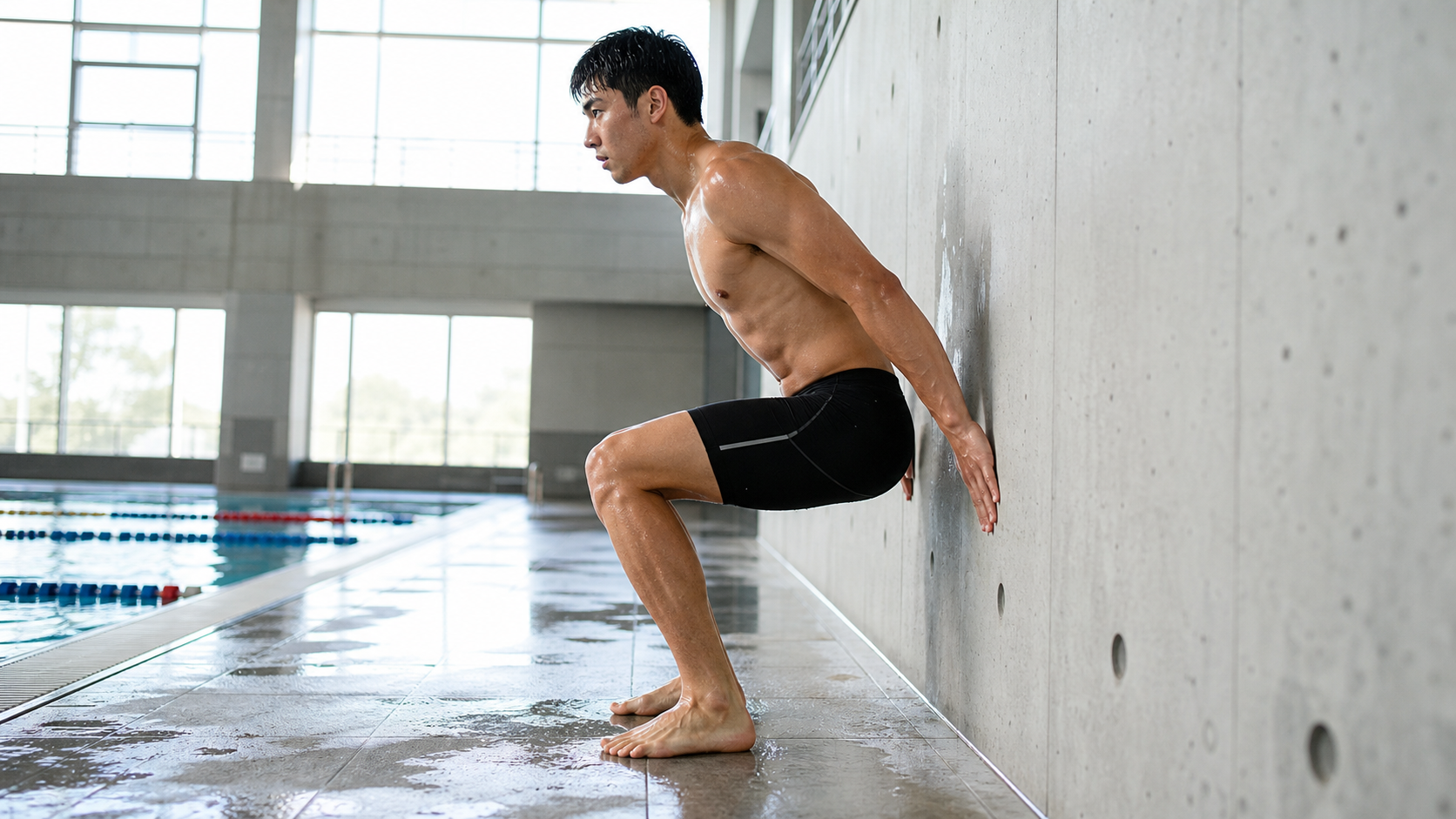
The Wall Pushoff: Swimming’s Most Overlooked Source of Speed
A 1500-meter freestyle race (50-meter pool) requires 29 turns. If each turn is 0.1 seconds faster than your opponent’s, that adds up to nearly 3 seconds of advantage—equivalent to gaining half a body length over your rival in a middle-distance race.
Pushoff power is the decisive factor in turn speed, and it is primarily composed of the following movements:
- Tumble Turn: The angular velocity of the body’s rotation determines how long the wall contact takes
- Leg Drive: The explosive extension after both feet hit the wall—this is the main source of propulsion
- Streamline: Keeping the body tight after pushing off to reduce water resistance
- Underwater Dolphin Kick: The underwater dolphin kick after the pushoff maintains speed
This article focuses on point 2, “leg drive explosiveness,” and its dry-land strengthening exercises.
Biomechanical Analysis of the Wall Pushoff
Mechanical characteristics of an efficient wall pushoff:
| Characteristic | Elite Swimmers | Amateur Swimmers |
|---|---|---|
| Knee flexion angle at wall contact | 100–120 degrees | 130–160 degrees (too much or too little) |
| Wall contact time | 0.2–0.3 seconds | 0.4–0.6 seconds |
| Initial pushoff velocity | 2.5–3.5 m/s | 1.5–2.0 m/s |
| Ankle extension angle at pushoff | Full plantar flexion (toes pointing back) | Incomplete, residual ankle dorsiflexion |
Key finding: The main problems for amateur swimmers are “poor wall contact angle (knees bent too much or too little)” and “incomplete ankle extension.” Dry-land training can directly target and improve both of these issues.
Core Dry-Land Strengthening Exercises
Exercise 1: Wall Squat Explosive Press
Purpose: To simulate the leg angle and explosive timing of the wall pushoff
Execution:
- Stand with your back against a wall, feet about 50 cm away, knees bent to 100–110 degrees (simulating the pushoff angle)
- Hold this position for 2 seconds (simulating the wall contact pause)
- Explosively drive up, fully extending the knees and ankles
- You may add a jump to enhance peak explosive power
Sets: 4 sets × 8 reps, 90 seconds rest between sets
Exercise 2: Explosive Plantar Flexion
Purpose: To strengthen the explosive power of full ankle extension and resolve the “residual ankle dorsiflexion” problem
Execution:
- Stand with feet shoulder-width apart
- Quickly rise onto your toes (plantar flexion) to the highest point, feeling the soleus and gastrocnemius fully contract
- Drop back down immediately after each rise (do not lower slowly)
- Advanced version: jump rope or single-leg explosive calf raises
Sets: 3 sets × 20 reps (basic) → 3 sets × 20 reps single-leg (advanced)
Exercise 3: Lateral Roll to Jump
Purpose: To simulate the rotation-to-explosion sequence of rolling over and quickly pushing off the wall
Execution:
- Lie on your side on the floor, quickly roll onto your feet (simulating the flip turn)
- Immediately jump straight up upon standing, with both arms extended overhead (simulating streamline)
- Emphasize “maximizing speed” throughout the movement sequence
Sets: 4 sets × 6 reps, be mindful of floor safety
Exercise 4: Box Jump with Rotation
Purpose: To train the rapid initiation of the rotational kinetic chain (for the rotator muscles used in the flip turn)
Execution:
- Stand in front of a low box (30 cm), turned 90 degrees sideways
- Rotate 90 degrees while jumping onto the box, landing with both feet
- Land with stability and no wobbling
Sets: 3 sets × 6 reps per side
Complete Dry-Land Pushoff Strengthening Program (2 times per week)
Warm-up (10 minutes):
- Squats 15 reps (emphasizing glute activation)
- Ankle circles 15 reps per side
- Glute bridges 15 reps
- Jump rope 2 minutes (to warm up the ankles)
Main workout (30 minutes):
- Wall Squat Explosive Press: 4×8
- Explosive Plantar Flexion: 3×20
- Lateral Roll to Jump: 4×6
- Box Jump with Rotation: 3×6 per side
Integration training (10 minutes):
- Using resistance bands to simulate the wall pushoff motion: 3×8
- Drop Jumps: 3×8 (to strengthen reactive strength for immediate rebound upon ground contact)
Integration with In-Water Technique Training
Dry-land training must be paired with in-water technical reinforcement to achieve maximum benefit:
- Precise wall contact distance: Before each turn, confirm the “number of strokes to the wall” rhythm so the knees land at the optimal 100–120 degree angle
- Turn timing drills: Use a stopwatch to record the time from wall contact to the 15-meter mark, aiming to shave 0.05 seconds off every 4 weeks
- Streamline maintenance training: After the pushoff, maintain at least 5–6 dolphin kicks before surfacing to maximize underwater speed
Conclusion
Pushoff power is the “hidden score” in swimming speed, and targeted dry-land training can lead to significant improvements in a short period. With a complete program of 2 sessions per week, 50 minutes each, most swimmers can shave 0.1–0.2 seconds off their turn time after 8 weeks. In highly competitive swimming races, this is precisely the key difference between “finishing the race” and “finishing fast.”
Related Reading
- The Mechanics of the Swimming Turn Pushoff: Technical Details for Maximum Propulsion
- Refining Turn Technique: Wall Contact Angle and Pushoff Timing in the Flip Turn
- Analyzing Swimming Turn Efficiency: Maximizing Pushoff Force and Glide Distance in the Flip Turn
- Refining Swimming Turn Technique: Pushoff Timing and Streamline Maintenance in the Flip Turn
西進武嶺 8000名單車友數據分析 PART1 | 從新手到高手數量/瓦數/推力比/FTP推力比/功率計使用率 大解析 | 公路車 | CTYeh
5 年前
實景訓練台) 彰化經典百K 高強度喵團 90分鐘 跟著一起練功 2019 Indoor workout Changhua Classic 100 Taiwan
7 年前
福隆鐵人團練隨拍
8 年前
戰略) Zwift Race 如何咬在第一集團 如何評估自己要開多少推力 (請開1.5倍速看)
7 年前
西進武嶺 免費訓練分析服務 Intervals | 練不夠還是練過頭?你哪一種類型選手?AI模型告訴你! | 備戰神器 | 公路車 訓練 | CT Yeh
4 年前
CT 喇低賽) 武嶺牽車 才是王道 西進牽車四小時內秘訣 攝手位置 如何判斷 防抽筋小秘訣
7 年前
RAMP FTP Test 直播 究竟能撐到幾瓦 訓練台 Gravat Zwift
6 年前
抖肩舞 台灣x日本交流版 (台灣 vs 前橋) 赤城山登山賽 coincidance
8 年前