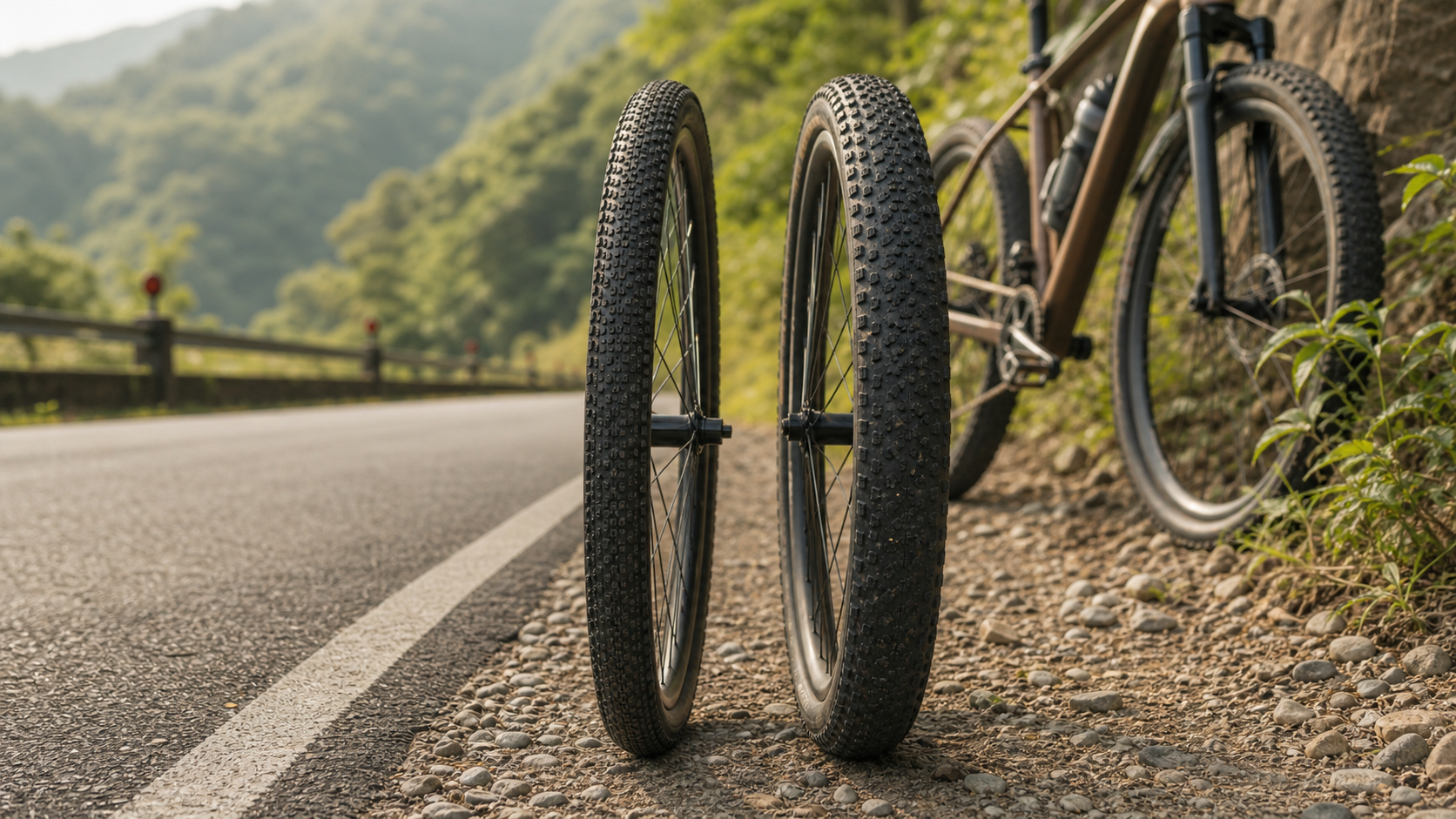
Gravel Tire Selection: 700c vs 650b, and Suitable Scenarios for 35–50mm Widths
If there is one topic in gravel riding that never ends, it has to be tire selection. 700c or 650b? 35mm or 45mm? Tubeless system? Slick or semi-knob tread? Every dimension has its own advocates, each with their own arguments. But this question actually has an answer—not a one-size-fits-all answer, but a systematic decision-making framework based on your route characteristics, weight, and riding style.
The Wheel Size Debate: The Physics of 700c vs 650b
At the core of this wheel size debate is a mathematical fact:
- 700c × 40mm tire has an outer diameter of approximately 710mm
- 650b × 47mm tire also has an outer diameter of approximately 710mm
In other words, using a narrower 700c tire or a wider 650b tire can achieve the same outer diameter, but with completely different contact patch shapes and air column shapes.
Advantages of 700c:
- At the same contact patch area, the contact ellipse is longer and narrower, with slightly lower rolling resistance
- Faster on firm surfaces (packed gravel, crushed stone roads)
- Compatible with mainstream road bike rims, making spare availability more convenient
- Most gravel tire options in Taiwan are 700c
Advantages of 650b:
- At the same air column volume, the air column is rounder with greater deformation capability
- Better cushioning on loose, rough surfaces (rocky forest roads, dirt trails)
- Can fit up to 2.1 inches (53mm) wide, approaching MTB-level grip
- Lowers the overall center of gravity by about 15mm, offering slightly higher handling stability
| Comparison Item | 700c × 40mm | 650b × 47mm |
|---|---|---|
| Outer Diameter | Approx. 710mm | Approx. 709mm |
| Rolling Resistance (firm surfaces) | Slightly lower | Slightly higher |
| Impact Absorption | Moderate | Better |
| Maximum Usable Tire Width | 45–50mm (frame-limited) | 50–57mm |
| Spare Availability | Easier in Taiwan | Stocked at some shops |
| Suitable Routes | Mixed asphalt and gravel | Pure gravel/forest roads |
Tire Width Selection: 35–50mm for Different Purposes
Tire width is a variable that affects riding feel more directly than wheel size.
35–38mm: Speed-Oriented Gravel
Suitable surfaces: Mostly asphalt, occasionally entering firm gravel surfaces (such as flat farm roads, riverbed crushed stone roads)
Advantages: Rolling efficiency close to wide road tires, minimal speed loss on asphalt sections
Limitations: Limited grip on loose gravel, sidewalls prone to cuts from sharp stones
Recommended uses: Gravel races (such as Taiwan’s local gravel road events), commuting + occasional gravel exploration
40–43mm: All-Rounder Gravel
This is the most widely used size range in gravel tires, offering the best balance between speed and grip.
Suitable surfaces: 60% gravel, 40% asphalt, or entirely gravel surfaces
Advantages: Wide adjustable pressure range (28–45 psi), adaptable to various conditions
Limitations: Still struggles in deep, soft mud
Recommended uses: Taiwan mountain forest roads, gravel industrial roads, short bikepacking trips
45–50mm: Off-Road Gravel
Suitable surfaces: 80% or more gravel/dirt surfaces
Advantages: Closest to lightweight XC MTB tire grip performance, low-pressure settings (23–30 psi) provide excellent comfort
Limitations: Noticeable rolling loss on asphalt sections, feels heavy at high-speed cruising
Recommended uses: Taiwan’s Central Mountain Range forest roads, multi-day bikepacking trips, wet-season riding
Tread Pattern Selection
Gravel tire tread patterns generally fall into three categories:
Semi-Slick: Smooth center strip + edge knobs
Best for: Dry gravel surfaces where speed is the priority. The smooth center strip provides low rolling resistance, while the edge knobs offer lateral grip when cornering.
All-Terrain Tread: Evenly distributed medium knobs
Best for: Mixed surfaces, wet gravel during Taiwan’s plum rain season. This is the most versatile tread type.
Aggressive Tread: Tall, widely spaced knobs
Best for: Muddy forest roads, deep loose gravel. Excellent self-cleaning ability, but noise and rolling resistance increase significantly on dry surfaces.
Tubeless System Considerations
In Taiwan’s gravel riding environment, a tubeless system is almost a necessary investment, for the following reasons:
- Gravel in Taiwan’s mountain areas is sharp, and the flat rate with tubed systems is quite high on long rides
- Tubeless allows you to lower pressure by 8–12 psi, greatly improving comfort and grip without increasing flat risk
- Small punctures (under 3mm in diameter) can be sealed automatically by sealant, without needing to stop and change tubes
Recommended sealant amount: 40–60ml per tire, topped up every 3–4 months (Taiwan’s climate is hotter, so sealant evaporates faster).
Practical Advice for Taiwanese Riders
Based on the characteristics of Taiwan’s gravel routes, here is a practical tire selection decision framework:
- Northern Mountain Areas (Taipei, Yilan): Choose 700c × 40–43mm, all-terrain tread, use tubeless year-round
- Central Mountain Areas (Nantou, Taichung): Choose 700c × 43mm or 650b × 47mm, depending on the route
- Eastern Taiwan (Hualien, Taitung): Road conditions are better, 700c × 40mm is sufficient
- Rainy Season (May–September): Regardless of what you normally use, consider lowering tire pressure by 3–5 psi and switching to all-terrain tread during the rainy season
Conclusion
There is no absolute right or wrong in gravel tire selection—only what is “suitable for your route” and what is “not suitable for your route.” Once you establish your own selection framework, every tire change becomes an opportunity to fine-tune your riding experience. Starting with an all-rounder 700c × 40mm tire and gradually exploring the differences between various specifications is the most effective way to build your tire knowledge.
Related Reading
- 650B vs 700C: The Complete Guide to Gravel Bike Wheel Size Selection
- Bicycle Tire Buying Guide: The Speed and Comfort Trade-off of 25c vs 28c vs 32c Widths
- Gravel Wheelset Buying Guide: Rim Width, Spoke Count, and Tire Compatibility
- Bicycle Tire Buying Guide: Speed and Comfort Comparison of 25c vs 28c vs 32c
Vision Metron RS 37碳幅條輪組 (非SL)官網沒有的 低調開箱 / 這重量太銷魂了 / 公路車 / CT Yeh
6 個月前
再一組! 全碳幅條 碟煞/無內胎輪組 開箱! 到底好騎嗎? UNAAS X40 | 公路車 | CT Yeh
4 年前
Unaas X50 全碳纖幅條輪 數據實測對比PK | Lun Hyper 的高階版 | 板輪爬坡也可以很厲害? ! 武嶺2小時大師一起親測! CP值超高 | 公路車 | CT Yeh
4 年前
Nepest NOVA 碳條輪組:輕量、空力、舒適一次滿足!/ 公路車 / CT Yeh
7 個月前
鉅齒紋輪組!? ControlTech MEG-T50 EVO 碳纖維幅條輪組/ 功率對比實驗 / 公路車 / CT Yeh
2 年前
多到選擇障礙... 換個單車把帶想一個小時 / BTP / 編織&軟木特有材質超吸睛! / 公路車 / CT Yeh
1 年前
單車 一日北高 ( 雙城 ) 肥宅雙人瘋狂行 紀錄片 REACTO
10 年前
碟煞公路車 優缺點?換車一年半實際經驗分享 / 公路車 / CT Yeh
2 年前