MTB Braking Systems: Adjusting Hydraulic Disc Brakes and Preventing Heat Fade
There is a hidden danger in Taiwan’s summer MTB riding: disc brake heat fade after long, continuous descents. Hydraulic disc brakes offer powerful braking and a linear feel under normal use, but after prolonged, continuous braking (such as descending a steep slope with 300 meters of elevation loss), rotor temperatures can rapidly climb from room temperature to 200–400°C. This temperature can cause brake fluid to boil (vapor lock), sintered brake pads, and even a temporary loss of braking power. Understanding how disc brake systems work and how to maintain them is essential knowledge for MTB riders in Taiwan.
Basic Operating Principles of Hydraulic Disc Brakes
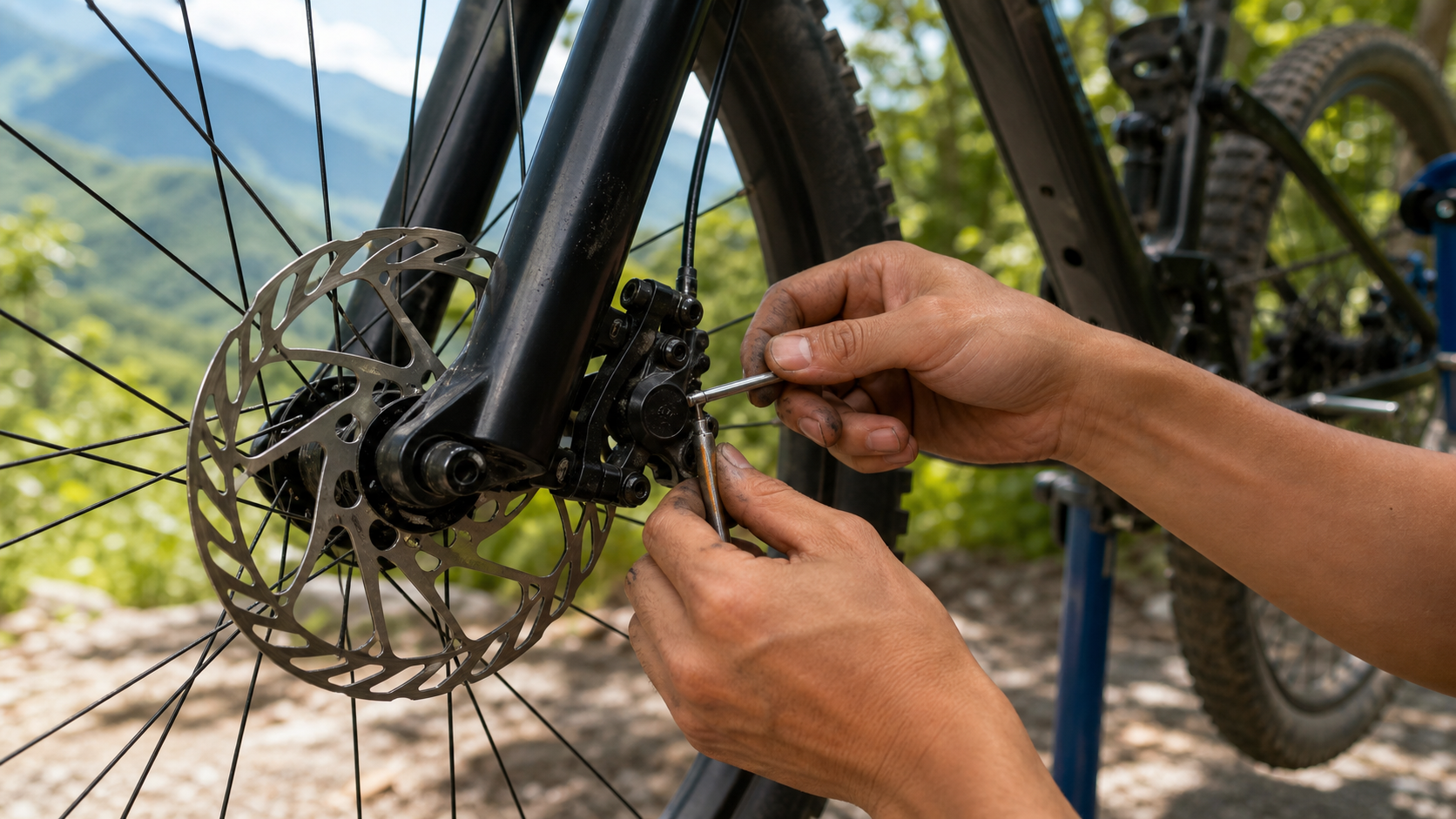
The core of a hydraulic disc brake system is a sealed hydraulic circuit: the master cylinder on the handlebar transmits hydraulic pressure through the brake hose to the pistons in the caliper, which push the brake pads against the rotor to generate braking friction.
Key materials in the entire system:
- Brake Fluid: Shimano uses mineral oil, while SRAM/TRP use DOT fluid (DOT 4/DOT 5.1). The two are not interchangeable; mixing them will damage the seals.
- Rotor: Steel rotors are lightweight but dissipate heat poorly; steel-aluminum composite rotors (such as Shimano IceTech) offer 30–50% better heat dissipation. Composite rotors are recommended for Taiwan’s long summer descents.
- Brake Pads: Resin/organic pads offer a linear feel and quiet operation, suitable for general trail riding; metallic/sintered pads have higher heat resistance and longer life, suitable for wet, muddy terrain and long descents.
Basic Disc Brake Adjustment: Alignment and Clearance
The most common disc brake issue is rotor rubbing against the caliper, causing noise and drag. The root cause is usually a misaligned caliper or a warped rotor.
Caliper Alignment Steps:
- Loosen the caliper mounting bolts (usually two 5mm hex bolts), just enough so the caliper can move
- Pull and hold the brake lever (use a rubber band or have someone help), allowing the pistons to push the pads against the rotor, which automatically centers the caliper
- While the caliper is clamped onto the rotor, retighten the mounting bolts
- Release the brake lever and spin the wheel to confirm the rotor no longer rubs against the caliper
If the rotor still rubs slightly after adjustment, the rotor may be slightly warped. Use a rotor truing tool (a specialized thin steel tool, available at most bike shops in Taiwan) to gently apply force from the direction of the rub to straighten it. A few attempts usually resolve the issue.
| Symptom | Possible Cause | Recommended Action |
|---|---|---|
| Persistent rubbing noise | Caliper misalignment or warped rotor | Realign caliper, true the rotor |
| Sharp squealing | Oil contamination on pads or rotor | Clean the rotor; replace pads if heavily contaminated |
| Spongy lever feel (pulls to the bar) | Hydraulic leak or needs bleeding | Check hose fittings, bleed the system |
| Lost lever feel after heat fade | Vapor lock (fluid boiling) | Stop and let cool; avoid this situation |
The Mechanism and Prevention of Heat Fade
Vapor lock is the most dangerous failure mode for disc brakes: when brake fluid boils from heat, it turns from liquid to gas. The compressibility of gas causes hydraulic pressure transmission to fail, and the lever pulls straight to the bar with no braking power.
Heat Fade Risk Assessment for Taiwan’s Mountainous Terrain:
- Descent gradient over 15% with a continuous distance over 2 km: moderate risk
- Gradient over 20% with a continuous distance over 3 km: high risk (especially with resin pads)
- Summer temperatures above 30°C + continuous long descents: extremely high risk
Prevention Strategies:
-
Intermittent Braking: On long descents, use an intermittent “brake → release → brake” pattern, giving the rotor time to cool between each application. Compared to continuous braking, intermittent braking can lower rotor temperatures by 30–50%.
-
Choose Rotors with Better Heat Dissipation: Models like Shimano IceTech composite rotors, TRP drilled rotors, and Magura Storm HC all offer better heat dissipation. Upgrading from a 160mm to a 180mm rotor also significantly improves cooling (increasing the heat dissipation area by approximately 26%).
-
Switch to Metallic Pads: If you frequently ride routes with long descents, upgrade from resin pads to semi-metallic or fully metallic pads. Metallic pads have a heat tolerance roughly 50–80°C higher than resin pads, but they are slightly noisier and have a firmer initial bite.
-
Regular Bleeding: Brake fluid absorbs water over time, which lowers its boiling point and makes vapor lock more likely. It is recommended to bleed the system and replace the brake fluid every 12–18 months.
Brake Pad Wear Assessment and Replacement
Brake pad lifespan varies greatly depending on terrain and riding style. In Taiwan’s mountainous, muddy conditions, pads can be worn out in just a few long rides.
Wear Assessment Methods:
- New pads are typically 3.5–4mm thick (including the backing plate)
- Functional minimum: approximately 1mm of pad material remaining (about 2.5mm total thickness including the backing plate)
- The most intuitive check: if you need to pull the lever further than before to achieve the same braking power, the pads are likely close to needing replacement
Rotor Oil Contamination Issues
A common issue when riding Taiwan’s trails is rotor contamination from oil (chain lube, valve cap oil), causing a sudden drop in braking power and a sharp squealing noise.
Emergency Cleaning (in the Field):
- First, stop and let the system cool completely (using water or cleaner on a hot rotor can cause warping)
- Use a paper towel or cloth dampened with clean water to wipe the rotor surface
- Lightly apply the brakes 8–10 times to help wear away contaminants from the pad surface
Thorough Cleaning (Back Home):
- Remove the wheel and wipe both sides of the rotor with isopropyl alcohol (75% alcohol)
- Isolate the caliper with a plastic bag to prevent cleaner from entering
- If the pads are heavily contaminated, they need to be replaced (pads saturated with oil cannot be fully restored)
Conclusion
Hydraulic disc brakes are the most important safety system for MTB riders in Taiwan, and regular maintenance and proper use are basic responsibilities. Check pad thickness before every long descent ride, clean the rotors every 6 months, and bleed and replace the fluid every 12–18 months—these three habits will ensure your disc brake system delivers the most reliable stopping power when you need it most.
Related Reading
- The Evolution of Road Bike Braking Systems: Mechanical Disc vs Hydraulic Disc vs Rim Brakes Comparison
- Bicycle Disc Brake Technology: The Braking Science and Maintenance of Hydraulic Disc Brakes
- Descending Braking Techniques and Brake System Protection: Ride Safely and Save Your Brake Pads
- The Physics of Braking Systems: Disc Brake Heat Fade, Rim Brake Cooling, and Safety Margins on Long Descents
碟煞公路車 銑面器 !? 原來銑完差這麼多! 降低蹭碟機率! | TIME 公路車 保養小記錄 | CT Yeh
3 年前
碟煞公路車 優缺點?換車一年半實際經驗分享 / 公路車 / CT Yeh
2 年前
再一組! 全碳幅條 碟煞/無內胎輪組 開箱! 到底好騎嗎? UNAAS X40 | 公路車 | CT Yeh
4 年前
公路車 BB培林大升級! / 備戰海鷗繞圈賽 Canyon Aerod & TIME 一起改 / MIT大廠 CEMA對鎖式陶瓷培林BB & 導輪 / 公路車 / CT Yeh
2 年前
西進武嶺 自製新版AI配速表產生器 x 賽前攻略 抱佛腳! 沒有功率計也可以產生配速表嗎?有什麼其他眉角賽前要注意的呢? | 西進武嶺 / 東進武嶺 KOM 攻略 | 公路車 | CT Yeh
4 年前
鉅齒紋輪組!? ControlTech MEG-T50 EVO 碳纖維幅條輪組/ 功率對比實驗 / 公路車 / CT Yeh
2 年前
一日北高/長距離團騎 常見問題補充篇 / 組團或跟團的眉角 / 壯車友容易被瘦車友慢性拉爆 / 原來屁股痛可能是這個原因...? / 風場配速法 / 公路車 / CT Yeh
2 年前
功率實測 Lun Hyper 2023 碳幅條輪組 D45 碟煞 | 公路車 | CT Yeh
3 年前