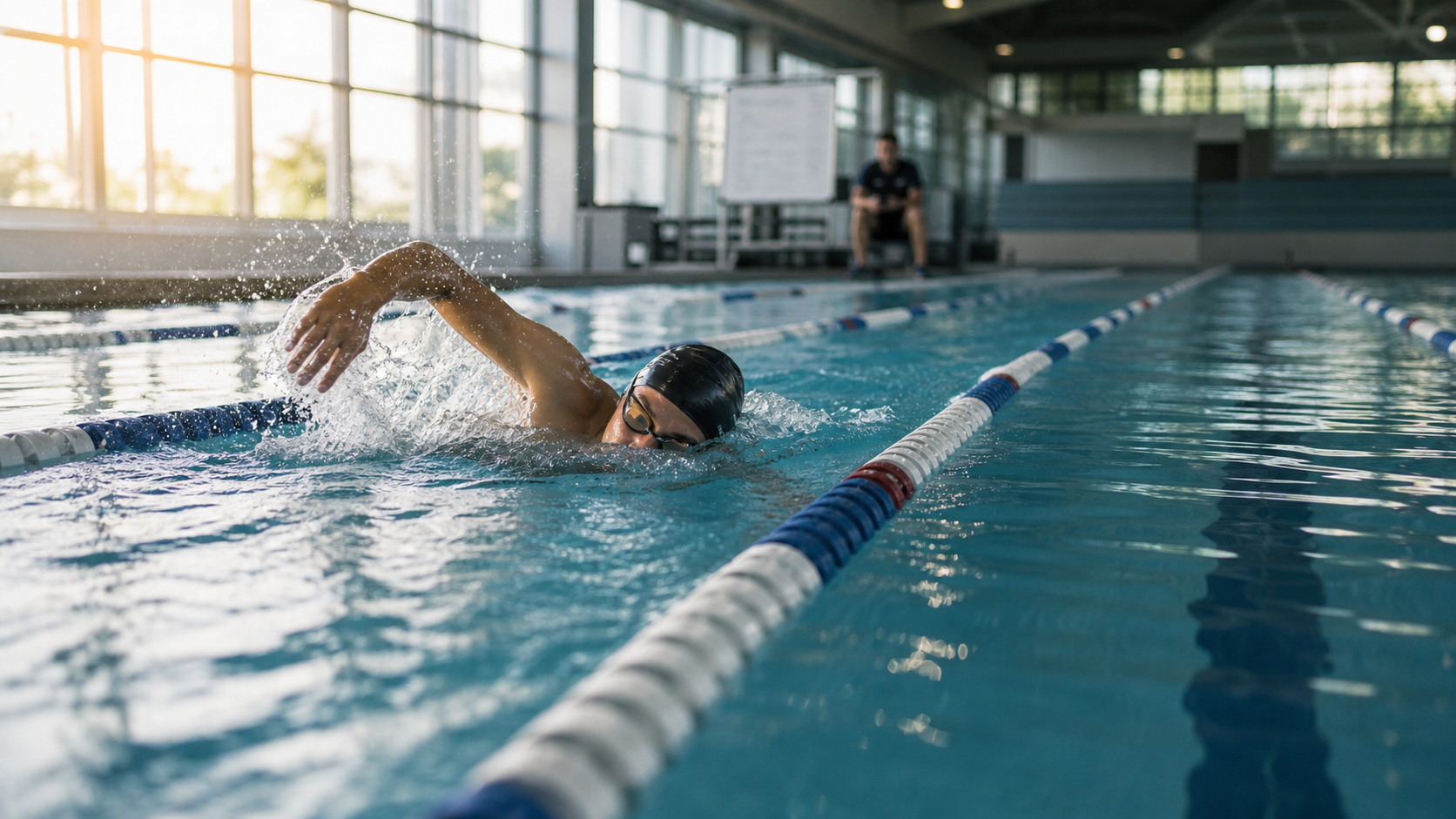
Why Is 3000m the Classic Training Volume for Long-Distance Workouts?
For long-distance swimmers with a solid foundation (swimming 10,000m+ per week), 3000m is an ideal single-session training volume: long enough to fully stimulate the aerobic system, yet not so long as to cause excessive fatigue that compromises the quality of the next day’s practice. The swim leg of a 51.5 standard-distance triathlon is 1500m, making 3000m roughly twice that distance—a reasonable setting for building an adequate training buffer. For swimmers targeting long-distance or half-ironman triathlons (1900m swim leg), a 3000m single-session workout is also 1.5 times the race distance, consistent with the principle of training exceeding race distance.
Training Set Structure: The Three-Phase Framework
Whether running, cycling, or swimming, well-designed endurance training sets follow a “warm-up → main set → cool-down” three-phase structure. In swimming, the proportions and design of these three phases each carry their own physiological logic.
| Phase | Recommended Distance (3000m Total) | Proportion | Intensity Zone |
|---|---|---|---|
| Warm-up | 500–600m | 17–20% | Z1–Z2 |
| Main Set | 1800–2000m | 60–67% | Depends on training goal |
| Cool-down | 400–500m | 13–17% | Z1 |
Warm-up Design (500–600m)
The purpose of the warm-up is to gradually raise core body temperature, activate the neuromuscular system, prepare mobility in the shoulder and hip joints, and allow heart rate to slowly rise toward the target zone of the main set.
Recommended Warm-up Structure (600m):
- 200m Easy Freestyle: Z1 intensity, untimed, focusing on technique: hand entry, body roll, and kick rhythm.
- 100m Technique Drills: Stroke drills such as “catch-up drill” or “fingertip drag.”
- 100m Kickboard: Actively engages the core and lower body, reinforcing the kick-body connection.
- 100m Build Swim (25m easy + 25m moderate + 25m fast + 25m easy): Prepares the nervous system for pace transitions.
- 100m Choice: Can be switched to breaststroke or backstroke to warm up the shoulder joint in multiple directions.
Main Set Design (1800–2000m): Adjust According to Training Purpose
The content of the main set depends on this week’s training purpose. Below are three common main set designs:
A. Aerobic Base Set (Z2 Continuous Swimming)
Suitable for the aerobic base phase, developing fat oxidation capacity and swimming economy.
- 2×800m with 60 seconds rest between reps, Z2 intensity (T-pace +12 sec/100m)
- Or 1×1800m continuous swim, Z2 intensity, slightly adjusting breathing rhythm every 400m
B. Lactate Threshold Set (T-pace Tempo Swimming)
Suitable for the mid-competition preparation phase, reinforcing metabolic adaptation to race pace.
- 6×300m with 20 seconds rest, target pace T-pace +3–5 sec/100m
- Or 3×600m with 30 seconds rest, T-pace pace
C. Mixed Set (Aerobic + Speed)
Suitable for 6–8 weeks before competition, balancing both base and speed stimulus.
- 800m Z2 easy swimming
- 8×100m with 15 seconds rest, Z4 intensity (T-pace −3 sec/100m)
- 400m Z2 easy recovery
Cool-down Design (400–500m)
The importance of the cool-down swim is often overlooked. A proper cool-down swim offers the following benefits:
- Accelerates lactate clearance: Easy Z1 swimming maintains muscle blood flow, aiding in lactate metabolism and clearance.
- Reduces muscle stiffness: Stopping immediately after the main set can easily cause stiffness in the shoulders and neck; an easy cool-down swim allows muscles to recover smoothly.
- Mental relaxation: Transitioning from high-intensity training back to a normal state avoids the “adrenaline cliff” after training.
Recommended Cool-down Structure (400m):
- 200m easy freestyle, Z1, untimed, relaxing the shoulders and neck
- 100m backstroke (to stretch and relax the front of the shoulders)
- 100m choice to finish
Common Training Set Design Mistakes
- Starting the main set without adequate warm-up: If the first rep of the main set is very slow and the shoulders feel tight, that’s a sign of insufficient warm-up.
- Using up all energy in the main set and skipping the cool-down: Saving time comes at the cost of slower recovery and a higher risk of injury.
- Swimming the same set every time: Insufficient training variety leads to diminishing returns once the body adapts; it’s recommended to change the main set design every 3–4 weeks.
- Neglecting technique drills: Swimming differs from running—technical efficiency has a huge impact on oxygen consumption. Technique drills before the main set should not be skipped.
Practical Tips
- Build a set template library: Prepare 4–6 main set designs and rotate through them according to the purpose of each training cycle.
- Use a timer: Use a waterproof timer or the pool wall clock to ensure precise interval rest times.
- Plan ahead and execute immediately at the pool: Decide your training set structure at home to avoid “swimming on a whim” once you arrive at the pool.
- Record each rep’s pace: Every rep time in the main set should be logged as a basis for adjusting the next training set.
- Stay flexible: If you feel fatigued after the warm-up, lower the main set intensity (not the distance)—completing the full set structure matters more than intensity.
Conclusion
A well-structured 3000m training set isn’t just about swimming all 30×100m reps and calling it done—it’s about doing the right thing at the right time: warm-up to activate, main set to stimulate, cool-down to recover. This training set design philosophy applies not only to 3000m but also serves as the foundational design principle for all long-distance swimming training sets.
Related Reading
西進武嶺 免費訓練分析服務 Intervals | 練不夠還是練過頭?你哪一種類型選手?AI模型告訴你! | 備戰神器 | 公路車 訓練 | CT Yeh
4 年前
Live) 備戰2019彰化經典百K 賽前攻略 (已完賽請看新影片
7 年前
一日北高前的高裝檢 | 北高 360 | 挑戰11小時的裝備 | 一日雙塔 | 補給
6 年前
2023桃園團體繞圈賽 / 海鷗繞圈賽 | 全程空拍數據版 | 公路車 | CT Yeh
2 年前
實景訓練台) 彰化經典百K 高強度喵團 90分鐘 跟著一起練功 2019 Indoor workout Changhua Classic 100 Taiwan
7 年前
一日北高常見問題大集合 | 攻略 | 路線 | 訓練 | 補給 | 自行車 單車 | 一日雙城 | 雙塔 | TWB北高360 | 屁股痛
6 年前
一日北高/長距離團騎 常見問題補充篇 / 組團或跟團的眉角 / 壯車友容易被瘦車友慢性拉爆 / 原來屁股痛可能是這個原因...? / 風場配速法 / 公路車 / CT Yeh
2 年前
2019 夏季KOM 5小 完賽心得 準備攻略 東進武嶺 夏季登山王之路 Taiwan KOM Challenge
7 年前