Breathing Rhythm for Long-Distance Swimming: Endurance Benefits of 3-Stroke, 5-Stroke, and 7-Stroke Breathing
Why Is Breathing Rhythm So Important?
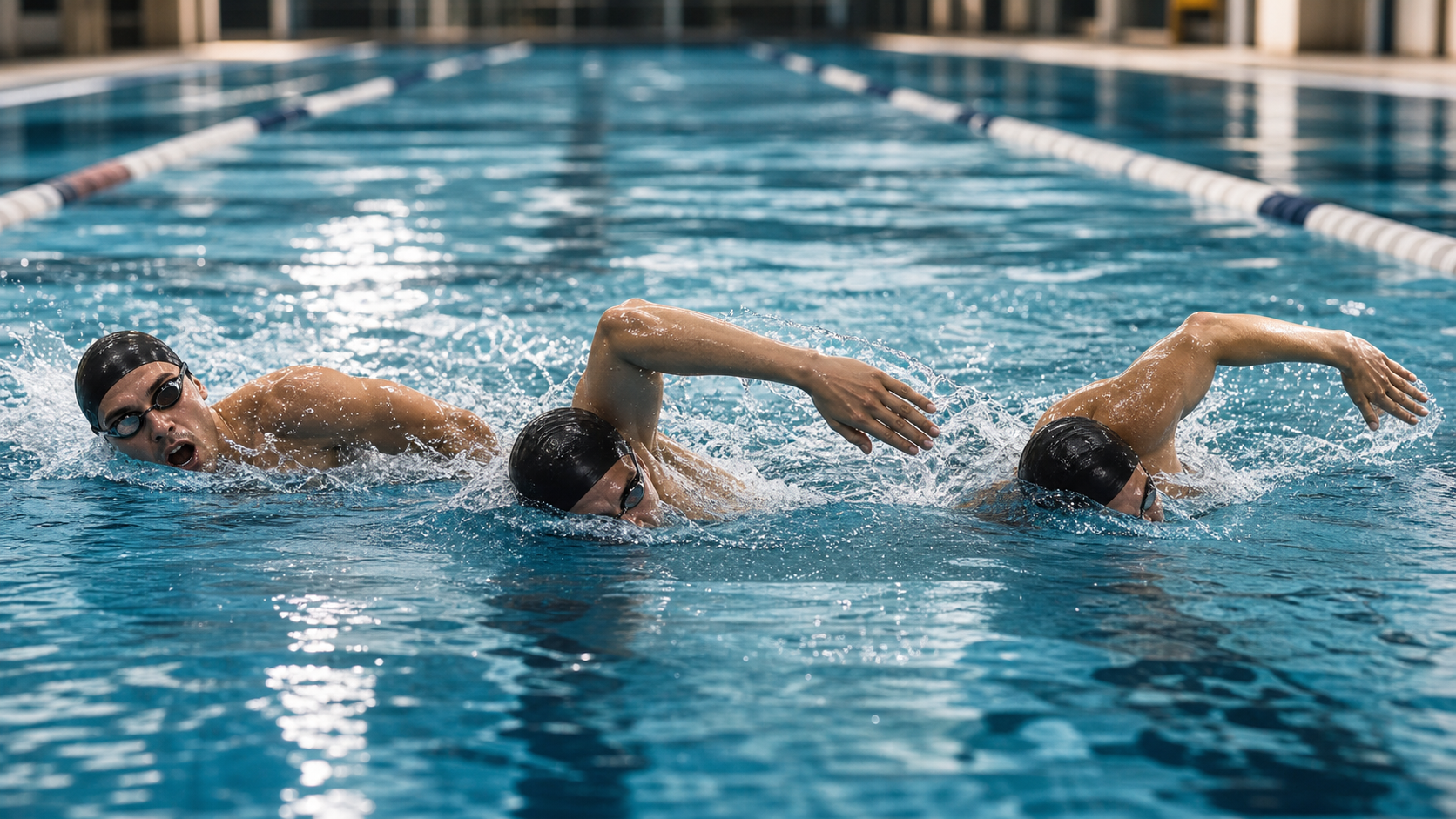
Breathing is one of the most complex technical elements in swimming. Breathing during land-based sports is continuous, but swimmers must control the timing of their breath in the water. Every breath requires turning the head and breaking the streamlined position, which, if handled poorly, can cause: increased drag, speed fluctuations, body misalignment, and neck and shoulder compensation. However, if breathing frequency is too low (e.g., breathing only every 7 strokes), blood oxygen drops and carbon dioxide accumulates, which actually accelerates fatigue. The breathing rhythm for long-distance swimming must strike a balance between oxygen efficiency, technical symmetry, and endurance management.
Basic Concepts: How Stroke Count Is Calculated
The “stroke count” in “breathing rhythm” refers to the number of arm strokes between two breaths:
- 3-stroke breathing: left stroke → right stroke → left stroke → breathe (right side); or right → left → right → breathe (left side), breathing every 3 strokes, alternating sides
- 5-stroke breathing: breathe every 5 arm strokes, alternating left and right sides
- 7-stroke breathing: breathe every 7 arm strokes, alternating left and right sides
Special note: 3-stroke breathing naturally produces bilateral breathing, because each breath alternates between the left and right sides, which greatly benefits technical symmetry.
| Breathing Rhythm | Breathing Frequency | Blood Oxygen Maintenance | Technical Symmetry | Suitable Scenarios |
|---|---|---|---|---|
| 2-stroke (breathe every stroke) | Highest | Optimal | Poor (fixed to one side) | Final sprint |
| 3-stroke | High | Good | Excellent | Aerobic base/long distance |
| 5-stroke | Medium | Good | Excellent | Tempo swimming/middle distance |
| 7-stroke | Low | Marginal | Excellent | CO₂ tolerance training |
| 9-stroke and above | Extremely low | Dangerous | — | Not recommended for general swimmers |
3-Stroke Breathing: The Primary Rhythm for Long-Distance Swimming
3-stroke breathing is the “default rhythm” recommended by most long-distance swimming coaches, for the following reasons:
- Frequent breathing, ample blood oxygen: Breathing every 3 strokes provides sufficient oxygen supply, preventing excessive carbon dioxide buildup, making it suitable for maintaining aerobic intensity over long periods.
- Forced bilateral breathing: 3 is an odd number, naturally causing swimmers to alternate breathing on the left and right sides, avoiding stroke efficiency differences and shoulder compensation injuries caused by technical asymmetry.
- Stable rhythm: Compared to 2-stroke (breathing every stroke), 3-stroke gives the body one extra stroke of streamlined gliding time, making the overall pace smoother.
Suitable scenarios:
- Z2 aerobic base training (used throughout)
- Base rhythm for races of 1500m and longer
- Open water swimming (bilateral breathing helps with observing the environment)
5-Stroke Breathing: An Intermediate Rhythm for Advanced Endurance
5-stroke breathing has a breathing frequency 40% lower than 3-stroke, meaning longer underwater control is required between each exhale and inhale. This is an advanced challenge for breathing control ability.
Training benefits:
- Improved CO₂ tolerance: Longer underwater time trains the body’s ability to stay relaxed in a higher CO₂ environment.
- Improved stroke efficiency: With fewer breaths, swimmers are forced to focus more on the propulsion of each stroke, subtly improving Stroke Efficiency.
- Tactical option for long-distance races: In downstream, downwind, or low-intensity segments, using 5-stroke can slightly reduce the number of head rotations, decreasing drag.
Suitable scenarios:
- T-pace tempo swimming
- Pace control during the middle of a 1500m race
- Primary rhythm for breathing control training sets
7-Stroke Breathing: CO₂ Tolerance and Mental Resilience Training
7-stroke breathing is a purposeful hypoxic training tool, not a primary rhythm for long-distance swimming. Using 7-stroke breathing, the body works in a lower blood oxygen environment, simulating the oxygen stress of the final stretch of a race and improving mental tolerance.
Cautions:
- Not suitable for beginners: Excessively low blood oxygen can cause swimmers to temporarily lose consciousness (Shallow Water Blackout); training must be done in an environment with a lifeguard present.
- Should not be used throughout an entire session: 7-stroke breathing should only be used for specific repeats within a workout, not as the primary rhythm.
- Recommended for use in a 25m short-course pool: If you feel dizzy or your vision blurs, breathe immediately or stop.
Suitable scenarios:
- Hypoxic sets, e.g., 3×100m (first 50m using 7-stroke, last 50m using 3-stroke)
- Specific training repeats to improve CO₂ tolerance
How to Switch Breathing Rhythms in Training?
Here is a sample 2000m workout integrating all three rhythms:
- Warm-up: 400m, 3-stroke breathing throughout
- Main set:
- 4×200m T-pace: first 100m using 5-stroke, last 100m using 3-stroke, 20 seconds rest
- 4×50m easy: 2-stroke breathing (relaxation focus)
- 2×100m: 7-stroke breathing throughout (hypoxic training), 30 seconds rest
- Cool-down: 300m, 3-stroke breathing
Practical Tips
- Master 3-stroke before learning 5-stroke: Many swimmers attempt 5-stroke before their 3-stroke technique is fluid, resulting in greater body rotation.
- Exhale fully underwater: Regardless of the rhythm, the underwater exhale must be complete (through both mouth and nose) to make the inhale during the breath more efficient.
- Don’t lift your head when breathing: The head should only rotate, not lift; the ear should remain close to the water surface, and the eyes should look to the side rather than straight up.
- Combine with technique drills: Practicing breathing rhythm transitions during warm-up technique sets is more efficient than practicing them during main sets.
Conclusion
Breathing rhythm is not a fixed answer, but a tool to be flexibly applied based on training goals and race demands. 3-stroke is the best companion for long-distance swimming, 5-stroke is an advanced tool for improving endurance, and 7-stroke is an intensifying stimulus to be used with caution. Mastering the ability to switch between the three rhythms will greatly expand your swimming skill set.
Related Reading
- Swimming Breathing Pattern Training: Building Tolerance with 3-Stroke and 5-Stroke Breathing
- Freestyle Breathing: How to Choose Between 2-Stroke, 3-Stroke, and 5-Stroke? A Rhythm vs. Fitness Trade-off Chart
- Breathing Rhythm in Open Water: Maintaining Technique Over Long Distances
- Swimming Breathing Technique: Pros and Cons of Side Breathing vs. Bilateral Breathing
多機位拍片神器 DJI Action 2 拍出速度張力感 | 類空拍機視角 4陣列麥克風超強降風噪 實測! | 公路車 | CT Yeh
3 年前
#公路車 #Vo2Max #最大攝氧量 測驗 體驗 | 心肺測試
6 年前
類空拍神器 Feiyu Pocket 2s (有優惠連結)三軸穩定 運動攝影機 開箱!比GoPro 還強的滑順視角!三小時長時間錄影 行車記錄器 | 環花東365實測 | 公路車 CT Yeh
4 年前
Live) 備戰2019彰化經典百K 賽前攻略 (已完賽請看新影片
7 年前
CT 喇低賽) 武嶺牽車 才是王道 西進牽車四小時內秘訣 攝手位置 如何判斷 防抽筋小秘訣
7 年前
西進武嶺 免費訓練分析服務 Intervals | 練不夠還是練過頭?你哪一種類型選手?AI模型告訴你! | 備戰神器 | 公路車 訓練 | CT Yeh
4 年前
實景訓練台) 彰化經典百K 高強度喵團 90分鐘 跟著一起練功 2019 Indoor workout Changhua Classic 100 Taiwan
7 年前
一日北高前的西濱集訓 | 跟著11小時軍團 | 300W踩不動的大逆風 | 輪車破風差幾瓦?
6 年前