What is Rhythm Training?
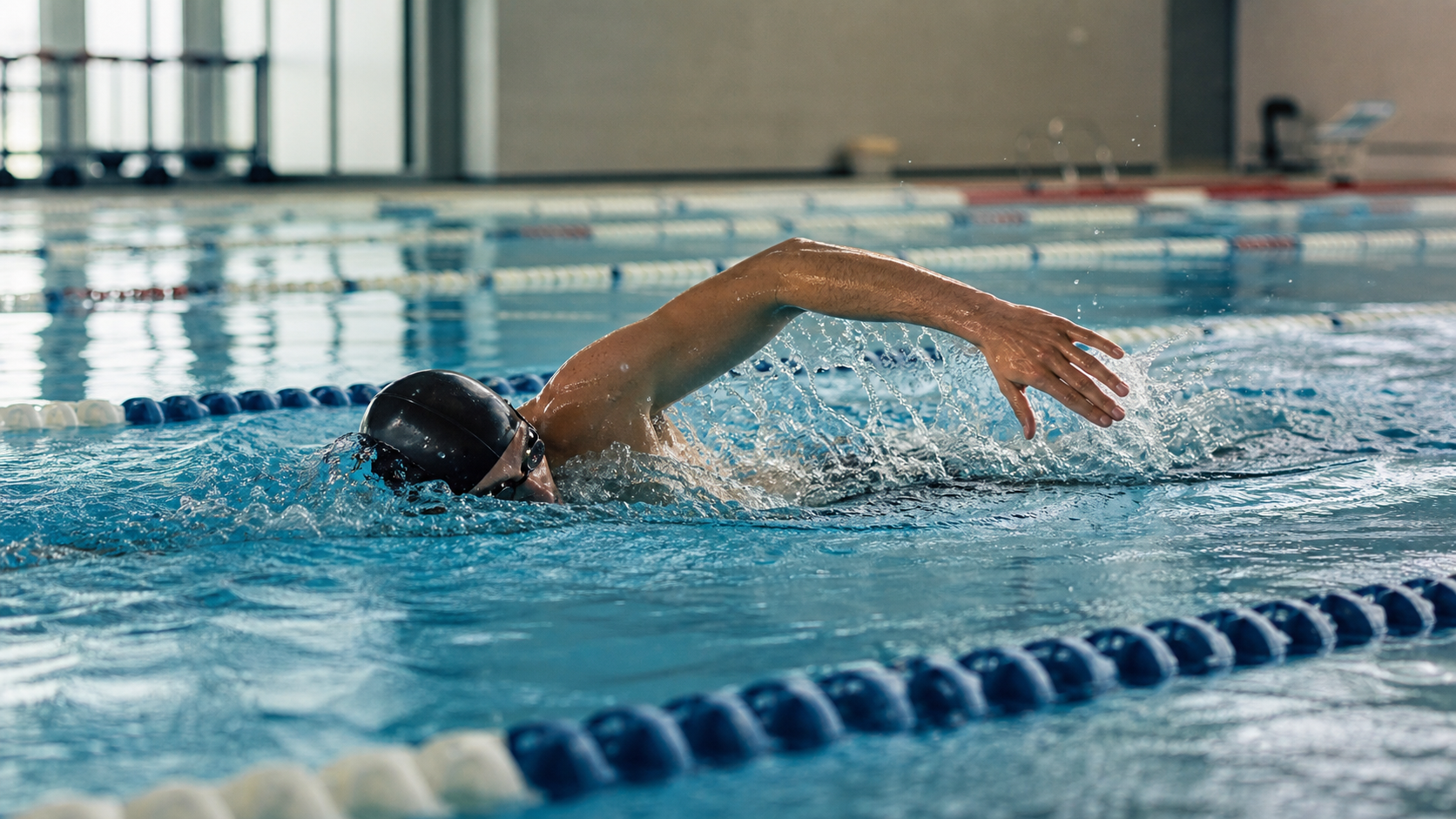
In swimming training systems, “Tempo Swimming” refers to swimming continuously at a pace near the lactate threshold. It is neither easy aerobic swimming nor an all-out sprint interval; rather, it is that “pace where it’s a bit difficult to talk, but you can still grit your teeth and hold on.” This intensity zone corresponds exactly to Z3–Z4 and is one of the most effective intensities for improving endurance performance.
The core design principle of tempo swimming is: swim continuously for 15–30 minutes (or accumulate the same time in segments) at your target race pace +5 seconds/100m. This “+5 seconds” setting keeps the intensity right around the lactate threshold—challenging enough, but not so intense that lactate accumulates rapidly.
The Physiological Mechanism of Lactate Threshold Training
When swimming speed exceeds the lactate threshold, the rate of lactate production exceeds the rate of clearance, causing lactate to accumulate in the blood, leading to muscle acidification, decreased efficiency, and a forced reduction in speed. The goal of tempo swimming is to “push” this threshold to a faster pace, allowing you to maintain aerobic metabolism at higher speeds.
Specific physiological adaptations include:
- Increased Lactate Dehydrogenase (LDH) activity: Faster lactate clearance.
- Increased mitochondrial density: Expanded aerobic metabolic capacity.
- Improved skeletal muscle buffering capacity: Better tolerance to lactate accumulation.
- Improved cardiac output efficiency: More blood pumped per heartbeat.
How to Calculate Your Tempo Pace?
The calculation of tempo pace depends on your target race pace (rather than your current ability):
| Race Target | Target Pace/100m | Tempo Swim Pace (+5s) |
|---|---|---|
| 1500m 24 min | 1:36/100m | 1:41/100m |
| 1500m 22 min | 1:28/100m | 1:33/100m |
| 1500m 20 min | 1:20/100m | 1:25/100m |
| Triathlon 51.5 1500m 28 min | 1:52/100m | 1:57/100m |
You can also calculate using CSS: Tempo swim pace ≈ CSS + 3–5 seconds/100m (slightly slower than the lactate threshold).
Tempo Swim Workout Design
The challenge of tempo swimming lies in maintaining consistency in pace, rather than fluctuations like “swimming fast then slowing down.” Here are three common tempo swim formats:
Format A: Continuous Tempo Swim (The purest form of rhythm training)
- 1×1500m @ Tempo Pace
- Suitable for swimmers with a solid foundation; emphasizes pace stability.
- Heart rate should be at 80–85% of maximum heart rate upon completion.
Format B: Segmented Accumulation (Recommended for beginners)
- 5×300m @ Tempo Pace, 20 seconds rest
- Accumulate 1500m of tempo swimming; the rest allows the pace to be maintained.
- Note: Heart rate should not fully recover during the rest periods.
Format C: Tempo Pyramid (Advanced, improves speed endurance)
- 400m → 600m → 800m → 600m → 400m
- Entire session @ Tempo Pace, 30 seconds rest
- Accumulate 2800m of tempo swimming; the 800m in the middle is the biggest test.
Consistency Check for Tempo Pace
The most important indicator of tempo swim quality is the pace deviation between sets/segments. In an ideal tempo swim, the pace difference per 100m should be within ±2 seconds:
- Deviation <2 seconds: Excellent pace control, high training quality.
- Deviation 2–5 seconds: Acceptable, but requires more pace awareness.
- Deviation >5 seconds: Pace setting is too fast; the target pace should be lowered.
Common patterns of lost pace control: “Starting too fast (excitement), slowing down in the middle (fatigue), and sprinting at the end (for pride)”—this pattern is far less effective for improving the lactate threshold than swimming at a stable pace.
Where Tempo Swimming Fits in a Periodized Plan
Tempo swimming should not be used extensively during the aerobic base phase (more than 12 weeks before a race) and should be arranged according to the training cycle:
- Base Phase (12+ weeks out): Focus on Z2, 1 tempo swim per week, mainly in short 3×400m formats.
- Build Phase (8–12 weeks out): Increase tempo volume, 1–2 times per week, 5×400m or 3×600m.
- Peak Phase (4–8 weeks out): Reach peak tempo volume, 2 times per week, including continuous tempo swim formats.
- Taper Phase (2–3 weeks before race): Maintain tempo swimming but reduce volume to retain the feel of race pace.
Practical Advice
- Test your CSS before your first tempo swim: Ensure your tempo pace setting is data-driven, not based on feeling.
- Use a pace clock or watch to record each set: Monitoring pace in real-time is the most important training habit for tempo swimming.
- Perform a full warm-up before tempo swimming: At least 600m including progressive speed swimming to fully prepare the body for threshold intensity.
- Replenish carbohydrates after tempo swimming: Glycogen consumption during tempo swimming is significant; consuming 30–50g of carbohydrates within 30 minutes after training helps with recovery.
- Do not turn tempo swimming into a race: The purpose of tempo swimming is lactate threshold stimulation, not maximum effort swimming; pace is more important than how you feel.
Conclusion
Tempo swimming is the most “cost-effective” type of workout in swimming training—its intensity is sufficient to raise the lactate threshold, yet it does not require the long recovery time needed for VO2max intervals. Master the “race pace +5 seconds” tempo swimming technique, and your long-distance swimming will evolve from “just being able to finish” to “reaching the finish line with stability.”
Related Reading
西進武嶺 免費訓練分析服務 Intervals | 練不夠還是練過頭?你哪一種類型選手?AI模型告訴你! | 備戰神器 | 公路車 訓練 | CT Yeh
4 年前
教學) 如何做出專業 慢動作 影片 Slow Motion 120fps GoPro 7 ActionCam AX700 A99II
7 年前
西進武嶺 自製新版AI配速表產生器 x 賽前攻略 抱佛腳! 沒有功率計也可以產生配速表嗎?有什麼其他眉角賽前要注意的呢? | 西進武嶺 / 東進武嶺 KOM 攻略 | 公路車 | CT Yeh
4 年前
FTL 與 SYB 車隊專訪 西進武嶺 實用攻略分享! 2小時 如何練?!你不知道的眉角!新手準備武嶺必看 EP1 | 實力派女車友 | 精華版 | 公路車 | CTYeh
4 年前
[教學] Premiere 影片 手震 修正 教學 防抖 單眼 影像 GoPro 穩定 Video Stabilization
8 年前
#公路車 #Vo2Max #最大攝氧量 測驗 體驗 | 心肺測試
6 年前
風櫃嘴 衝刺慢動作回放!
8 年前
[教學] Dashware 教學 如何製作有 速度 功率 心律的 騎車影片 Guages Video
8 年前