1500m Freestyle Race Training: Pacing Strategy by Splits and Energy Reserve for the Final Sprint
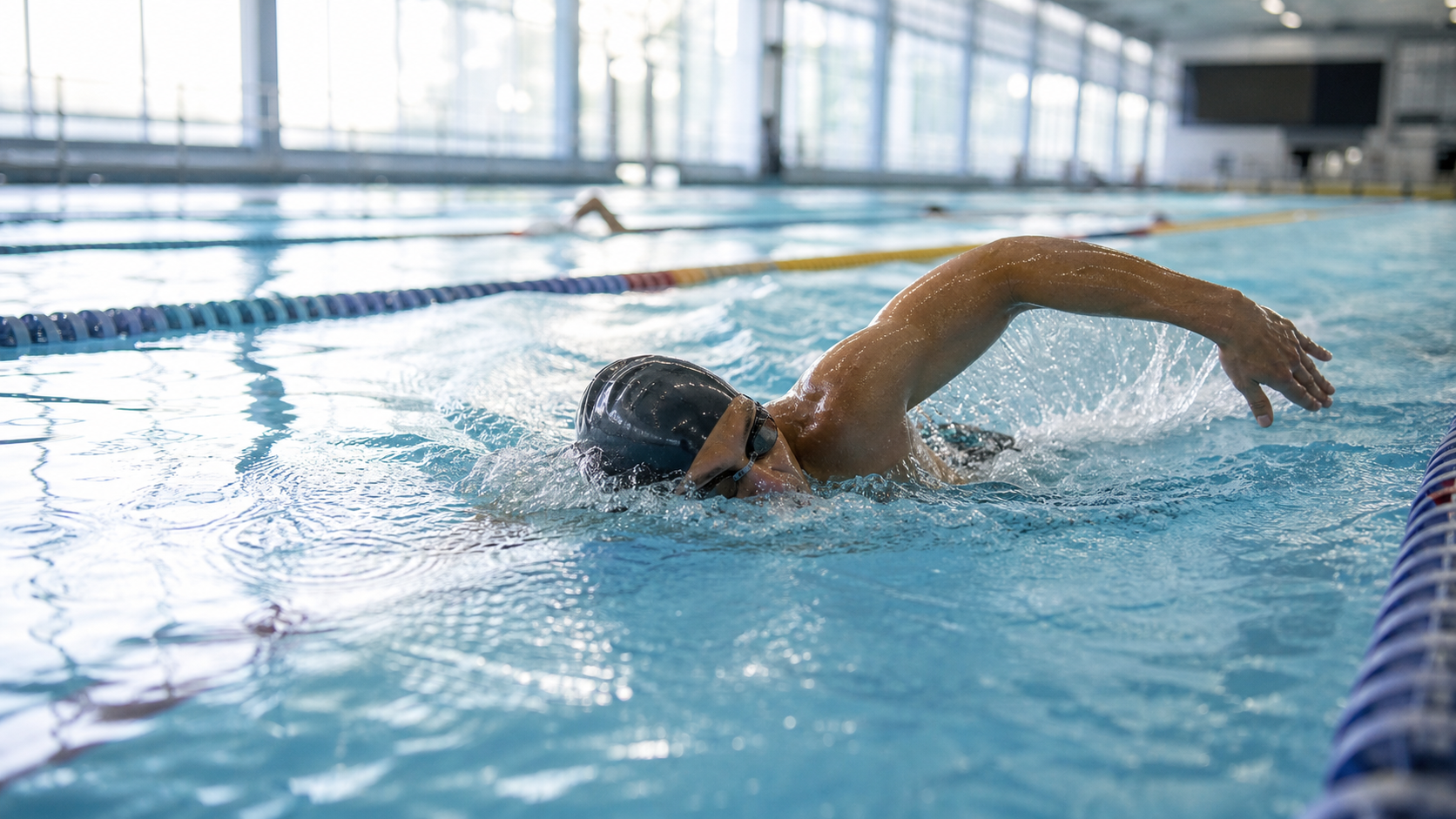
1500m Freestyle: The Pinnacle of Long-Distance Swimming
The 1500m freestyle is known as the “marathon of swimming” and is the signature Olympic long-distance event (for men). Its uniqueness lies in this: it is short enough to require speed, yet long enough to require strategy. For most amateur swimmers and triathletes, completing a 1500m freestyle within 25 minutes represents a solid aerobic swimming foundation; and how you allocate your energy output across those 25 minutes is often the area with the most room for improvement among amateur swimmers.
Energy System Analysis: The Metabolic Demands of the 1500m
The completion time for the 1500m freestyle ranges from approximately 15 minutes (elite swimmers) to 30 minutes (amateur swimmers), and the entire process relies almost completely on aerobic metabolism.
| Metabolic System | Energy Contribution | Active Duration | Role in the 1500m |
|---|---|---|---|
| Phosphocreatine (ATP-CP) | <5% | 0–10 sec | Starting burst |
| Anaerobic glycolysis | 10–15% | 10 sec–2 min | Start acceleration phase |
| Aerobic system | 80–90% | 2 min and beyond | Main pacing |
This means: an excessive sprint in the first 100–200m may feel like “getting ahead,” but it actually depletes a large amount of anaerobic reserves, and 3–5 minutes later it exacts double the toll in the form of premature fatigue.
Optimal Pacing Strategy: Negative Split
Sports science research shows that the optimal pacing strategy for long-distance swimming is the negative split: swimming the second half (750–1500m) 1–3 seconds/100m faster than the first half (0–750m). The reasons are as follows:
- The aerobic system has a delayed activation: During the first 2–3 minutes, the aerobic system is not yet operating at full capacity. If you start out too fast, the aerobic system “can’t catch up,” requiring more anaerobic metabolism to compensate.
- Lactate clearance improves after the 5-minute mark: The first 4–5 minutes are the most dangerous pacing window. This is when lactate accumulates fastest; if you are already over pace, the second half will see a significant drop in speed.
- Psychological advantage: Passing opponents in the second half provides positive psychological feedback, which helps maintain rhythm.
1500m Split Pacing Plan (Using a 24-Minute Target as an Example)
Target finish time: 24:00, target average pace: 96 sec/100m (1:36/100m)
| Segment | Distance | Target Time | Target Pace/100m | Strategy Notes |
|---|---|---|---|---|
| Start segment | 0–100m | 1:30 | 1:30 | Starting sprint, using momentum |
| Settling segment | 100–400m | 4:54 | 1:38 | Deliberately conservative, finding rhythm |
| Main segment | 400–1200m | 12:48 | 1:36 | Target pace, steady output |
| Surge segment | 1200–1400m | 3:04 | 1:32 | Begin accelerating, feel the increase |
| Final sprint | 1400–1500m | 1:24 | 1:24 | All-out sprint to the finish |
| Total | 1500m | 23:40 | 1:35 | Completed with a negative split |
Energy Reserve Strategy for the Final Sprint
To be able to accelerate in the second half, you must deliberately “bank time” in the main segment:
Tip 1: Swim the first 400m “2 seconds slower” than it feels
The excitement after the start will make your target pace feel “easy.” At this point, you should deliberately slow down to save energy for the second half.
Tip 2: Do not change breathing rhythm before the 1200m mark
Maintain a 3-stroke breathing pattern for the first 1200m, and only consider switching to a 2-stroke breathing pattern at the 1300m mark to increase oxygen delivery.
Tip 3: Conserve energy with efficient push-offs at turns
Make full use of every turn’s push-off (extending fully) to reduce the work of your arm strokes. This is a key energy-saving factor for long-distance swimmers.
Tip 4: The “mental trigger point” after the 1200m mark
When 300m remains, tell yourself, “Every remaining lap must be faster than the last,” establishing a rhythm of progressive acceleration.
Race Preparation Plan: 8-Week Training Focus for the 1500m
Weeks 1–3: Aerobic Base Consolidation
- Focus on Z2, swimming 15,000–18,000m per week
- 1 T-pace session per week (5×300m)
Weeks 4–6: Pace Adaptation
- Introduce continuous 1000m race-pace swimming
- Practice negative split pacing (first 500m conservative → last 500m faster)
- 1 VO2max session per week (10×100m)
Weeks 7–8: Race Simulation
- 1 full 1500m simulation swim per week (timed)
- Analyze split times, correct pacing control issues
- Taper volume, maintain intensity
Practical Advice
- Do a timed 1000m every 4 weeks: Use it as a baseline to estimate 1500m pace (1000m pace +3 sec/100m ≈ 1500m pace).
- Practice split awareness in training: Every time you do a long-distance session, record split times at 400m, 800m, and 1200m to develop a sense of rhythm where “feel matches the clock.”
- Avoid high-intensity training three days before the race: Allow the neuromuscular system to be fully prepared for maximum output on race day.
- Warm up thoroughly: Complete at least 600m of formal warm-up before the race, including 2–3 progressive swims, so the aerobic system is already at working capacity before the start.
Conclusion
The outcome of the 1500m freestyle is often not decided by the final 100m sprint, but by whether you successfully restrained the urge to “blast off” in the first 400m. A scientific split pacing strategy lets you trade energy reserves for speed in the second half, conquering the most classic long-distance swimming arena with a perfect negative split.
Related Reading
- Long-Distance Strategy for the 1500m Freestyle: Split Pacing and Mental Milestone Management
- Swimming 1500m Race Preparation Plan: A 12-Week Training Structure
- Building Rhythm in Long-Distance Swimming: Split Pacing Strategies for the 1500m
- Pacing Strategies for Long-Distance Swimming (800m/1500m): Even Pacing vs. Negative Splits
西進武嶺 免費訓練分析服務 Intervals | 練不夠還是練過頭?你哪一種類型選手?AI模型告訴你! | 備戰神器 | 公路車 訓練 | CT Yeh
4 年前
Live) 備戰2019彰化經典百K 賽前攻略 (已完賽請看新影片
7 年前
西進武嶺 自製新版AI配速表產生器 x 賽前攻略 抱佛腳! 沒有功率計也可以產生配速表嗎?有什麼其他眉角賽前要注意的呢? | 西進武嶺 / 東進武嶺 KOM 攻略 | 公路車 | CT Yeh
4 年前
FTL 與 SYB 車隊專訪 西進武嶺 實用攻略分享! 2小時 如何練?!你不知道的眉角!新手準備武嶺必看 EP1 | 實力派女車友 | 精華版 | 公路車 | CTYeh
4 年前
西進武嶺配速器 3.0更新 / NEW 免功率FTP估算! / 大數據xAI體能模型 / 如何模擬人止關前集團效應 / 配速儲存功能 / AI全台自行車賽事行事曆 / 公路車 / CT Yeh
1 年前
#公路車 #西進武嶺 配速配瓦實驗 坡度分析 四小時內攻略 建大盃 NeverStop #西進武嶺攻略
6 年前
live) 超越北高 之一日北高12小時 策略
7 年前
一日北高前的高裝檢 | 北高 360 | 挑戰11小時的裝備 | 一日雙塔 | 補給
6 年前