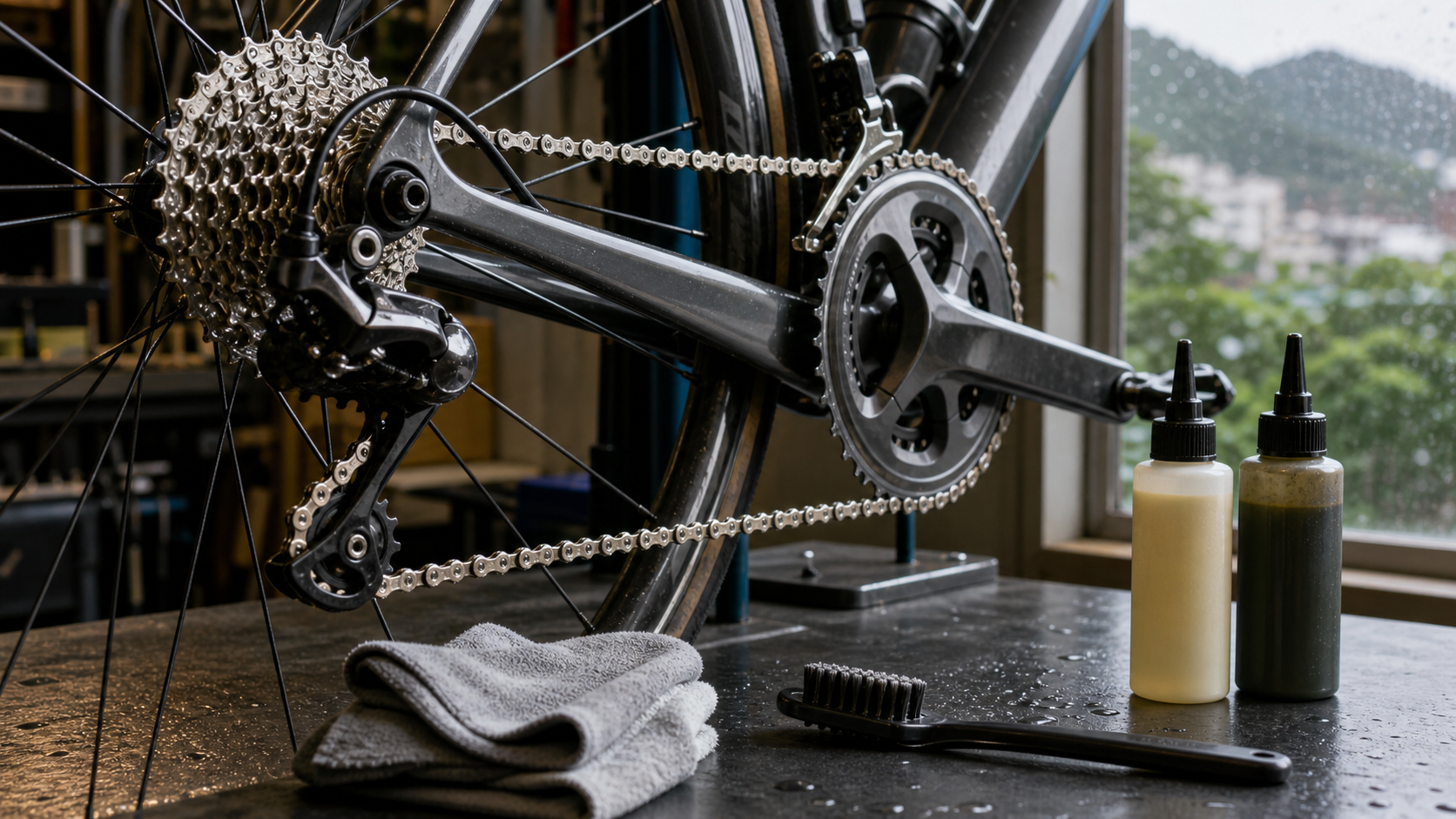
Bicycle Chain Cleaning and Lubrication: The Logic Behind Choosing Dry vs. Wet Chain Lube
Introduction
The chain is arguably one of the hardest-working parts of a bicycle’s drivetrain. With every pedal stroke, the chain endures hundreds of newtons of tension while still needing to flex smoothly in all kinds of conditions. In Taiwan, hot and humid summers, rainy winters, and oily urban road surfaces all make chain maintenance especially important. Choosing the right lubricant and cleaning method isn’t just about saving money — it’s an investment in drivetrain efficiency.
Why Is Chain Cleaning So Important?
A dirty chain accelerates wear on the following components:
- The chain itself: Grit trapped inside the links acts like an abrasive, causing the chain to stretch quickly
- Chainrings and cassette: Once the chain stretches, the tooth profile no longer matches, and the teeth wear rapidly
- Rear derailleur pulleys: Built-up grime causes gummy buildup that reduces shifting precision
- Pedaling efficiency: Dirt increases the coefficient of friction, raising drivetrain losses
Studies show that a dirty chain can produce 3–5 watts more drivetrain loss than a clean one — a difference that’s far from negligible on long rides.
Cleaning Tools and Steps
Basic Tool List
- Chain scrubber
- Chain degreaser or food-grade kerosene
- An old toothbrush or stiff-bristle brush
- A clean rag or old cloth
- Rubber gloves
Cleaning Steps
- Dry wipe: First wipe off surface dust with a dry cloth so the degreaser isn’t overly diluted
- Apply degreaser: Clip the chain scrubber onto the chain, add cleaning fluid, and pedal forward to turn the chain about 30 revolutions
- Detail brushing: Use a toothbrush to clean the rear derailleur pulleys, front derailleur, and the gaps between cassette cogs
- Rinse: Rinse with clean water (indoors, use a small amount of water with an absorbent cloth)
- Dry completely: Wipe dry with a cloth, then let it sit for 10–15 minutes so moisture inside the links can evaporate
- Lubricate: Apply lubricant immediately after drying to prevent rust
Dry vs. Wet Chain Lube Comparison
| Characteristic | Dry Lube | Wet Lube |
|---|---|---|
| Best weather | Sunny, dry conditions | Rain, humid conditions |
| Adhesion | Low — leaves a waxy film once solvent evaporates | High — oily components cling for a long time |
| Dirt attraction | Low (stays cleaner) | High (easily picks up grit) |
| Durability | Shorter, reapply every 100–200 km | Longer, about 200–400 km |
| Ease of cleaning | Easy | More troublesome |
| Recommended use in Taiwan | Sunny summer road riding on flat terrain | Plum rain season, wet mountain roads |
How to Choose the Right Chain Lube for Taiwan’s Conditions
Taiwan’s climate varies widely. Here are recommendations for different riding scenarios:
- Urban commuting (year-round): A semi-dry ceramic chain lube is recommended for moderate adhesion and easy cleaning
- Summer road training: Use a dry wax-based lubricant for maximum drivetrain efficiency
- Winter or plum rain season: Switch to a wet mineral-oil chain lube for stronger water resistance
- Off-road (MTB): Use a wet synthetic oil to handle muddy conditions
Application Tips
- One drop per link is enough — excess oil attracts more dust
- While applying, slowly rotate the chain and drip lube onto the inside of each link (where the pins sit)
- After application, let it sit for 10 minutes so the oil can soak into the links
- Use a dry cloth to lightly wipe the outside of the chain to remove excess oil
Recommended Maintenance Frequency
| Riding Condition | Recommended Cleaning Interval | Recommended Relube Interval |
|---|---|---|
| Indoor trainer | Once a month | Every 200–300 km |
| Sunny road riding | Every 200 km | Every 150 km |
| After rain | Immediately after the ride | Immediately after drying |
| Off-road mud | After every ride | After every cleaning |
Practical Tips
- Don’t use WD-40 as chain lube: WD-40 is a rust penetrant/cleaner, not a lubricant. It washes away existing lubrication and leaves the chain drier once it evaporates
- Watch the chain’s color: A properly lubricated chain should appear golden and slightly shiny; if it looks black and gunky, it needs cleaning immediately
- Regularly measure chain stretch: Use a chain wear gauge — replace the chain once wear exceeds 0.75%, and once it exceeds 1%, the cassette may need replacing too
- Always lubricate a new chain: New chains ship with a rust-preventive coating, so clean it first and then apply a suitable chain lube
Conclusion
Chain maintenance is one of the most basic yet most cost-effective aspects of bicycle upkeep. Spending just 15 minutes cleaning and lubricating every 100–200 km not only makes every ride feel smoother, but can also extend a chain’s service life from around 2,000 km to over 3,000 km. Riders in Taiwan should choose the right chain lube based on seasonal weather and build a habit of regular maintenance — it’s one of the best investments you can make in your bike.
Related Reading
洗單車神器 吹水機! 實際洗車用用看 暴力洗鍊條大法 | 公路車 | CT Yeh
4 年前
自助洗車場 洗單車 50元有找 清鍊條大法 居然還有小小兵
7 年前
碟煞公路車 銑面器 !? 原來銑完差這麼多! 降低蹭碟機率! | TIME 公路車 保養小記錄 | CT Yeh
3 年前
鉅齒紋輪組!? ControlTech MEG-T50 EVO 碳纖維幅條輪組/ 功率對比實驗 / 公路車 / CT Yeh
2 年前
靠單車減肥35公斤 心得分享與整理
7 年前
2025 自行車錶排行榜 兩萬車友大數據 / Garmin Bryton 排名會大洗牌嗎? / 全新的碼表前身分析 /公路車 / CT Yeh
1 年前
高雄綠園道鐵路自行車道 / 外地人能輕鬆駕馭 還是整路崩潰? / 2025 全線開通 春節實地探索一次!(附GPS連結)/ 公路車 / CT Yeh
1 年前
用了AirTag 單車就不怕被偷?盲點大測試 結果… |公路車|CT Yeh
5 年前