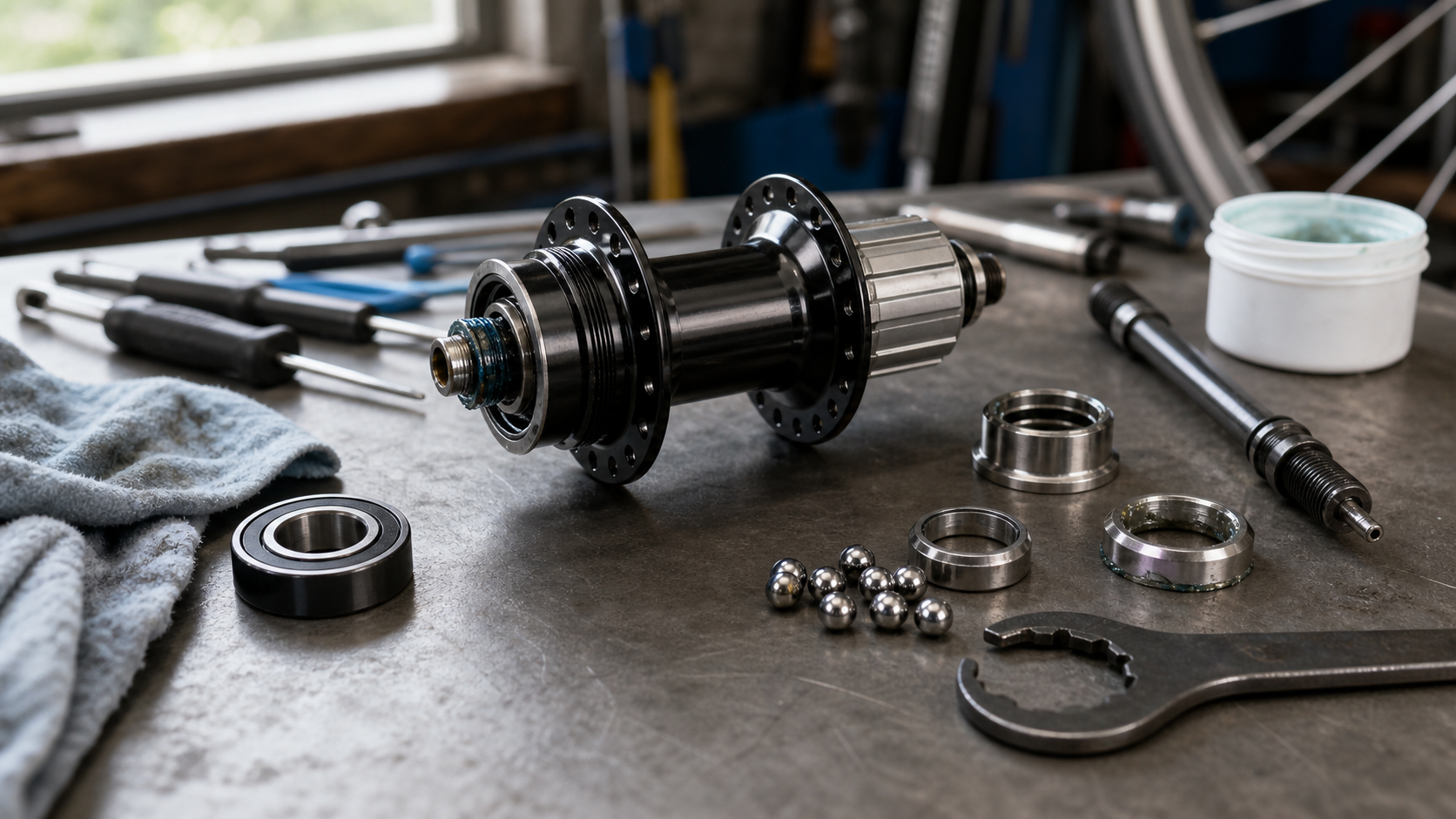
Hub Maintenance: Service Intervals for Sealed Cartridge Bearings and Cup and Cone Bearings
Introduction
A smoothly spinning hub is the soul of a great wheelset. When hub bearings are in good condition, the wheel can coast for over a dozen rotations before stopping on inertia; if the bearings are worn or water has gotten in, not only will the spin be rough, but the accumulated drag will silently sap your pedaling energy over time. There are currently two main bearing designs on the market: sealed cartridge bearings and traditional cup and cone bearings, each with its own maintenance logic.
Comparison of the Two Bearing Designs
| Feature | Sealed Cartridge Bearing (Sealed) | Cup and Cone Bearing (Cup & Cone) |
|---|---|---|
| Representative Brands | Chris King, DT Swiss, Campagnolo | Shimano (most hubs) |
| Structure | Complete bearing unit held in place by snap rings | Steel balls + cup + cone nut, assembled as separate parts |
| Water Resistance | Better (sealed at the factory) | Depends on adjustment precision |
| Adjustability | Not adjustable (replace as a unit) | Preload tension adjustable |
| Maintenance Difficulty | Low (replace as a unit) | Medium (requires disassembly, cleaning, then adjustment) |
| DIY Suitability | High | Medium (requires special tools) |
| Cost | Higher (complete unit) | Lower (steel balls are inexpensive) |
How to Tell If Bearings Need Service or Replacement?
Perform the following simple tests:
- Feel Test: Remove the wheel, grip both ends of the quick release (or axle) with both hands, and rock the wheel side to side to feel for play (wobble)
- Spin Test: Spin the rim and feel for resistance or irregularity (a rough feeling indicates bearing wear)
- Listening Test: While spinning the wheel, bring your ear close to the hub; if you hear a grinding or scraping sound, the bearings need service
| Symptom | Possible Cause | Action |
|---|---|---|
| Play or wobble | Cup and cone preload too loose, or worn bearings | Adjust preload or replace bearings |
| Resistance when spinning | Preload too tight, water ingress, insufficient lubrication | Adjust or re-lubricate |
| Grinding or scraping sound | Worn bearings, sand ingress | Clean and lubricate, or replace |
| Wheel won’t spin past 10 rotations in coast test | Combination of issues | Full disassembly and service |
Sealed Cartridge Bearing Hub Maintenance
Tools
- Bearing removal tool (Park Tool BBT series or a universal bearing removal punch)
- Bearing installation tool (press sleeve of the corresponding size)
- Small mallet
- High-quality bicycle bearing grease
- Replacement bearings of the same specification (check according to hub model; common sizes include 6803, 6802, etc.)
Maintenance Steps
- Remove the wheel and confirm the hub model (usually printed on the side of the flange)
- Remove the quick release or axle
- Remove the bearings: Insert the bearing removal tool from one side and push out the opposite bearing; repeat for the other side
- Clean the bearing seats: Use IPA to clean the bearing seats inside the hub and remove old grease
- Assess the condition of the old bearings:
- Spins smoothly → Only needs fresh lubrication; can be reused
- Feels rough or makes noise → Replace with new bearings
- Install new bearings: Apply a thin layer of grease to the outer race (to help them seat), then press them in using the sleeve, applying force to the outer race until you feel them bottom out
- Reassemble the axle and test the spinning feel
Service Intervals
- Normal riding: Every 6,000–10,000 km, or every 1–2 years
- Frequent riding in rain, or water ingress after washing: Every 3,000–5,000 km
- Replacement criteria: Replace immediately when a rough feeling or lateral play develops
Cup and Cone Bearing (Shimano) Hub Maintenance
Tools
- 14mm thin open-end wrench (dedicated cone wrench)
- 15mm open-end wrench
- Small scraper or tweezers (for cleaning)
- Plenty of bicycle grease
- Spare steel balls (3/16 inch or 1/4 inch, depending on specification)
Disassembly Steps
- Remove the wheel and loosen the quick release
- Use two wrenches (14mm + 15mm) locked against each other to loosen the locknut
- Carefully remove the adjusting cone, being careful to catch any steel balls that fall out
- Remove the axle, then remove the steel balls from the fixed cup on the other side of the hub
- Clean: Use a cloth and IPA to clean the cup races, steel balls, and cones
- Carefully inspect the cup races for pitting (small divots) or grooves; if present, they need to be replaced
Reassembly and Preload Adjustment
- Pack the cup races generously with grease (enough to hold roughly 7–9 steel balls in place)
- Place the steel balls (don’t underfill, but don’t overfill either; usually leave a gap of about one ball’s worth of space)
- Install the axle, thread the adjusting cone on by hand, and tighten gently to the point where it just eliminates lateral play while still spinning freely
- Tighten the locknut; note that the cone will tighten slightly during this process (compensate in advance by backing off about half a turn)
- Final test: Spins smoothly, no play
Practical Advice
- After the rainy season, be sure to remove the wheels and spin the hubs by hand to check for signs of water ingress (spinning becomes heavier)
- Most carbon wheelset hubs use sealed cartridge bearings; the loud ratchet sound of DT Swiss or Chris King hubs is normal
- Pawl-type hubs (non-ratchet) require regular maintenance of the pawl springs, otherwise they are prone to slipping
Conclusion
Hub maintenance is a great entry-level project for advanced DIY repair; you don’t need expensive tools to maintain your wheelset’s optimal rolling efficiency. Replacing sealed cartridge bearings is something almost anyone can do; cup and cone bearings require a bit more skill, but once you master the feel of preload adjustment, you can enjoy the satisfaction of precisely tuned Shimano hubs. Maintain your hubs regularly, and your wheelset will perform at its best on every ride.
Related Reading
- Complete Road Bike Hub Maintenance Guide: Disassembly, Cleaning, Lubrication, Assembly
- The Complete Hub Maintenance and Lubrication Manual: The Key to Extending Wheelset Life
- Bicycle Bearing Maintenance: Lubrication and Replacement for Hubs, Bottom Brackets, and Headsets
- The Complete Guide to Bicycle Bearings: Types, Lifespan, and When to Replace
公路車 BB培林大升級! / 備戰海鷗繞圈賽 Canyon Aerod & TIME 一起改 / MIT大廠 CEMA對鎖式陶瓷培林BB & 導輪 / 公路車 / CT Yeh
2 年前
碟煞公路車 銑面器 !? 原來銑完差這麼多! 降低蹭碟機率! | TIME 公路車 保養小記錄 | CT Yeh
3 年前
鉅齒紋輪組!? ControlTech MEG-T50 EVO 碳纖維幅條輪組/ 功率對比實驗 / 公路車 / CT Yeh
2 年前
再一組! 全碳幅條 碟煞/無內胎輪組 開箱! 到底好騎嗎? UNAAS X40 | 公路車 | CT Yeh
4 年前
來都來了!改好改滿 / CS大導輪 + BB 可以省幾瓦? / 同場加映 TIME XPRO卡踏 / #公路車 #ceramicspeed / CT Yeh
1 年前
CT 喇低賽) 武嶺牽車 才是王道 西進牽車四小時內秘訣 攝手位置 如何判斷 防抽筋小秘訣
7 年前
Unaas X50 全碳纖幅條輪 數據實測對比PK | Lun Hyper 的高階版 | 板輪爬坡也可以很厲害? ! 武嶺2小時大師一起親測! CP值超高 | 公路車 | CT Yeh
4 年前
單車胎壓觀察到的有趣現象,SRAM Quarq TyreWiz 2.0 無內胎胎壓計 / 裝了有哪些幫助? / Tubeless / 公路車 / CT Yeh
1 年前