Weather Strategies for a Round-Island Cycling Trip: Seasonal Selection and Gear Preparation for Sudden Rain
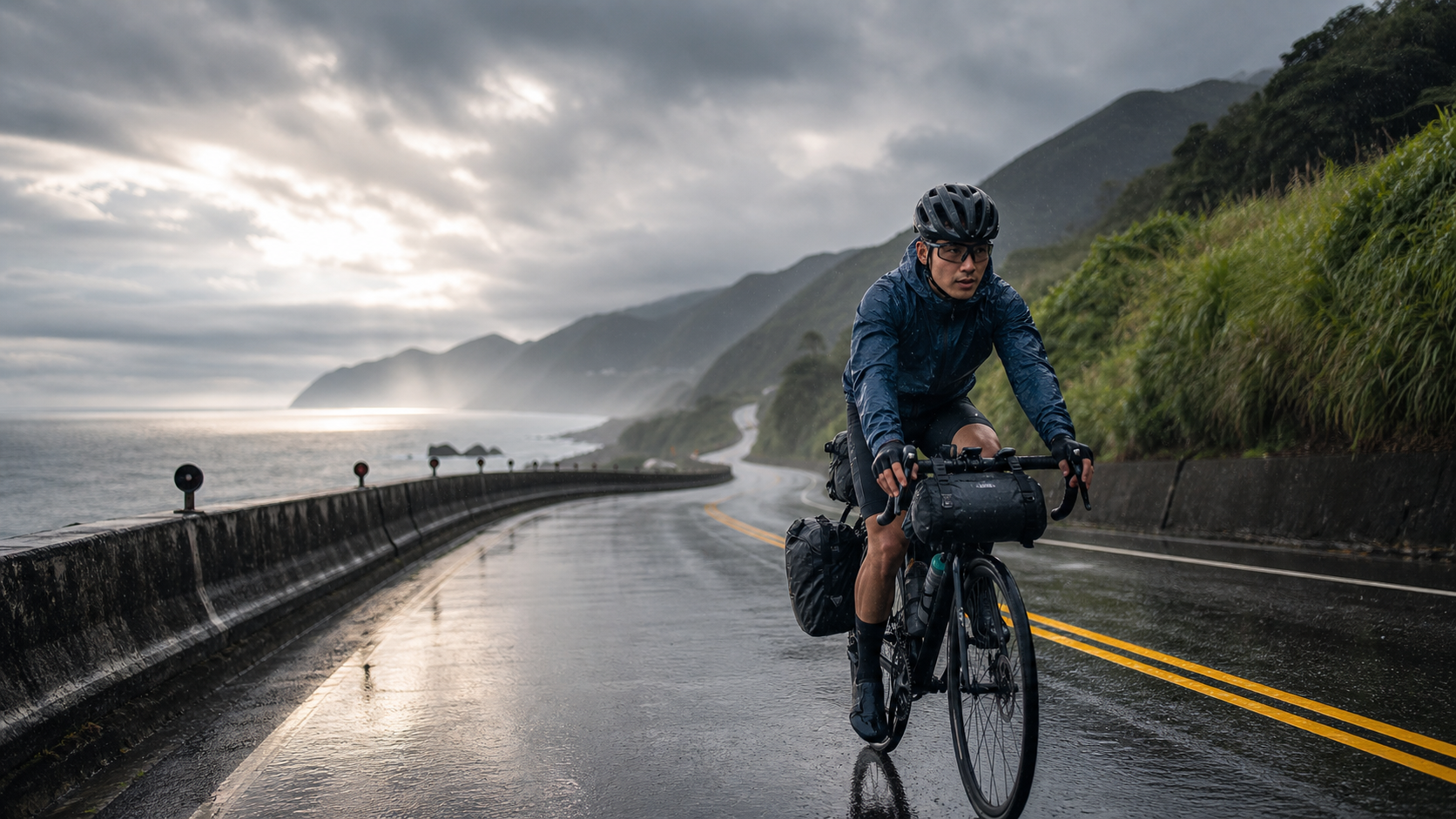
Round-the-Island Weather Preparedness: Seasonal Choices and Gear for Sudden Rain
Introduction
Taiwan’s weather is famously “unpredictable”—even if you check the forecast before setting off, the afternoon clouds can still catch you off guard. Many riders’ first thought after completing a round-the-island trip isn’t how beautiful the roads were, but “that rain really did me in.”
Being prepared for the weather isn’t about guaranteeing you won’t get wet; it’s about being able to keep riding and keep moving forward even after you’re soaked, so that the weather never becomes the reason your round-the-island plan falls apart.
Pros and Cons of Riding in Each Season
| Season | Pros | Cons | Most Dangerous Weather |
|---|---|---|---|
| Spring (Mar–May) | Mild temperatures, weakening northeast monsoon | Plum rain season (May) brings continuous rainfall | Plum rain fronts |
| Summer (Jun–Aug) | Long daylight hours, best scenery on the east coast | Frequent typhoons, midday heat exceeding 35°C | Typhoons, afternoon thunderstorms |
| Autumn (Sep–Nov) | Most stable weather, ideal for Suhua Highway | Occasional typhoon tail effects in October | Autumn typhoons |
| Winter (Dec–Feb) | Fewer crowds, cheaper accommodation | Overcast and rainy in the northeast (Keelung, Yilan) | Strong northeast monsoon winds |
Recommended Season: October to November
Late autumn to early winter is Taiwan’s golden window for a round-the-island trip: typhoon season is over, the plum rains haven’t arrived, and the northeast monsoon is starting but not yet too strong. The rice paddies in the Huadong Rift Valley turn golden—one of the most beautiful sights of the year.
Second choice: March to April (before the plum rains, temperatures 20–26°C, quite comfortable)
Types of Rainfall and Response Strategies
Taiwan has several main types of rainfall, each requiring a different approach:
1. Afternoon Thunderstorms (most common in summer)
- Characteristics: Usually occur between 1 and 4 PM, brief but intense, stopping after 30 minutes to 1 hour
- Response: Try to complete most of your daily mileage before 2 PM; if you encounter a thunderstorm, take shelter at a convenience store or under an awning and wait for the rain to stop before continuing
- What NOT to do: Keep riding through a thunderstorm—lightning strikes on cyclists are rare but real
2. Plum Rain Fronts (May–June)
- Characteristics: 3 to 7 consecutive days of overcast rain, not heavy but relentless
- Response: Check the 5-day forecast before departing; it’s best to avoid the plum rain season altogether. If you’re already on the road, prepare full-body waterproofing and accept “wet riding”
3. Typhoons
- Characteristics: Forecasts available 3 to 5 days in advance, with violent winds and rain
- Response: Stop riding immediately once a typhoon warning is issued, find accommodation nearby and wait it out—never push through
4. Northeast Monsoon (northern and northeastern regions)
- Characteristics: Persistent overcast rain and strong winds in Keelung and Yilan during winter
- Response: If your route passes through these areas, minimize your time there and choose inland routes that avoid the wind (e.g., the Beiyi Highway as an alternative)
Rain Gear Checklist
Essential Waterproof Gear
- Waterproof jacket (Gore-Tex or equivalent): Weighing 200–400g, it fully blocks sudden downpours. Avoid jackets with only a “DWR treatment”—they’ll soak through after 30 minutes in the rain.
- Waterproof gloves: Cold, wet hands directly compromise brake control—this is a safety issue, not a comfort issue.
- Waterproof shoe covers/booties: Riding with wet feet rapidly degrades your performance; lightweight silicone shoe covers are well worth packing.
Recommended Additions
- Waterproof dry bags: Even if you use waterproof panniers, put essential items (passport copy, phone, chargers) in an extra dry bag
- Quick-dry towel: To dry yourself and your bike upon reaching accommodation
- Spare waterproof phone case: Water damage to your phone while navigating mid-ride would be a major headache
Practical Weather Resources
- Central Weather Administration (cwb.gov.tw): Taiwan’s most accurate weather forecast; check the “township forecast” rather than the county-level one for greater precision
- Windy.com: Visualizes wind direction and rainfall distribution, especially useful for checking daily conditions on the Suhua Highway and South Link Highway
- Rainfall observation stations (Water Resources Agency 1688 app): Check real-time rainfall across locations to determine whether it’s a brief shower or sustained rain
Mental Preparation: Embrace “Wet Riding”
No matter how well prepared you are, a 10-day round-the-island trip will almost certainly include a few encounters with rain. The key mindset is: getting rained on isn’t failure—keeping going is the true spirit of the round-the-island ride.
In many riders’ memories of completing the journey, the most unforgettable moments are often that sudden downpour and the rainbow that followed—that’s the gift Taiwan’s roads give you.
Conclusion
Weather is the one variable in a round-the-island trip you cannot control, but gear and strategy can minimize its impact. Choosing the right season, bringing truly waterproof equipment, and learning to stop and wait out the rain at the right moments—these three things can turn the weather from “the enemy of the round-the-island ride” into “part of the round-the-island ride.”
Related Reading
- The Best Season for a Taiwan Round-the-Island Trip: Spring/Autumn Climate and Typhoon Season Timing
- Complete Preparation for Cycling Around Taiwan: 14-Day Route, Accommodation, and Resupply Planning
- Train Year-Round: A Guide to Periodizing Your Annual Training Around Taiwan’s Climate
- Weather Strategies for Cycling in Taiwan: Best Riding Climates and Precautions by Month
一日北高前的西濱集訓 | 跟著11小時軍團 | 300W踩不動的大逆風 | 輪車破風差幾瓦?
6 年前
5 ℃ 櫻花之旅 / 75萬單車直接雨中洗車.../ 平菁街 / 北迴歸小隊 / 公路車 / CT Yeh
5 個月前
大武山後門26%歡樂陡坡!JJSC南台灣單車行Day2 / 被颱風追著跑 / 公路車 / CT Yeh
2 年前
金門 ! 我騎過最棒的離島了 / 最後可以騎車上金門大橋的機會!?/ 公路車 / CT Yeh
1 年前
微東進 太魯閣 蘇花 單車兩日遊 ! 颱風過後路況超刺激 行程大亂 | 最狂的鹹酥雞訂單 | CT Yeh | 4K 高畫質空拍絕景!
4 年前
水金九不厭五分 10度寒流冷到不願停!feat. 卡卡 / 公路車 / CT Yeh
6 個月前
微雨戰! 2022桃園市長盃錦標賽 無敵交管 沒來玩太可惜了! 羅馬公路太可怕 差點成佛! 公路車 | CT Yeh
4 年前
2022 環花東挑戰賽 Day2 搭到特快車 高速真空吸引! 台東一路逆風殺回花蓮! 總排 ??| Feiyu Pocket 2s | 公路車 | CT Yeh
4 年前