IRONMAN World Championship Kona: In-Depth Analysis of Course Features, Wind Conditions, and Athlete Strategies
Introduction
The IRONMAN World Championship, commonly known as “Kona,” has been the pinnacle of long-distance triathlon since its founding in 1978 in Kona on the Big Island of Hawaii. Every October, more than 2,000 athletes from around the world take on the ultimate test of a 3.86 km swim, 180 km bike, and 42.195 km run across this lava wasteland. What makes Kona daunting for every athlete is not just the distance itself, but its relentless environmental conditions.
Course Geography
Kona sits on the west coast of the Big Island of Hawaii, surrounded by ancient lava terrain. The swim takes place in Kailua Bay, where water temperatures hover around 27–29°C with high visibility—theoretically a good swim venue. However, the pre-race swells and the chaotic mass start with a large field of athletes test mental toughness and pacing control.
The bike course departs from Alii Drive, heads north across the lava plains to the Hawi turnaround, then returns along the same route, with virtually no shade the entire way.
| Segment | Distance | Elevation Gain | Unique Challenges |
|---|---|---|---|
| Swim | 3.86 km | — | Swells, open-water navigation |
| Bike | 180 km | Approx. 1,600 m | Crosswinds, intense lava heat radiation |
| Run | 42.195 km | Approx. 400 m | Afternoon heat, energy depletion |
The Notorious Kona Wind Conditions
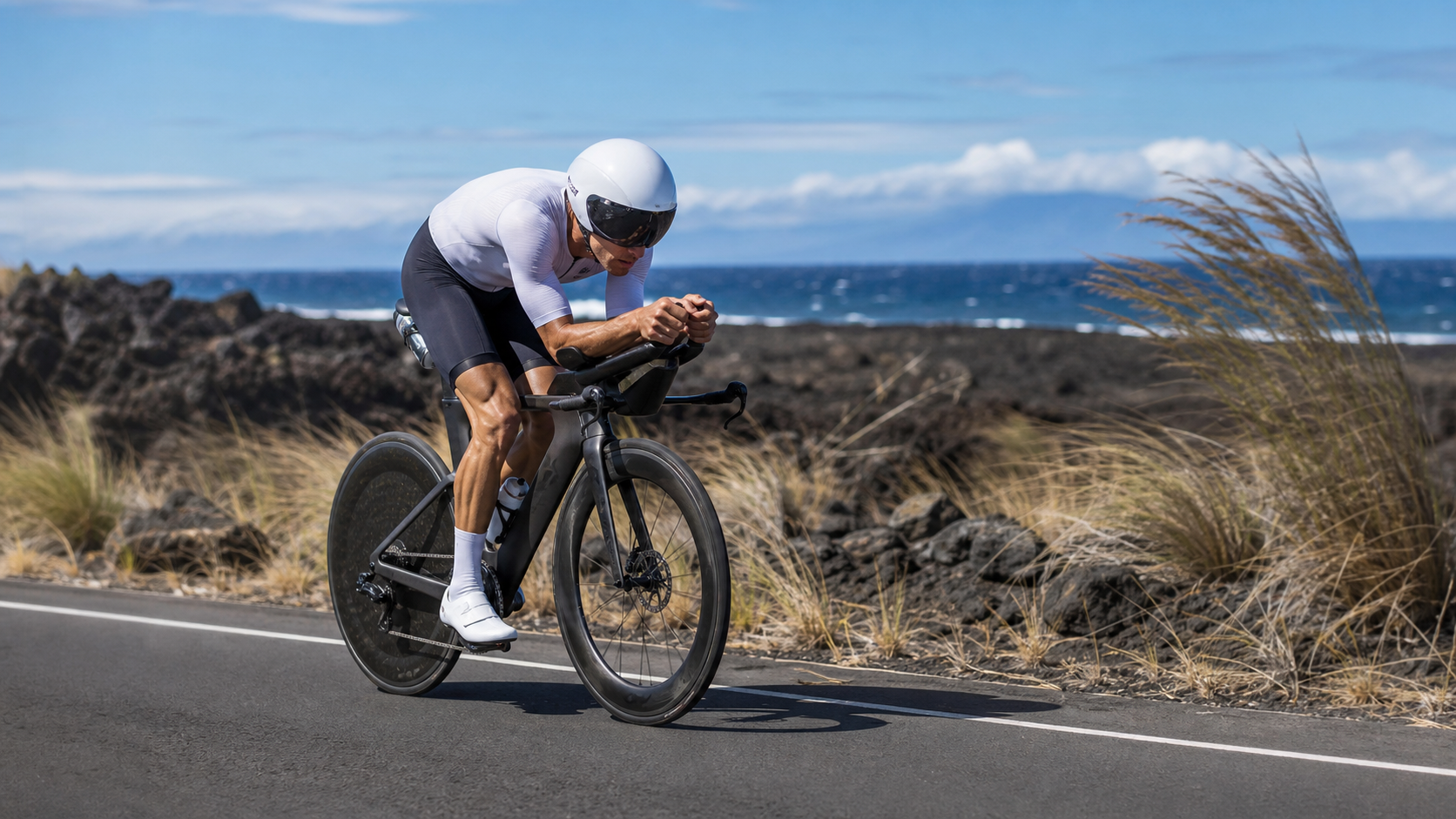
What troubles athletes most in Kona are the “Alii Drive crosswinds” and the “lava plains crosswinds.” When the Trade Winds funnel through the valleys, they create lateral gusts of 40–60 km/h in specific sections—a nightmare for athletes riding disc wheels. Top athletes must make the following choices during preparation:
- Wheel selection: Deep-section disc wheels offer an aerodynamic advantage, but control becomes exponentially harder in crosswinds; many athletes opt for a compromise of a 60mm front wheel paired with an 80mm rear wheel
- Pacing on the Hawi section: The stretch before and after the Hawi turnaround is an uphill headwind segment; overly aggressive pacing can lead to a collapse in the second half
- Feeding timing: Grabbing bottles in strong wind sections is extremely difficult, requiring athletes to practice one-handed handling in advance
Differences in Athlete Strategy: Aggressive vs. Conservative
In recent years, the men’s Kona champions have almost all overtaken their rivals on the run. Take Jan Frodeno and Patrick Lange, for example—both maintained relatively conservative power output on the bike (approximately 72–75% of FTP), deliberately reserving energy for the run. In contrast, some athletes who push hard on the bike often pay the price in the latter stages of the marathon.
On the women’s side, Lucy Charles-Barclay has long used a front-running swim strategy to apply pressure, typically exiting the swim 5–8 minutes ahead of second place, forcing chasers to expend more energy on the bike.
Heat Acclimation and Nutrition Strategy
Temperatures in Kona on race day typically reach 33–36°C, and with radiant heat from the lava ground, the perceived temperature can exceed 40°C. Top athletes’ heat acclimation training includes:
- 10–14 days of heat acclimation training in high-temperature environments (or saunas) before the race
- Increased race-day fluid intake (600–1,000 ml per hour)
- Using ice buckets and ice caps for mid-race cooling
- Electrolyte replacement strategies tailored to individual sweat rates
Practical Advice
For Taiwanese athletes aspiring to race Kona, the following points deserve special attention:
- Arrive early to adapt: It is recommended to arrive in Kona 10–14 days before the race to allow the body to fully adapt to the humid heat and jet lag
- Simulation training sessions: Conduct long bike training during midday hours in Taiwan’s summer to simulate Kona’s heat stress
- Equipment testing: Test wheel selections on roads in Taiwan with crosswind conditions to ensure safe bike handling
- Nutrition plan: Aid stations on the Kona course are spaced farther apart, so precise calculations of energy gel and electrolyte quantities are essential
Conclusion
Kona is not just a physical race—it is a psychological battle between human and environment. The heat of the lava, the Pacific crosswinds, and the endlessly stretching Queen K Highway all test whether an athlete’s preparation is truly complete. For Taiwanese athletes, setting Kona as a goal is not an unreachable dream—as long as you start with systematic training, precise strategic planning, and adequate heat acclimation, this lava coast will eventually welcome you.
Related Reading
- IRONMAN World Championship Kona Introduction: History of the Hall of Glory and Qualifying Races
- A Triathlete’s World Bucket List: Ten Must-Pilgrimage Triathlon Races in a Lifetime
- Triathlon Future Trends: Climate Change Challenges and Response Strategies for the Kona Course
- Complete Kona World Championship Analysis: From 1978 to Today—The Triathlon Holy Land, Course Wind and Heat, and the KQ Qualification System
2019 夏季KOM 5小 完賽心得 準備攻略 東進武嶺 夏季登山王之路 Taiwan KOM Challenge
7 年前
2023 夏季KOM 參賽實況 / 穿越空拍視角 / 整車都凸台 / 太魯閣峽谷x合歡山絕美大景 / 東進武嶺 / Taiwan KOM Challenge / 公路車 / CT Yeh
3 年前
嘉義大埔、阿婆灣挑戰賽,美到以為在日本!ft. 環騎5 Cool 西拉雅188 / 公路車 / CT Yeh
7 個月前
超激烈!2025 南庄仙山KOM 賽事精華 / 男菁英A x 女菁英A / 公路車 / CT Yeh
9 個月前
#KOM 夏季登山王之路 比賽實況 #東進武嶺
7 年前
2025 乘鞍岳登山賽 比賽全紀錄篇 / 完整路線攻略介紹 / 日本版武嶺 公路最高點 / 高山空拍絕景 / 明年會開團! / 公路車 / CT Yeh
10 個月前
2023 台灣KOM自行車登山王挑戰 (AI修復版) / Taiwan KOM Challenge / Live 實況直播 / 班傑明刷破大會成績全記錄
2 年前
和Q老師去福井單車遊 | 絕美三方五湖 全新密境 | feat. Q老師 & 運動生活 | CT Yeh
8 個月前