Triathlon Transition Zone Strategy: A Complete Guide to the Second-Saving Techniques of World-Class Athletes in T1 and T2
Introduction
Many triathletes invest significant time in swim, bike, and run training, yet overlook a critical component that often determines race results—the transition zone. In professional triathlon events, the time difference in T1 (swim to bike) and T2 (bike to run) can reach 30–90 seconds, which in top-tier competitions where overall race gaps are only a few minutes, is often the decisive factor.
The Race Impact of Transition Times
Let’s use numbers to understand the importance of the transition zone:
| Race Type | Elite T1 Time | Elite T2 Time | Average Age-Grouper |
|---|---|---|---|
| Full IRONMAN | 3–5 min | 2–4 min | 5–10 min |
| IRONMAN 70.3 | 2–4 min | 1–3 min | 4–8 min |
| Olympic Distance (WTS) | 0:45–1:15 | 0:30–1:00 | 1:30–3:00 |
In WTS Olympic-distance races, professional athletes can complete T1 in under 1 minute, requiring extremely refined technique and meticulous pre-race preparation.
Key T1 (Swim→Bike) Techniques
Transition from Water to Shore:
- Start walking upright in shallow water rather than waiting until you are fully stable before running
- Remove goggles and swim cap while running toward T1, rather than waiting until entering the transition zone
- Confirm the exact location of your bike before the T1 entrance (scout the course multiple times pre-race)
Tri Suit Strategy:
- Wearing a tri suit eliminates the time needed to change out of swimwear
- Tri suit selection must balance swim drag, bike comfort, and run breathability
Advanced Cycling Shoe Technique:
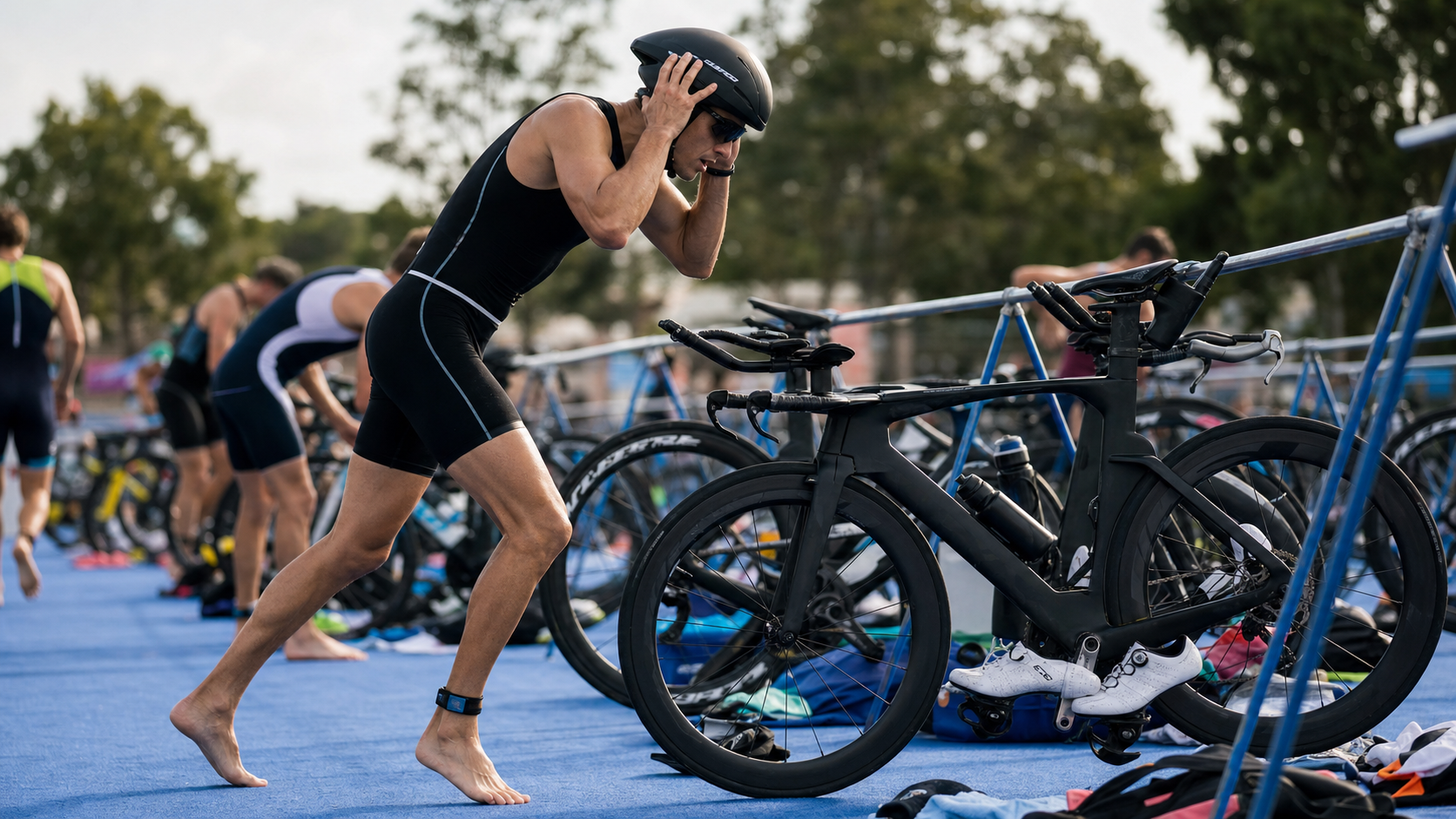
- Elite athletes often use the “shoes pre-attached to pedals” technique: shoes are already clipped onto the bike, athletes run barefoot out of transition, then put on shoes after mounting
- This technique requires extensive practice; beginners are advised to master the basics before attempting it
Helmet Strap Strategy:
- The helmet strap must be fastened before mounting the bike (regulation)
- Elite athletes can fasten the strap while picking up the helmet, taking only 2–3 seconds
- Training method: practice quickly putting on the helmet 10 times after every workout to build muscle memory
Key T2 (Bike→Run) Techniques
Dismount Technique:
- Begin removing cycling shoes 200 meters before entering the transition zone (if using the pre-attached method)
- Coast into the transition zone with feet resting on top of the shoes, decelerating while maintaining forward momentum
- Elite athletes can dismount directly from the bike at low speed without coming to a complete stop
Running Shoe Technique:
- Pre-modify running shoes with elastic laces or use Velcro running shoes to eliminate tying time
- Lock Laces (elastic laces) are the most cost-effective transition speed investment for age-group athletes
- In long-distance races, put on running shoes while running toward the exit rather than sitting down to put them on
Race Number Handling:
- Use an elastic race belt for quick rotation to the front (T2 requires the number to face forward)
- During the bike leg, the number can be rotated to the back (if regulations allow), then rotated back to the front at T2
Pre-Race Transition Preparation Strategy
Transition time savings depend heavily on pre-race preparation:
- Course Reconnaissance: Walk through the transition zone multiple times before the race, memorizing the exact location of your bike
- Gear Placement: Arrange items neatly in order of use to reduce searching time
- Visual Markers: Attach a brightly colored flag to your bike bag for quick identification among many bikes
- Mental Rehearsal: Repeatedly visualize the entire transition sequence in your mind before the race
Most Effective Transition Practice Methods
- Brick Training: Rehearse the complete T2 procedure during every brick workout
- Timed Practice: Use a stopwatch to time your transitions, setting targets for each session
- Pre-Race Simulation: 1–2 weeks before race day, perform a full transition simulation, including the exit-from-water scenario
Special Considerations for Taiwan’s Environment
- Taiwan’s summer heat: transition zone ground can be extremely hot; pay extra attention during barefoot periods
- Wet surfaces: transition zones at Taiwan’s coastal races can be slippery; moderate your running speed accordingly
- Sunscreen replenishment: T2 can include a quick sunscreen reapplication routine (if needed for long-distance races)
Conclusion
The transition zone is one of the most “trainable” technical aspects of triathlon—it requires no talent, only the right methods and sufficient practice. The combined T1+T2 time of elite professional athletes can be 5–10 minutes shorter than age-group athletes, and this gap can be fully narrowed through systematic practice. For Taiwanese athletes, incorporating transition training into your weekly routine starting today is one of the fastest ways to improve your triathlon performance.
Related Reading
- Triathlon Transition Zone Strategy: Saving Every Second in T1 and T2
- Mastering the Triathlon Transition Zone: Techniques and Tactics for T1 and T2
- Triathlon Transition Zone (T1/T2) Guide: Transition Techniques Where Every Second Counts
- Triathlon Transition Training: Speed Drills for T1 (Swim→Bike) and T2 (Bike→Run)
西進武嶺 免費訓練分析服務 Intervals | 練不夠還是練過頭?你哪一種類型選手?AI模型告訴你! | 備戰神器 | 公路車 訓練 | CT Yeh
4 年前
CT 喇低賽) 武嶺牽車 才是王道 西進牽車四小時內秘訣 攝手位置 如何判斷 防抽筋小秘訣
7 年前
2019 夏季KOM 5小 完賽心得 準備攻略 東進武嶺 夏季登山王之路 Taiwan KOM Challenge
7 年前
Live) 備戰2019彰化經典百K 賽前攻略 (已完賽請看新影片
7 年前
FTL 與 SYB 車隊專訪 西進武嶺 實用攻略分享! 2小時 如何練?!你不知道的眉角!新手準備武嶺必看 EP1 | 實力派女車友 | 精華版 | 公路車 | CTYeh
4 年前
#東進武嶺 全程實況錄影 5小時半 #夏季KOM #太魯閣 Taiwan KOM Challenge Reality Video Taroko scenery
7 年前
Zwift跨國線上追逐賽 第二站 台灣 TTR vs. 日本 JETT 第二場 (台灣追日本) | 數百位國內外公路車高手,同場較勁 | 多視角賽事直播
4 年前
2025 自行車錶排行榜 兩萬車友大數據 / Garmin Bryton 排名會大洗牌嗎? / 全新的碼表前身分析 /公路車 / CT Yeh
1 年前