Complete Guide to Buying Swim Goggles: Frame Shapes, Anti-Fog Coatings, and Prescription Options Explained
Introduction
A good pair of swim goggles does more than just let you see clearly underwater—it reduces training interruptions caused by leaks, minimizes eye irritation, and can even affect your swimming stroke and speed perception. The Taiwanese market offers a wide range of swim goggles, from entry-level models under NT$100 to racing models costing several thousand NT$. Where exactly do the differences lie? This article systematically breaks down the three most critical aspects of choosing swim goggles.
Frame Shape Selection
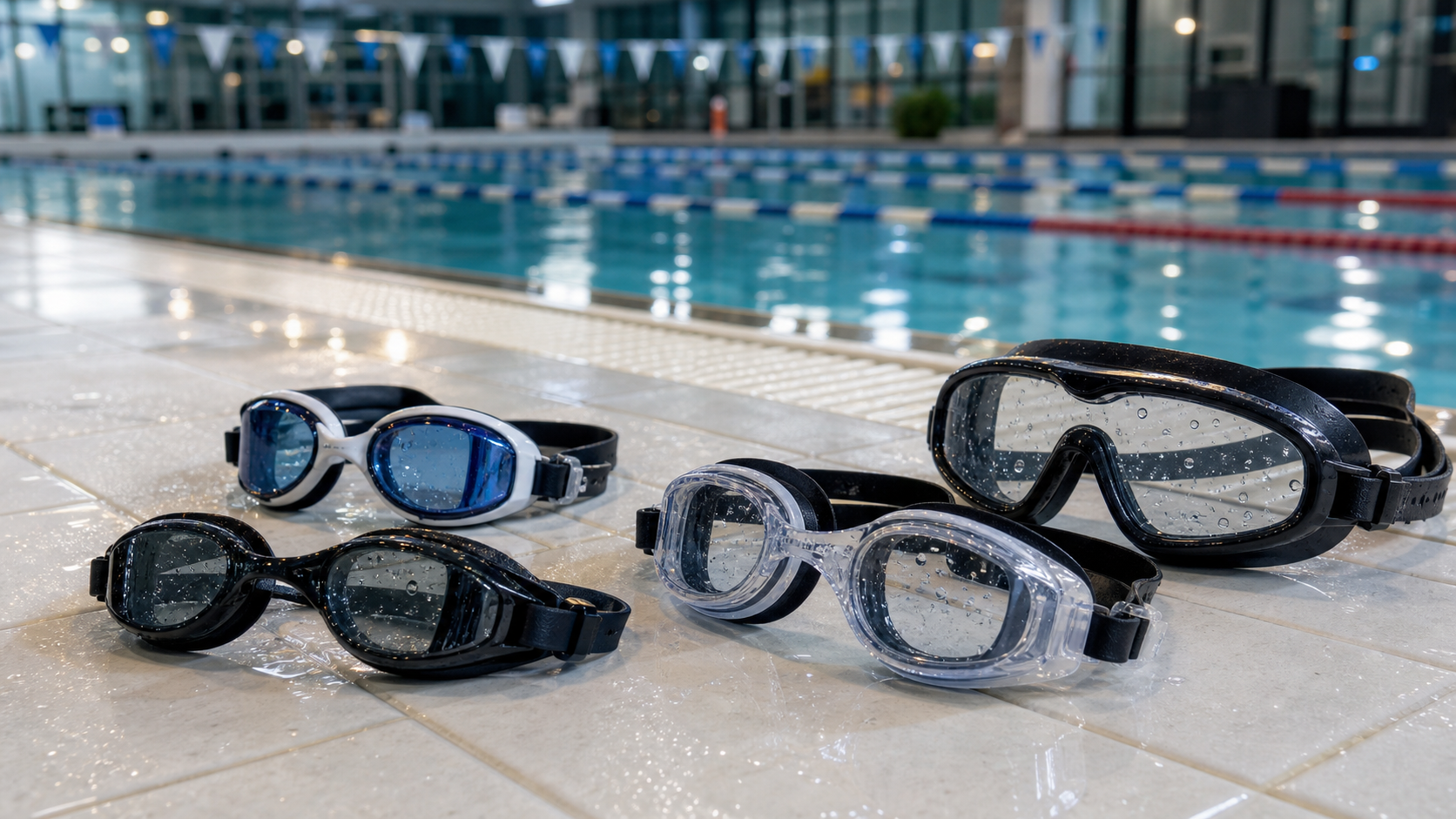
Comparison of Mainstream Frame Types
| Frame Type | Features | Suitable For | Field of View |
|---|---|---|---|
| Racing (Small Frame) | Low water resistance, snug fit around eye sockets | Competitive swimmers | Narrower |
| Standard Training | Balances comfort and sealing | General swimmers | Medium |
| Large-Frame Panoramic | Wide field of view, even pressure distribution | Recreational swimming, scuba-to-pool converts | Widest |
| Marathon/Open Water | Polarized edges, wide viewing angle | Open water swimmers | Wide |
How to Tell If a Frame Fits Your Face Shape
- Eye Socket Pressure Test: Gently press the lenses against your eye sockets (without fastening the strap). If they naturally hold for about 3–5 seconds, the shape fits.
- Nose Bridge Width: If you have a wider nose bridge, choose models with interchangeable nose bridges; Asian face shapes typically require a narrower nose bridge than Western versions.
- Pupillary Distance Measurement: The average pupillary distance (PD) between the eyes is about 62–68 mm. Frames that are too large or too small will both cause leaking.
Anti-Fog Coating Technology Explained
How Anti-Fog Works
Temperature differences in water cause fog to form on the inside of the lens. Anti-fog coatings use super-hydrophilic materials to spread water molecules evenly into a transparent film rather than opaque water droplets.
Comparison of Different Anti-Fog Coating Levels
- Basic Hydrophilic Coating: Common on entry-level models; performance noticeably degrades after 3–6 months. Avoid touching the inside of the lens with your fingers.
- Permanent Anti-Fog Film (e.g., Speedo Biofuse Flexiseal): Fused with the lens, more durable, but still requires avoiding friction.
- Replaceable Anti-Fog Insert Design: Some advanced training models allow adding anti-fog spray to extend service life.
- Dual-Lens Thermal Insulation Design: An air layer between two lenses reduces temperature differences, minimizing fog at the source.
Anti-Fog Maintenance Tips
- Rinse with clean water after use; never wipe the inside of the lens with a towel.
- Commercial anti-fog sprays (e.g., Speedo Anti-Fog Spray) can restore performance after the coating degrades.
- Store in a dry place and avoid prolonged pressure on the lenses.
Prescription Lens Options
Options for Prescription Swim Goggles
- Ready-Made Prescription Goggles: Brands offer fixed diopter options, typically from -1.0 to -8.0, increasing in 0.5 steps, with the same prescription for both eyes.
- Custom Prescription Swim Goggles: Some optical shops or swim specialty stores in Taiwan can custom-make goggles based on your eye exam results, accommodating different prescriptions for each eye.
- Interchangeable Lens Systems: Some brands (e.g., Swans) offer prescription lenses that can be directly swapped into the same frame model.
Considerations When Choosing Prescription Strength
- Due to refraction effects while swimming, distance perception underwater differs from in air. It is recommended to choose a prescription 0.5 diopters lower than your everyday eyeglasses.
- For those with astigmatism over 100 degrees, standard prescription goggles have limited effectiveness. Consult an ophthalmologist or opt for specially customized models.
- Wearing contact lenses under regular goggles is possible, but pool water can still cause corneal infections. It is recommended to use goggles with a good seal.
Lens Color Selection
- Clear/Light Tint: The top choice for indoor pools; does not affect brightness.
- Dark/Smoked Gray: For shading in outdoor pools or open water; too dark for indoor use.
- Yellow/Orange: Enhances contrast in low-light conditions; suitable for overcast days or early morning training.
- Mirrored Reflective Coating: For outdoor competitions; reflects intense sunlight to protect the eyes.
Practical Buying Tips
- Try Them On in Person Whenever Possible: Swim goggles are highly personal. Online shopping carries higher risk, so it is recommended to try them on at a physical store before deciding.
- Check the Strap Adjustment Mechanism: A good quick-adjust system lets you fine-tune quickly before a race.
- Budget Allocation: NT$500–1,500 for everyday training models and NT$1,500–4,000 for racing models are reasonable ranges.
- Brand Recommendations: Speedo Vanquisher 2.0 (high value training model), Arena Cobra Ultra Swipe (top-tier racing), Swans SR-2N (professional prescription option).
Conclusion
There is no one-size-fits-all answer when buying swim goggles. Face shape, vision condition, training environment, and personal preference all influence the final choice. Beginners are advised to start with a mid-priced training model, confirm the frame shape they like, and then upgrade to racing or prescription models. Most importantly, find a pair that fits comfortably and doesn’t leak at all, so you can focus on your training instead of stopping every few minutes to adjust.
Related Reading
- The Complete Guide to Buying Swim Goggles: Full Testing of Anti-Fog, UV Protection, and Frame Seal
- The Complete Swimming Gear Guide: Buying Advice for Swim Goggles, Wetsuits, and Training Aids
- Swim Goggle Prescription Strength: Configuring and Buying Prescription Swim Goggles
- Swim Goggle Buying Guide: Field of View and Seal Differences Between Wide-Angle vs. Racing Goggles
開箱) 近視車友 也可以很帥的 Envis Transform 太陽眼鏡開箱 翔鷹 配近視框超便宜秘訣
7 年前
近視雷射三個月後悔嗎?單車族/工程師必看,Smart TransPRK 術後血淚史與後遺症全公開 / CT Yeh
4 個月前
3C心得) 電腦用 43吋 4K 螢幕 適合嗎 ! BDM4350UC 長期使用心得 剪接影片 修圖 Premiere Davinci Lightroom
7 年前
Vision Metron RS 37碳幅條輪組 (非SL)官網沒有的 低調開箱 / 這重量太銷魂了 / 公路車 / CT Yeh
6 個月前
單車 一日北高 ( 雙城 ) 肥宅雙人瘋狂行 紀錄片 REACTO
10 年前
[教學] Premiere 影片 手震 修正 教學 防抖 單眼 影像 GoPro 穩定 Video Stabilization
8 年前
iPad Pro 2021 M1 12.9吋 5G 版 三個月使用心得 MiniLED有這麼爛嗎? 有了這絕招,不需買512G以上也可以很有生產力!
4 年前
Nepest NOVA 碳條輪組:輕量、空力、舒適一次滿足!/ 公路車 / CT Yeh
7 個月前