Hand Paddle Buying Guide: Understanding the Training Differences Between Large, Medium, and Finger Paddles
Introduction
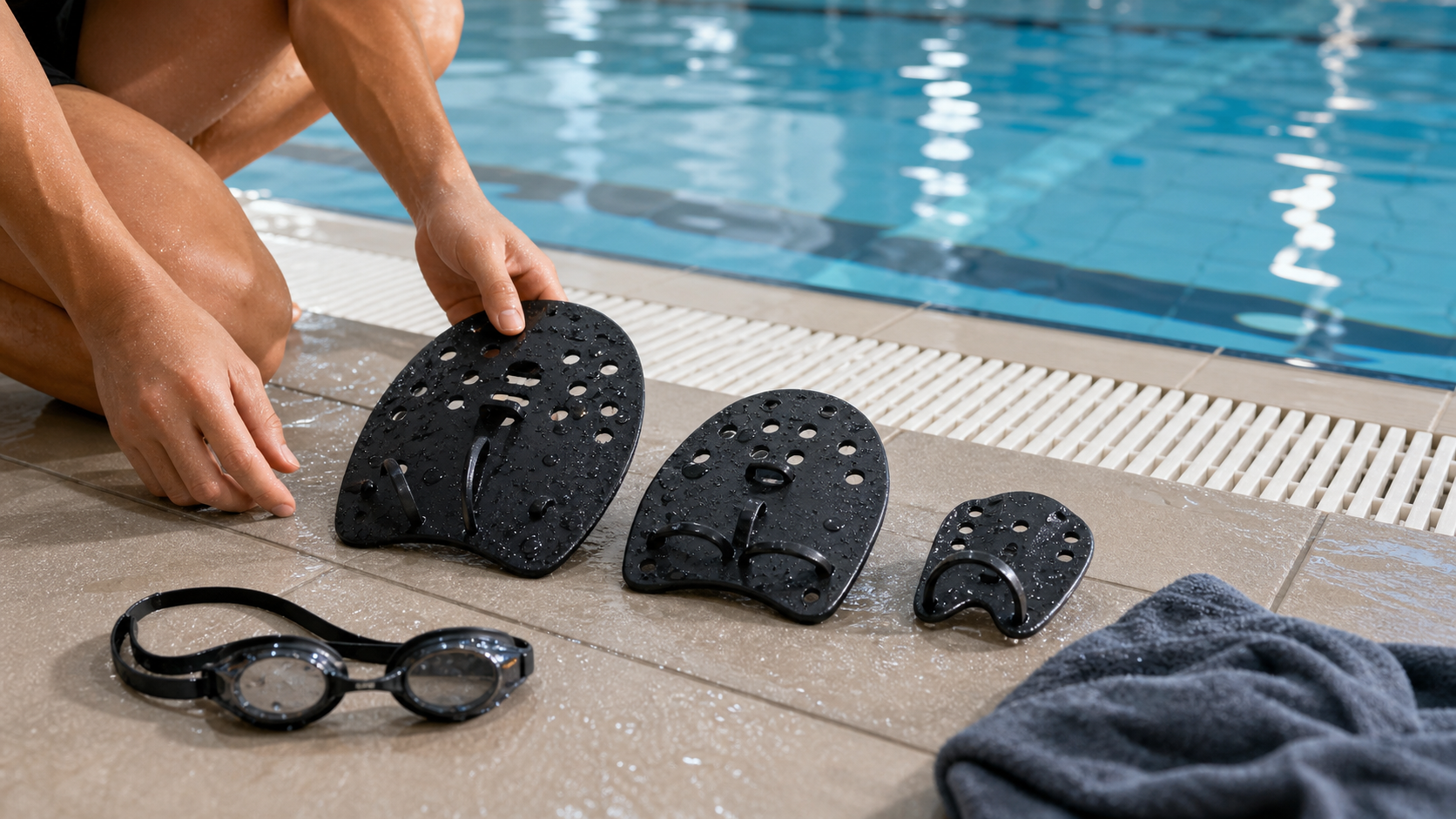
Among swim training tools, the hand paddle is one of the most effective pieces of equipment for quickly changing how a stroke feels. By increasing the surface area of the hand in contact with the water, paddles let swimmers feel a stronger “catch,” which helps develop correct stroke technique and power. However, paddles on the market generally fall into three main categories—large, medium, and finger paddles—each with a distinctly different training purpose. Choosing the wrong size can actually lead to shoulder injury.
Core Comparison of the Three Sizes
| Type | Hand Coverage | Resistance Level | Main Training Purpose | Recommended For |
|---|---|---|---|---|
| Large Paddle | 150–200% of palm area | High | Strength training, muscle conditioning | Advanced swimmers with an existing shoulder training base |
| Medium Paddle | 110–140% of palm area | Medium | Technique correction, developing feel for the water | Intermediate to advanced swimmers |
| Finger Paddle | Covers fingers only | Low | Fingertip catch sensation, fine technique work | All levels, especially beginners |
Large Paddle
Design Features
Large paddles are typically about 1.5–2 times the size of the hand, with slightly rounded edges and holes in the center to increase water-feel feedback, secured with a wrist strap and finger tether.
Training Benefits
- Strengthens the stroke muscles: The significant increase in water resistance provides stronger training stimulus for the latissimus dorsi, posterior deltoids, and triceps
- Extends stroke length: Large paddles force swimmers to complete a full stroke arc, helping build the habit of a long, complete pull
- Speed perception: After removing the paddles, swimmers often feel a sense of “lightness,” which provides a psychological speed boost
Risks of Use
- High risk of shoulder injury: Excessive resistance combined with an incorrect hand entry angle can place excessive stress on the rotator cuff muscles
- Can mask technique problems: Some swimmers rely on the paddle to drive propulsion and neglect proper stroke form
- Not suitable for beginners: At least 6 months of training experience is recommended before attempting large paddles
Training Recommendations
Use 2–3 times per week, no more than 1,000 m per session, ideally combined with a pull buoy so the upper body fully drives propulsion.
Medium Paddle
Design Features
Medium paddles are roughly the same size as the hand or slightly larger. This is the most widely used size, with a design that emphasizes ergonomics; some models include an angled surface to encourage a correct hand entry angle.
Training Benefits
- Balances technique and strength: Resistance is not excessive, allowing swimmers to build stroke power while maintaining correct form
- Immediate feedback: If the hand entry angle is incorrect, water will spill off the edge of the paddle, letting the swimmer feel the flaw in their technique
- Shoulder-friendly: For most swimmers, 45–60 minutes of use is unlikely to cause overuse injury
Suitable Training Uses
- Reinforcing High Elbow Catch technique in freestyle
- Combined with long-distance aerobic training
- Strength maintenance training in the lead-up to competition
Finger Paddle
Design Features
Finger paddles cover only the first to third finger joints. The design is small but highly precise. Well-known brands such as Finis’s Agility Paddle even do without straps entirely, relying on water pressure to stay in place.
Training Benefits
- Enhances fingertip catch sensation: Trains the brain to sense the pressure point after the fingers enter the water, strengthening awareness of the “front catch”
- Does not mask technique flaws: If the movement is incorrect, the paddle will fly off, providing immediate visual feedback
- Zero shoulder risk: Adds almost no resistance and can be used safely at any training level
- Improves hand flexibility: A slightly spread finger position helps improve stroke efficiency
Suitable For
- Beginners just starting to learn correct stroke technique
- Advanced swimmers doing fine technique refinement (technique week before competition)
- Swimmers recovering from shoulder injury who cannot use large or medium paddles
Brand and Purchase Recommendations
| Brand | Recommended Model | Material | Taiwan Price | Features |
|---|---|---|---|---|
| Finis | Agility Paddle (Finger Paddle) | Soft EVA | NT$600–800 | No-strap design, precise movement feedback |
| Speedo | Power Paddle (Medium Paddle) | Rigid PP | NT$400–600 | Perforated design enhances water feel |
| Arena | Elite Paddle (Medium to Large) | Composite material | NT$500–900 | Ergonomic angled design for correct hand entry |
| TYR | Catalyst Paddle (Medium Paddle) | PP + foam wrist strap | NT$350–550 | Comfortable strap that won’t chafe |
Practical Tips
- Start with a medium or finger paddle: It’s not recommended to use a large paddle first—build technique before progressing to strength training
- Monitor your shoulder condition: If you feel discomfort at the front of the shoulder after use, stop immediately and assess your technique
- Combine with a pull buoy: Pairing hand paddles with a pull buoy fully isolates the legs so you can focus entirely on the upper body
- Set a usage ratio: It is generally recommended that paddle training not exceed 30% of total training volume
Conclusion
The choice of hand paddle should be based on your current training goal, not simply “bigger is better.” Beginners building technique should start with finger paddles, mid-stage training can use medium paddles to strengthen movement efficiency, and large paddles should only be introduced during the advanced strength phase. Understanding when each size is appropriate is what allows hand paddles to truly become a tool for improving swim performance, rather than a burden that increases the risk of injury.
Related Reading
- Hand Paddle Review: Matching Size Choice to Training Purpose
- Complete Guide to Swim Resistance Training Tools: Hand Paddles, Resistance Parachutes, and Resistance Bands
- Complete Guide to the Training Effects and Correct Use of Swim Paddles
- Hand Paddles, Kickboards, Fins: Correct Use of Swim Training Aids and the Shoulder Injury Red Line
訓練台體驗) 2019台北自行車展 三大家 訓練台體驗 Tacx Neo Flux 2 Xepdo Apx Wahoo Kickr
7 年前
西進武嶺 免費訓練分析服務 Intervals | 練不夠還是練過頭?你哪一種類型選手?AI模型告訴你! | 備戰神器 | 公路車 訓練 | CT Yeh
4 年前
[教學] Premiere 影片 手震 修正 教學 防抖 單眼 影像 GoPro 穩定 Video Stabilization
8 年前
3C心得) 電腦用 43吋 4K 螢幕 適合嗎 ! BDM4350UC 長期使用心得 剪接影片 修圖 Premiere Davinci Lightroom
7 年前
CT 喇低賽) 武嶺牽車 才是王道 西進牽車四小時內秘訣 攝手位置 如何判斷 防抽筋小秘訣
7 年前
如何把 GoPro 影片 翻轉 批次 轉正?
6 年前
滑雪新手們慘摔學習全紀錄(請開字幕),滑雪好好玩 | Snowboard + Ski | 岩原 スキー場 | 滑雪APP使用 | GoPro Max
6 年前
iPad Pro 2021 M1 12.9吋 5G 版 三個月使用心得 MiniLED有這麼爛嗎? 有了這絕招,不需買512G以上也可以很有生產力!
4 年前