Resistance Parachute Selection and Training Applications: Resistance Level Settings and Evaluation of Water Resistance Training Benefits
/no_think
Introduction
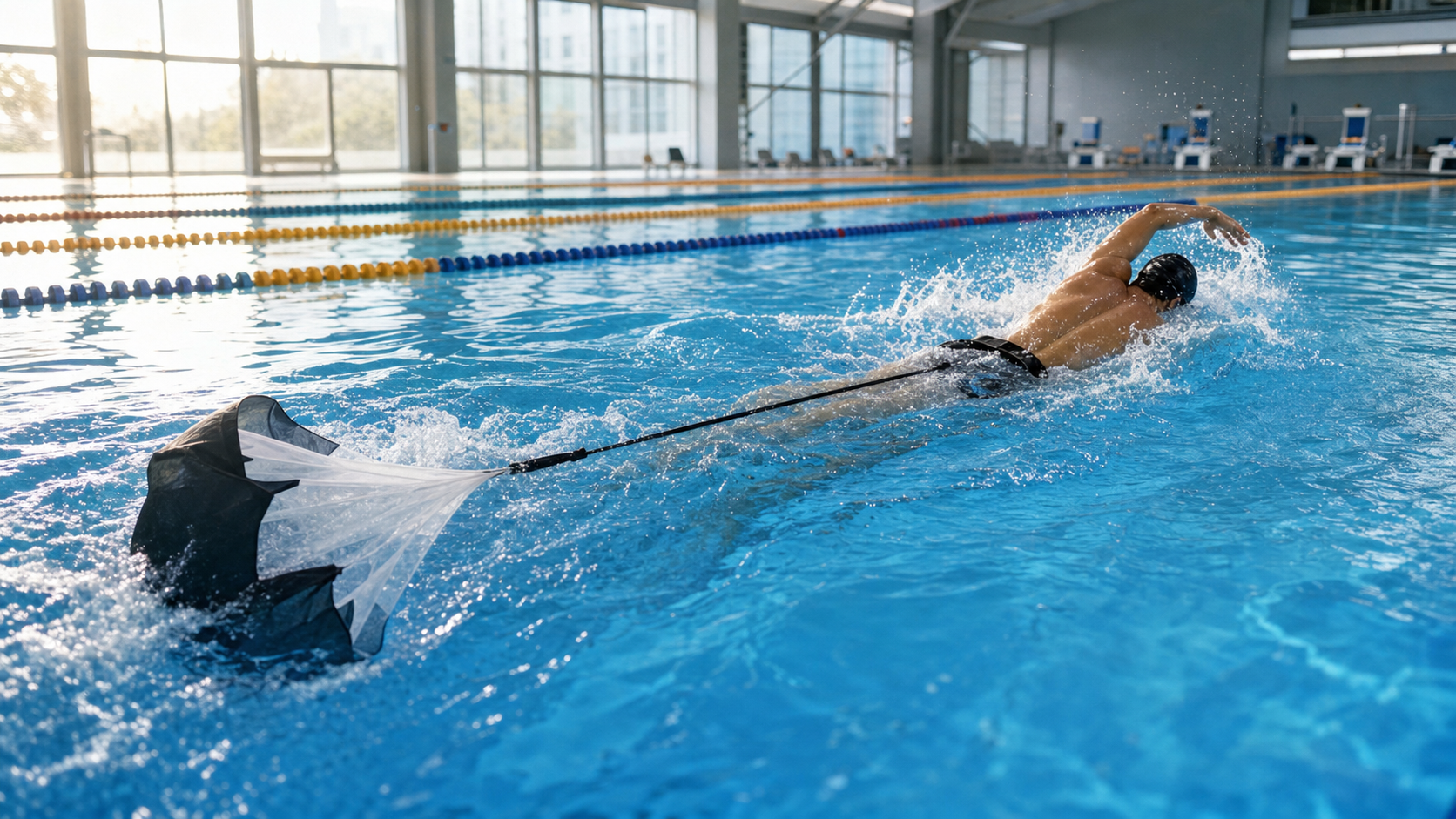
The drag chute (resistance parachute) is a high-intensity tool in competitive swimming training. By attaching a parachute-shaped device to the swimmer’s waist, it creates additional resistance in the water, forcing the swimmer to propel themselves with greater force. When the drag chute is removed, the swimmer experiences a distinct sense of “lightness.” This contrast effect (overspeed contrast training) is widely used to improve swimming speed.
How the Drag Chute Works
The drag chute is attached to an elastic waist belt and trails behind the swimmer, with the canopy opening in the water to create drag. The level of resistance is determined by three factors: canopy surface area, opening design, and swimming speed.
- The faster the speed, the greater the resistance: Resistance is proportional to the square of speed, meaning the challenge at fast speeds is far greater than at slow speeds
- Canopy surface area determines baseline resistance: The larger the diameter of the drag chute, the stronger the resistance produced
- Opening design affects stability: Some designs feature adjustment holes to prevent excessive side-to-side swaying
Drag Chute Sizes and Target Users
| Size | Canopy Diameter | Resistance Produced (approx.) | Target Users | Representative Brand Models |
|---|---|---|---|---|
| Small | 25–30 cm | Low to Medium | Youth swimmers, first-time users | Finis Drag Sock |
| Medium | 35–45 cm | Medium | General competitive training | Speedo Drag Bag |
| Large | 50–60 cm | High | Advanced swimmers in strength phase | TYR Power Chute |
| Adjustable | Multiple settings | Low to High | All levels | Aqua Sphere adjustable model |
Drag Chute vs. Other Resistance Tools
- Drag Shorts: Worn over the swimsuit, these increase water resistance through loose fabric. Resistance is distributed across the entire body, producing a gentler effect, making them suitable for long-distance endurance training
- Drag Chute: Concentrates resistance behind the waist, simulating opposing resistance for explosive propulsion, making it better suited for speed and power training
- Stretch Cord: Attached to a fixed point, it allows for stationary swimming or forward sprinting against elastic resistance, offering a different training mode
Training Application Methods
Basic Drag Chute Training
-
Contrast Method
- Swim 50 m with the chute, then immediately remove it and swim 50 m
- Feel the explosive speed sensation after removal
- Repeat 4–6 times per set, with 2–3 minutes rest between sets
-
Continuous Resistance Endurance Training
- Swim 200–400 m with the chute, maintaining proper stroke technique
- Emphasize posture retention; do not let form break down under excessive resistance
- Suitable for maintaining strength during the mid-season
-
Overspeed Training (combined with reverse application of stretch cords)
- After drag chute training, pair it with assisted swimming using a tether to experience faster-than-normal speed
- Helps establish neuromuscular patterns for high-speed swimming
Training Volume Recommendations
- First-time use: Once per week, with 500–800 m of chute training per session
- After adaptation (4–6 weeks): Twice per week, with 800–1,200 m per session
- 3 weeks before competition: Reduce usage, focusing primarily on technique training
Usage Precautions
- Ensure the waist belt is securely fastened: If the belt comes loose during swimming, it could entangle the legs, posing a safety risk
- Maintain distance from other swimmers: The drag chute can extend 60–80 cm behind the swimmer when deployed, so keep adequate spacing
- Establish proper technique before use: The drag chute amplifies technical flaws; it is recommended to use it under coach supervision for the first time
- Do not use simultaneously with paddles: Having resistance tools on both upper and lower limbs creates excessive intensity and a high risk of technique breakdown
Benefit Assessment: What Scientific Research Says
Multiple swimming training studies show:
- After 8–12 weeks of drag chute training, swimmers’ 50 m freestyle times improved by an average of 1.5–3%
- Immediate speed boost from contrast training: Speed over the first 15 m after removing the drag chute increased by approximately 4–7% (acute effect)
- Improved strength indicators: Isokinetic strength tests of propulsive muscle groups (latissimus dorsi, glutes) showed approximately 8–15% improvement
Buying Considerations
- Material: Choose nylon fabric for the canopy (chlorine-resistant, tear-resistant), and an adjustable elastic belt
- Storage design: Models that fold into a mesh bag are more convenient to carry
- Purchase channels in Taiwan: Large swimming supply stores, sports brand flagship stores, or online shopping platforms such as Shopee and Pchome
Conclusion
The drag chute is a highly effective tool in advanced swimming training, and its contrast training principle is well supported by sports science. However, it is not suitable for everyone. Beginners should first build a solid technical foundation to ensure they can maintain proper form under high resistance before truly benefiting from drag chute training. Used correctly, the drag chute can be a powerful weapon for breaking through personal bests.
Related Reading
- Swimming Drag Chutes and Resistance Bands: An Analysis of Professional Assistive Tools for High-Intensity Training
- Swimming Drag Chutes and Drag Nets: A Comparison of Equipment for Resistance Training
- Resistance Training in Swimming: Training Design with Band Legs, Drag Chutes, and Resistance Cords
- The Complete Guide to Swimming Resistance Tools: Application Strategies for Paddles, Drag Chutes, and Resistance Cords
西進武嶺 免費訓練分析服務 Intervals | 練不夠還是練過頭?你哪一種類型選手?AI模型告訴你! | 備戰神器 | 公路車 訓練 | CT Yeh
4 年前
3D 列印車褲墊 / 舒適改善? / 無痕 x 分區壓縮 / ATK & Decider系列 / JE22黑科技 / #公路車 #CTYEH
11 個月前
鉅齒紋輪組!? ControlTech MEG-T50 EVO 碳纖維幅條輪組/ 功率對比實驗 / 公路車 / CT Yeh
2 年前
訓練台體驗) 2019台北自行車展 三大家 訓練台體驗 Tacx Neo Flux 2 Xepdo Apx Wahoo Kickr
7 年前
洗單車神器 吹水機! 實際洗車用用看 暴力洗鍊條大法 | 公路車 | CT Yeh
4 年前
西進武嶺 自製新版AI配速表產生器 x 賽前攻略 抱佛腳! 沒有功率計也可以產生配速表嗎?有什麼其他眉角賽前要注意的呢? | 西進武嶺 / 東進武嶺 KOM 攻略 | 公路車 | CT Yeh
4 年前
Fitting訓練兩用功率車 ! Thinkrider ST900 完整實測!/ 坡度升降 / 鄰居測試/ smart bike/公路車/ CT Yeh
2 年前
一日北高前的西濱集訓 | 跟著11小時軍團 | 300W踩不動的大逆風 | 輪車破風差幾瓦?
6 年前