Introduction
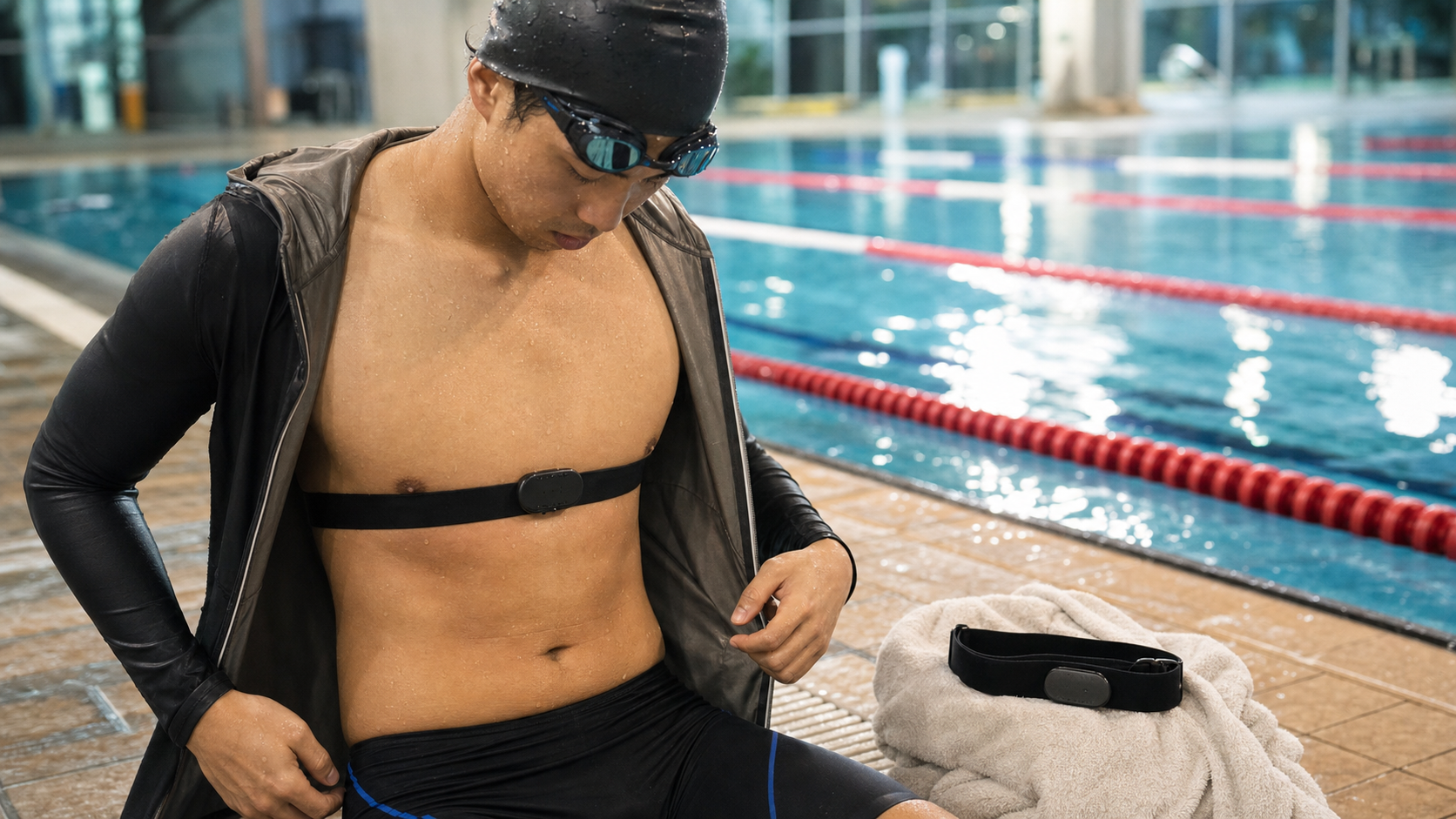
Swimming is one of the most difficult activities for heart rate monitoring among all endurance sports. Wrist-based optical heart rate (OHR) sensors suffer a significant drop in accuracy during swimming due to water interference and frequent wrist movement—a problem many runners only discover after transitioning to triathlon. While chest strap heart rate monitors are accurate, brand design differences are significant when it comes to stable operation in a swimming environment. This article focuses on the real-world swimming performance of two mainstream waterproof heart rate straps on the market: the Garmin HRM-Tri and the Polar H10.
Basic Specifications Comparison
| Specification | Garmin HRM-Tri | Polar H10 |
|---|---|---|
| Water Resistance | 5 ATM (50 m) | IPX7 (30 min/1 m) |
| Swimming Data Storage | Built-in memory, syncs after swim | Real-time transmission (requires paired device) |
| Connectivity | ANT+ (during swimming), Bluetooth (sync on land) | Bluetooth 5.0 + ANT+ |
| Battery Life | Approximately 10 hours | Approximately 400 hours (replaceable battery) |
| Battery Design | Rechargeable | CR2025 replaceable |
| Swimming Heart Rate Accuracy | ★★★★★ | ★★★★☆ |
| Taiwan Price | NT$3,500–4,500 | NT$2,800–3,800 |
| Device Compatibility | Best with Garmin watches, partial third-party support | Broad compatibility with multi-brand watches and phones |
Garmin HRM-Tri In-Depth Review
Core Design Advantages
The biggest feature of the Garmin HRM-Tri is built-in memory. Since ANT+ signals cannot penetrate water during swimming, Garmin’s solution is to store heart rate data directly on the strap itself, then automatically sync it once you approach your watch after the swim. This means that even if the watch cannot display heart rate in real time during swimming, you can still analyze complete swimming heart rate data afterward.
Swimming Accuracy
- Pool Swimming: Excellent—the built-in accelerometer helps identify strokes, and heart rate data is complete with a delay of under 5 seconds (after syncing)
- Open Water: Equally accurate, but it is recommended to ensure a snug fit of the chest strap; salt from seawater and sweat does not affect electrode function
- High-Intensity Intervals: Sensitive peak heart rate capture, accurately recording maximum heart rate during sprint segments
Usage Notes
- The snugness of the elastic chest strap directly affects heart rate accuracy; confirm it fits properly before each use
- After prolonged use, conductive electrodes may accumulate dead skin cells and affect the signal; clean them regularly
- Full functionality requires pairing with a Garmin device; some features may not work with other brand watches
Polar H10 In-Depth Review
Core Design Advantages
The Polar H10’s advantage lies in its broad Bluetooth compatibility, connecting to nearly all training apps that support heart rate straps (including Garmin Connect, Wahoo, Strava, Zwift, etc.), and it can connect to two Bluetooth devices simultaneously. The replaceable battery design lowers long-term usage costs.
Swimming Accuracy
- Pool Swimming: Requires a device with swimming heart rate strap reception capability, such as the Polar Vantage V2, Suunto, etc., or use the swimming mode in the Polar Beat App
- Open Water: Bluetooth does not penetrate the water surface; a paired watch with a swimming mode is recommended
- High-Intensity Training: Excellent electrode quality, accurately capturing heart rate across the range from resting to maximum
Usage Notes
- If the watch cannot receive data in real time during swimming, post-swim syncing depends on the level of support from the paired device
- Bluetooth 5.0 delivers excellent real-time connectivity above the water surface, ideal for displaying heart rate during running and cycling
How to Choose
Choose the Garmin HRM-Tri if you:
- Use a Garmin watch (Forerunner, Fenix, Instinct series)
- Value the completeness of swimming heart rate data and post-analysis
- Compete in triathlons and need full recording across swim → bike → run
Choose the Polar H10 if you:
- Use Polar, Suunto, or other brand devices
- Have multi-device needs (watch + phone app connected simultaneously)
- Prefer a replaceable battery design and don’t want to worry about charging when traveling abroad for races
Chest Strap Comfort Comparison
- Strap Width: Garmin is slightly narrower; Polar is slightly wider, with slightly less pressure felt during extended wear on the Polar
- Strap Material: Both use soft materials; long-distance triathletes report no significant discomfort after wearing either for 3–4 hours or more
- Sensitive Skin: Some people experience mild irritation from the electrode pad material; Polar offers more accessory options
Conclusion
For swimmers within the Garmin ecosystem, the HRM-Tri’s built-in memory is a killer feature, eliminating the blind spot in swimming heart rate data. The Polar H10, with its broad compatibility and durable replaceable battery design, becomes the best choice for multi-device users. If you’re buying just one heart rate strap for full triathlon use, the HRM-Tri offers more complete feature integration; if your primary focus is swimming heart rate monitoring but you also run and cycle, the H10 offers greater flexibility.
Related Reading
- Heart Rate Monitoring for Swim Training: Effective Ways to Use a Waterproof Heart Rate Strap
- Running Heart Rate Monitoring: In-Depth Accuracy Comparison Between Heart Rate Straps and Optical Sensors
- Heart Rate Strap vs Optical Sensor Review: Polar H10 vs Garmin HRM-Pro vs Apple Watch Accuracy
- Heart Rate Strap vs Optical Watch: Which Wins in Heart Rate Monitoring Accuracy?
Garmin Edge 1050 旗艦車錶 全台首測!/ 環法冠軍指定 / 對比Edge 1040改進哪些? / 公路車 / CT Yeh
2 年前
Garmin Edge 540/840 Solar 台灣首發開箱!完整車錶功能 道路實測 / ClimbPro 爬坡提示超級牛 / 強大續航實測 / 公路車 / CT Yeh
3 年前
首發 Garmin Edge 850 車錶 深入開箱!? / 公路車 / CT Yeh
10 個月前
超開放的自行車錶!可以玩遊戲裝APP!?/ SRAM合併的 Hammerhead Karoo深入開箱!/ 即時爬坡偵測 / 全球導航地圖 / Garmin Bryton / CT Yeh
1 年前
Garmin Edge 1040 重大韌體更新!! / 1050功能全下放!? / 坡度反應變快了嗎?/ 快速對比實測 / 公路車 / CT Yeh
1 年前
全台首發神車錶! iGPSPORT iGS630 兩趟一日北高的續航! 超強導航、功率訓練、超人性APP! Garmin & Bryton 有對手了嗎? | 公路車 |CT Yeh
3 年前
Bryton Rider S500 全面實測 有什麼缺點嗎?| CT Yeh | 公路車 車錶
4 年前
GoPro Hero 10 畫質好但 他是個吃電怪物 過熱只是小CASE 單車錄影實測 ! 耗電 災情 過熱實測 購買前請三思 OSMO Action 2了 !? | CT Yeh
4 年前