Pool Training Tool Combination Recommendations: Best Tool Setup for Beginners vs. Advanced Swimmers
Introduction
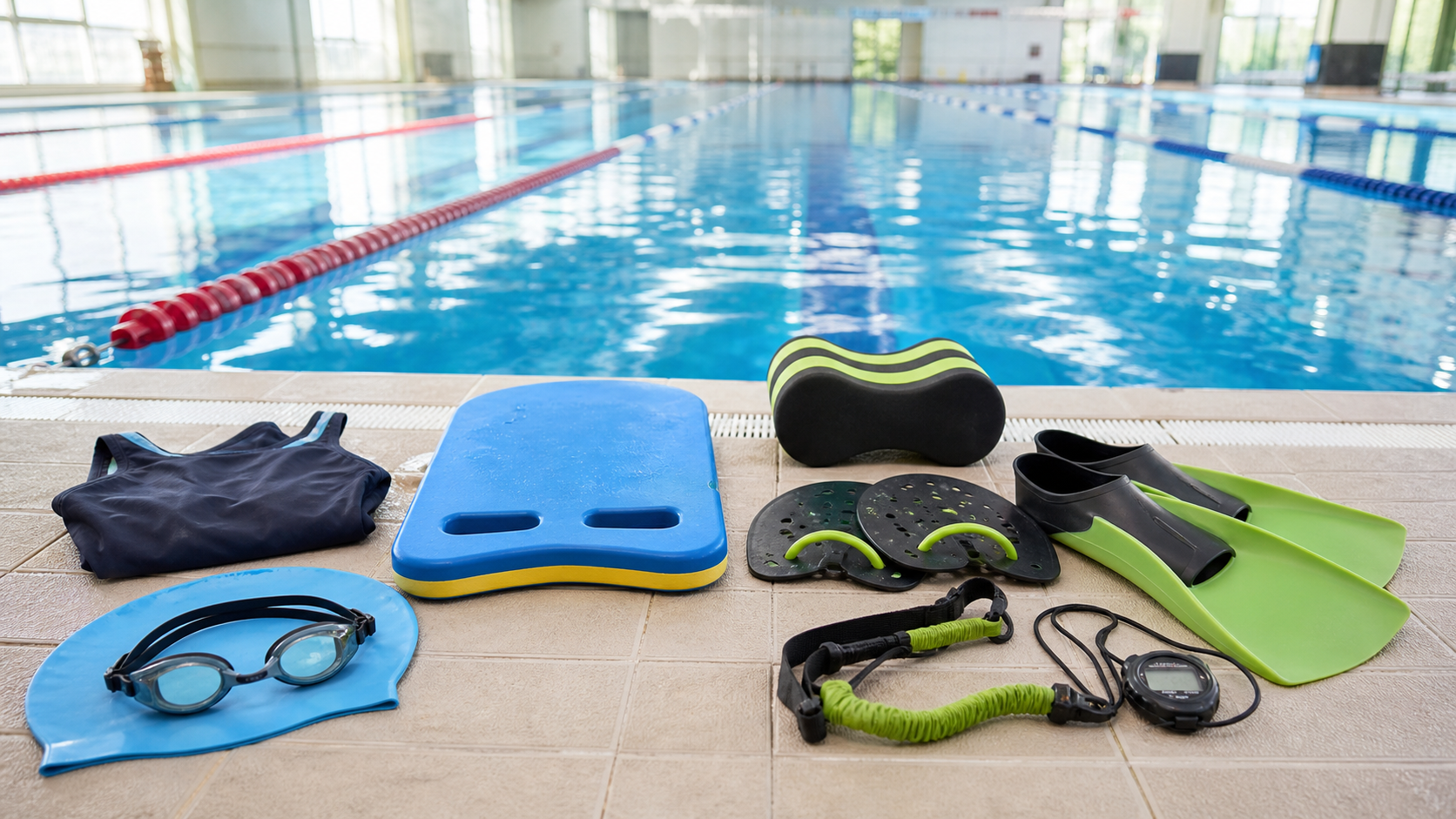
Walking into a swim shop or browsing online shopping platforms, the variety of training tools can be overwhelming: paddles, kickboards, pull buoys, fins, resistance parachutes, training goggles, stopwatches… Which ones are actually “useful”? This article plans the most practical training tool combinations for beginners and advanced swimmers based on training level, ensuring every dollar is well spent.
Basic Principles of Tool Investment
The purpose of training tools is to “amplify training effects,” not to replace proper technique. Before investing in tools, establish the following concepts:
- Tools serve training purposes: Before picking up any tool, you should know what training problem it solves
- Quality over quantity: One good kickboard beats three cheap tools
- Progress step by step: Beginners don’t need and shouldn’t use all advanced tools
- Tools have a shelf life: EVA kickboards last about 3–5 years, silicone swim caps 2–4 years; replace them regularly
Beginner Tool Combination (Within First 6 Months)
Essential Checklist
| Tool | Primary Use | Suggested Budget | Buying Considerations |
|---|---|---|---|
| Goggles | Underwater vision, eye protection | NT$400–1,000 | Try on to confirm a snug fit, medium frame |
| Silicone Swim Cap | Reduce drag, protect hair | NT$200–400 | Silicone material, fits head circumference |
| Standard Kickboard | Leg kick practice | NT$200–350 | Dense EVA, resistant to deformation |
| Training Swimsuit | Worn for every training session | NT$800–2,000 | Chlorine-resistant polyester |
Beginner 4-Piece Set Budget: NT$1,600–3,750
Beginner Tool Usage Recommendations
- Use goggles every training session: Don’t expect “adaptation training” without goggles; build correct habits from the very first session
- Kickboard is used most frequently in the first 2–3 months: Use it every practice when learning kick rhythm
- No need for a pull buoy: Before a beginner’s technique is stable, a pull buoy can actually create incorrect body position habits
Intermediate Swimmer Tool Combination (6 Months–2 Years of Training)
Advanced Checklist (Added on Top of Beginner Combination)
| Tool | Primary Use | Suggested Budget | When to Use |
|---|---|---|---|
| Pull Buoy (Figure-8) | Isolated pull training | NT$250–500 | 2–3 pull sessions per week |
| Finger Paddles (Finis Agility) | Refining pull technique | NT$600–800 | Technique sets, 400–600 m each time |
| Short Fins | Kick power and ankle flexibility | NT$800–1,500 | 1–2 times per week, no more than 1,000 m |
| Streamline Kickboard | Improve body position while kicking | NT$500–1,000 | Replace or pair with standard kickboard |
Intermediate Additional Budget: NT$2,150–3,800
Intermediate Tool Usage Recommendations
- Start with finger paddles: Don’t jump straight to medium or large paddles; first establish proper pull sensation
- Pull buoy use should not exceed 30% of training volume: Excessive tool training neglects leg function
- Choosing fins: Short fins (20–25 cm) are best for swim training; long fins are for diving—don’t mix them up
Advanced Swimmer Tool Combination (2+ Years, with Competition Goals)
Advanced Checklist (Added on Top of Intermediate Combination)
| Tool | Primary Use | Suggested Budget | When to Use |
|---|---|---|---|
| Medium Paddles | Pull strength development | NT$400–700 | Strength training phase, paired with pull buoy |
| Resistance Parachute | Explosive power and speed contrast training | NT$600–1,200 | 8–12 weeks before competition, twice per week |
| Racing Swimsuit | For competition | NT$8,000–20,000 | Competition use only |
| Swim Watch (Garmin Swim 2) | Training data tracking | NT$7,000–9,000 | Every training session |
| Waterproof Heart Rate Strap (Optional) | Heart rate zone training | NT$3,000–4,500 | Aerobic base phase, intensity monitoring |
Advanced Additional Budget: NT$19,000–35,400
Tool Usage Frequency Plan (Example: 5 Sessions per Week)
| Training Day | Primary Tools | Training Focus |
|---|---|---|
| Monday | Pull Buoy + Medium Paddles | Upper body strength (1,500 m pull) |
| Tuesday | Streamline Kickboard + Short Fins | Lower body kick efficiency |
| Wednesday | No tools | Technique swimming (focus on feel) |
| Thursday | Resistance Parachute | Speed contrast training (interval sets) |
| Friday | Finger Paddles | Technique refinement (low intensity) |
Storage and Maintenance Recommendations
- Rinse all tools with clean water after use, especially paddles with crevices
- Choose a mesh gear bag so wet tools can ventilate inside
- Foam tools (kickboards, pull buoys) should avoid prolonged heavy compression to prevent deformation
Conclusion
Investment in swim training tools should be gradual. Beginners only need goggles, a swim cap, a swimsuit, and a kickboard to start training; once you have a foundation, a pull buoy and finger paddles can effectively improve technique; at the advanced stage, add a resistance parachute and speed tools. Understanding the purpose of each tool and planning training content with coach guidance is what truly makes tools effective.
Related Reading
- The Complete Guide to Swimming Gear: Buying Advice for Goggles, Wetsuits, and Training Aids
- Complete Pool Training Plan Guide: Periodized Schedules from Beginner to Advanced Swimmers
- Kickboards and Paddles Serve Different Training Purposes: How to Properly Use Training Aids
- 4-Week Beginner Swimming Plan: First Steps for Complete Newcomers
西進武嶺 免費訓練分析服務 Intervals | 練不夠還是練過頭?你哪一種類型選手?AI模型告訴你! | 備戰神器 | 公路車 訓練 | CT Yeh
4 年前
滑雪新手們慘摔學習全紀錄(請開字幕),滑雪好好玩 | Snowboard + Ski | 岩原 スキー場 | 滑雪APP使用 | GoPro Max
6 年前
沉浸室內單車練功房開箱! 100吋大畫面,最便宜的花費? 居然還能K歌!? | 公路車 | CT Yeh
3 年前
訓練台體驗) 2019台北自行車展 三大家 訓練台體驗 Tacx Neo Flux 2 Xepdo Apx Wahoo Kickr
7 年前
入門車錶王者 iGPSPORT BSC100S 一千元的售價! 超大螢幕、連續兩趟北高的續航、藝術般的APP! Bryton Garmin 兩王地位撼動? | 公路車 | CT Yeh
3 年前
一日北高前的高裝檢 | 北高 360 | 挑戰11小時的裝備 | 一日雙塔 | 補給
6 年前
單車 一日北高 ( 雙城 ) 肥宅雙人瘋狂行 紀錄片 REACTO
10 年前
邁金 T500 訓練台開箱!有下坡輔助、路感模擬、不用插電、直驅電機 !兩萬級距頂規享受新選擇!/ 公路車 / 室內訓練 / CT Yeh
1 年前