Introduction
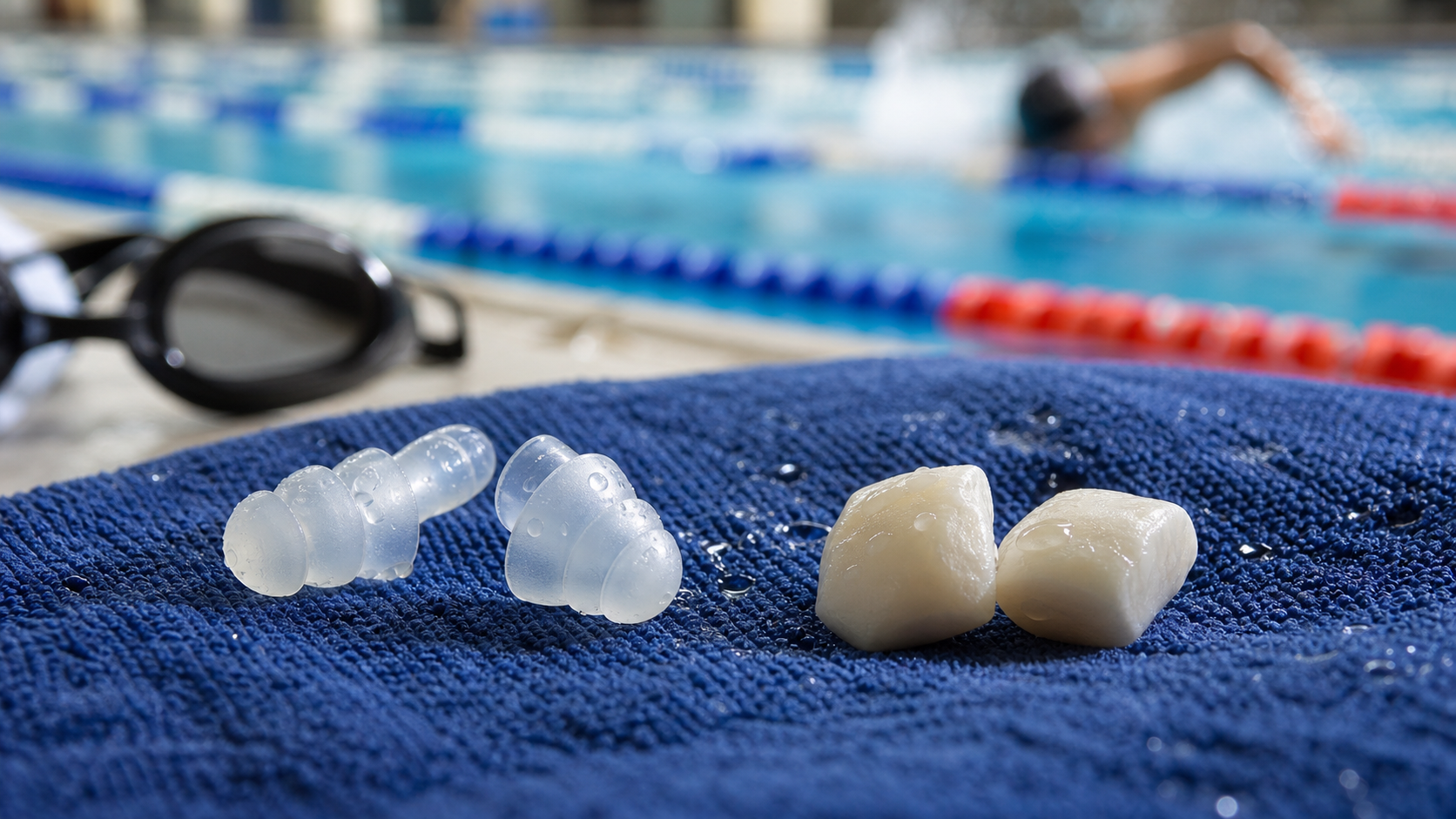
“Swimmer’s Ear” is the common name for otitis externa (outer ear canal infection), which is especially common among swimmers. Letting chlorinated pool water linger in the ear canal for extended periods not only raises the risk of bacterial infection, but can also accelerate earwax softening and damage to the outer ear canal’s skin. For swimmers with a history of ear tube placement, eardrum perforation, or ear surgery, wearing earplugs is a medical necessity. The two most mainstream options on the market are silicone earplugs and wax earplugs. This article takes an in-depth look at comparing their waterproofing performance and practicality.
Core Comparison: Silicone vs. Wax Earplugs
| Comparison Item | Silicone Earplugs | Wax Earplugs |
|---|---|---|
| Waterproof seal | ★★★★☆ Excellent | ★★★★★ Best |
| Wearing comfort | ★★★★☆ Good | ★★★★★ Outstanding |
| Reusability | ★★★★★ Excellent (10–30 uses) | ★★★☆☆ Limited (3–5 uses) |
| Learning curve for fitting | Low (simply insert) | Medium (requires molding by hand) |
| Suitable for children | Requires a children’s size | Can be molded and adjusted |
| Ear canal adaptability | Fixed shape, varies by person | Automatically conforms to ear canal shape |
| Cost per pair | NT$100–400 | NT$80–200 (multiple pairs per pack) |
| Foreign-body sensation after swimming | More noticeable | Less noticeable |
In-Depth Analysis: Silicone Earplugs
Main Material Types
- Rigid silicone earplugs: A fixed mushroom-shaped or tri-flange design that forms a mechanical seal once inserted into the outer ear canal
- Soft moldable silicone earplugs: Similar to wax earplugs, but made of soft silicone that can be shaped into a ball to seal the ear canal opening
- Flanged silicone earplugs: A multi-flange structure that creates multiple seals within the ear canal, offering the strongest waterproofing
Suitable Scenarios
- Everyday swim training: Rigid silicone is the most common choice and easy to use
- Competitive swimmers: Some competitive swimmers avoid earplugs, believing they interfere with the feel for the water, but swimmers with sensitive ears still need to use them
- Children’s swimming: Choose a corded pair connecting both earplugs to prevent loss
Cleaning and Maintenance
- Rinse with clean water immediately after use, and occasionally wash gently with mild soap
- Store in a breathable container, away from high temperatures (to prevent the silicone from deforming)
- Replace immediately if cracks or noticeable deformation appear
In-Depth Analysis: Wax Earplugs
Material and How They Work
Wax earplugs (typically a composite of beeswax and cotton, such as the Macks brand) work through an external seal: after being kneaded into a thin disc, the material is pressed against the outside of the ear canal opening (not inserted into the canal), using the wax’s moldability to completely seal off the ear canal entrance.
Advantages
- Fully conforms to the shape of the ear canal: Regardless of the size or shape of the ear canal, wax earplugs automatically adjust, making them suitable for all ear shapes
- Best waterproof seal: The external-seal design blocks water more completely than an inserted design
- No foreign-body sensation during use: Because it is not inserted into the ear canal, it does not fully block sound conduction and produces no feeling of pressure or expansion
- Medically recommended: For patients with a perforated eardrum or recovering from otitis media, doctors typically recommend wax earplugs
Disadvantages
- Limited number of reuses: The wax becomes dirty and loses its shape after use, and usually needs to be replaced after 3–5 uses
- Requires practice for first-time use: Kneading the wax into a ball and pressing it on correctly takes a few tries to master
- In high water-temperature environments (such as warm pools): The wax may soften excessively due to body heat, reducing sealing effectiveness
Correct Usage Method
- Warm the wax ball in your palm for 30 seconds to make it more moldable
- Knead it into a flat, round disc (avoid shaping it into a pointed form)
- Tilt your head slightly to one side and pull your outer ear back and up to open the ear canal opening
- Press the wax disc so it fully covers the ear canal opening and the surrounding skin
- Once you’ve confirmed there are no gaps, you can enter the water
Groups with Special Needs
- People with ear tubes (after tympanoplasty): Waterproof earplugs are essential; wax or custom-molded silicone earplugs are recommended, and consulting an ENT physician is advised
- Hearing aid users: Hearing aids should be removed before swimming, and silicone earplugs should be used instead
- People with very small ear canals (commonly children): Silicone earplugs generally come in an XS size for children, or moldable wax earplugs can be chosen instead
Recommended Products in the Taiwan Market
- Silicone options: Speedo Biofuse earplugs (tri-flange design, excellent waterproofing), Zoggs Silicone Ear Plugs (flanged seal)
- Wax options: Macks Pillow Soft (a common brand found in American pharmacies, also available at health food stores or sporting goods stores in Taiwan), Chinchin brand swim earplugs
Conclusion
The reusability and low maintenance cost of silicone earplugs make them the top choice for frequent trainers, while the unmatched conformity to ear shape and waterproofing of wax earplugs make them the preferred option for swimmers with sensitive ears, medical needs, or those seeking the best possible waterproofing. It’s recommended that every swimmer keep at least one pair of silicone earplugs on hand for everyday use, along with a pack of wax earplugs as a backup for when ear discomfort arises. Since the two are not mutually exclusive, choosing between them based on the situation is the most comprehensive strategy for protecting your ears.
Related Reading
- Swim Ear Protectors and Nose Clips: A Buying and Proper Usage Guide for Waterproof Protective Gear
- The Complete Swimmer’s Ear Protection Handbook: Preventing Otitis Externa, Ear-Drying Techniques, and Choosing Earplugs
- Swimmer’s Ear Problems: Preventing Otitis Externa and Choosing Ear Protectors
- Underwater MP3 Players: Sound Quality and Ear Canal Fit Review for Waterproof Headphones
單車 重低音 藍芽喇叭 音質實測 SoundBot SB525 Real Sound Test
8 年前
大家都在開箱的...單車用藍芽對講耳機真的有幫助嗎? SENA BiKom 20 長距離旅遊 & 海鷗繞圈賽 實際體驗心得 / 公路車 / CT Yeh
9 個月前
洗單車神器 吹水機! 實際洗車用用看 暴力洗鍊條大法 | 公路車 | CT Yeh
4 年前
詳測) 小米 電動打氣筒 公路車胎要充多久? 值得買嗎? 米家充氣寶 小心燙手!
7 年前
鉅齒紋輪組!? ControlTech MEG-T50 EVO 碳纖維幅條輪組/ 功率對比實驗 / 公路車 / CT Yeh
2 年前
3C開箱) SoundBot 老車升級智慧音響 SB360 藍芽 免持 接收器 Aux in 手機 汽車音響 美國聲霸
7 年前
類空拍神器 Feiyu Pocket 2s (有優惠連結)三軸穩定 運動攝影機 開箱!比GoPro 還強的滑順視角!三小時長時間錄影 行車記錄器 | 環花東365實測 | 公路車 CT Yeh
4 年前
Fitting訓練兩用功率車 ! Thinkrider ST900 完整實測!/ 坡度升降 / 鄰居測試/ smart bike/公路車/ CT Yeh
2 年前