Open Water Navigation Buoy Buying Guide: Safety Float Color Regulations, Inflation Methods, and Usage Guide
Introduction
The risks of open water swimming are far greater than in a pool. Beyond the challenges of currents, water temperature, and visibility, one of the greatest dangers is collision with watercraft (boats, speedboats, jet skis). A safety navigation buoy (Swim Buoy / Tow Float) is the most important piece of safety equipment for open water swimmers, making the swimmer clearly visible on the surface while also serving as an emergency distress signal and providing temporary resting buoyancy.
Safety Float Color Regulations
Internationally Recognized Color Meanings
| Color | Meaning | Recommended Use Case |
|---|---|---|
| Orange / Fluorescent Orange | Emergency distress signal (international maritime standard) | Emergency situations requiring rescue |
| Fluorescent Yellow / Yellow | General water activities, high visibility | Daytime open water swimming |
| Red | High-visibility warning; required by some events | Triathlon races |
| Black | Low visibility (not recommended) | Should be avoided |
| Blue | Used by some events to distinguish categories | Race category identification |
Important Reminder: Taiwan’s Coast Guard Administration and water activity regulations recommend that open water swimmers use fluorescent orange or fluorescent yellow floats to ensure maximum visibility in complex water environments. Black or dark blue floats have extremely low visibility and are absolutely not recommended for open water use in Taiwan.
Current Taiwan Regulations
Although Taiwan’s Water Recreation Activities Management Regulations do not mandate carrying a safety float, many local water management authorities (such as Penghu, Kenting, and the Northeast Coast) have issued local notices recommending or requiring them. It is advisable to check local regulations before heading out.
Safety Float Inflation Design Types
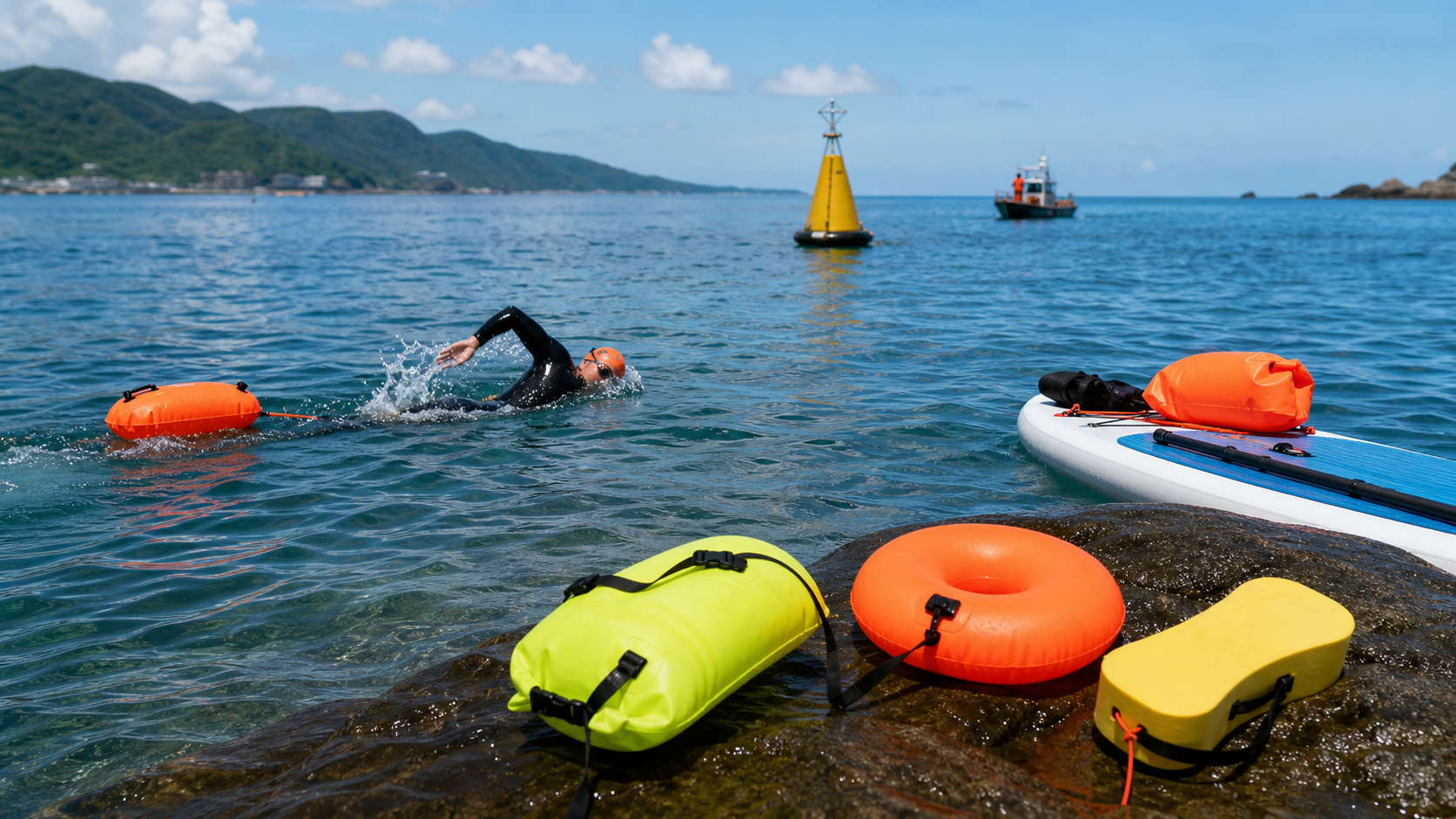
1. Dry Bag Type
Features: The float itself is a sealed air bladder that provides buoyancy when inflated, with an opening designed to store items (phone, supplies).
- Advantages: Combines float and dry bag functions; suitable for carrying supplies on long-distance swims
- Disadvantages: Larger in size; inflation level affects buoyancy; weight of stored items affects buoyancy performance
- Inflation Method: Mouth inflation or mini pump; inflate to 80–90% full (leaving room for thermal expansion)
2. Inflatable Tube Type
Features: Ring-shaped or elongated air bladder that forms a stable ring-shaped float when inflated.
- Advantages: Stable shape, low towing resistance, does not roll easily in water
- Disadvantages: No storage function; slightly larger than dry bag types
3. Fixed Foam Type
Features: Made of EVA or PVC foam; no inflation required; fixed shape.
- Advantages: Zero failure rate (no leak risk), simple maintenance
- Disadvantages: Larger in size; less convenient to carry than inflatable types
Inflation Precautions
- Check air tightness before every use: Inflate the float and let it sit for 5 minutes to confirm there is no air leakage
- Do not over-inflate: Especially in summer high temperatures, gas expansion from heat can cause the bladder to burst; it is recommended to inflate to 80–90%
- Re-check that the inflation valve is tightened before entering the water: A loose inflation valve is the most common cause of air leakage
Belt and Tow Line Design
The safety float is secured to the swimmer’s waist with a waterproof belt, with tow line lengths typically ranging from 0.8–1.5 m.
Selection Key Points
- Belt Material: Nylon or neoprene; must be quickly adjustable and must not come loose during swimming
- Quick-Release Buckle: Allows the belt to be quickly released in an emergency, especially if the float gets snagged
- Tow Line Length: 0.8–1 m suits swimmers with smaller stroke movements; 1.2–1.5 m allows the float to tow more smoothly
- Tow Line Material: Silicone tow lines tangle less easily than nylon ones
Usage Tips
First-Time Training
- First get used to the weight of towing the float in a pool (typically no more than 200 g when fully inflated, so the impact is minimal)
- When turning, be careful that the float does not wrap around your legs
- During breaststroke, pay attention to the tow line position to avoid interfering with leg movements
Emergency Use
- When exhausted, you can hold onto the float and rest on its buoyancy
- When in need of rescue, raise the float and wave it—the visual effect of fluorescent colors on the water surface is far superior to waving your arms
Recommended Brands in the Taiwan Market
- Orca Open Water Safety Buoy: Inflatable dry bag type, 28L capacity, available through Taiwan distributors
- Zone3 Swim Safety Buoy: British brand, lightweight inflatable type, excellent tow line design
- Huub Safety Tow Float: Entry-level option with great value for money; suitable for first-time buyers
- Local brands (Taiwan 3C or outdoor stores): Basic fluorescent orange inflatable types available from NT$400–800
Recommended Open Water Swimming Locations in Taiwan
| Location | Recommended Color | Recommended Float Type | Notes |
|---|---|---|---|
| Kenting Longkeng | Fluorescent Orange | Dry bag type | Stronger currents; high buoyancy needed |
| North Coast Fulong | Fluorescent Yellow/Orange | Inflatable ring type | Watch for surfing activity areas |
| Penghu Bay | Fluorescent Orange | Any type | Confirm local water area regulations |
| Hualien Yanliao | Fluorescent Yellow | Dry bag type | High water clarity; carrying supplies is important |
Conclusion
The safety float is the one piece of equipment that should never be omitted in open water swimming. Its cost is low (NT$400–2,000), yet it can save your life at a critical moment. When purchasing, choose fluorescent orange or fluorescent yellow as your first-choice colors, ensure the inflation design is reliable, and confirm the belt’s quick-release buckle functions properly. Taking 3 minutes before every swim to inflate and perform safety checks is a good habit that every serious open water swimmer should develop.
Related Reading
- Using Buoys in Open Water Swimming: Safety Aids and Competition Rules
- Open Water Swimming Floats: Dual-Function Analysis of Safety Visibility and Supply Storage
- Complete Guide to Swim Floats and Safety Gear: A Lifesaver for Open Water Swimmers
- Night Swimming Techniques in Open Water: Glow Sticks, Light Signals, and Safety Guidelines
大家都在開箱的...單車用藍芽對講耳機真的有幫助嗎? SENA BiKom 20 長距離旅遊 & 海鷗繞圈賽 實際體驗心得 / 公路車 / CT Yeh
9 個月前
CT 喇低賽) 武嶺牽車 才是王道 西進牽車四小時內秘訣 攝手位置 如何判斷 防抽筋小秘訣
7 年前
公路車 BB培林大升級! / 備戰海鷗繞圈賽 Canyon Aerod & TIME 一起改 / MIT大廠 CEMA對鎖式陶瓷培林BB & 導輪 / 公路車 / CT Yeh
2 年前
用了AirTag 單車就不怕被偷?盲點大測試 結果… |公路車|CT Yeh
5 年前
2026 車錶排行榜!誰是最多車友正在使用?練家子最愛哪款?🏆 (2萬名車友數據) / 公路車 / CT Yeh
5 個月前
多到選擇障礙... 換個單車把帶想一個小時 / BTP / 編織&軟木特有材質超吸睛! / 公路車 / CT Yeh
1 年前
超開放的自行車錶!可以玩遊戲裝APP!?/ SRAM合併的 Hammerhead Karoo深入開箱!/ 即時爬坡偵測 / 全球導航地圖 / Garmin Bryton / CT Yeh
1 年前
一日北高 實用 單車手機架!Bone蹦克磁吸單車手機綁 //環島/室內訓練 / 導航的APP推薦 / 日本島波海道取景 / 公路車 / CT Yeh
2 年前