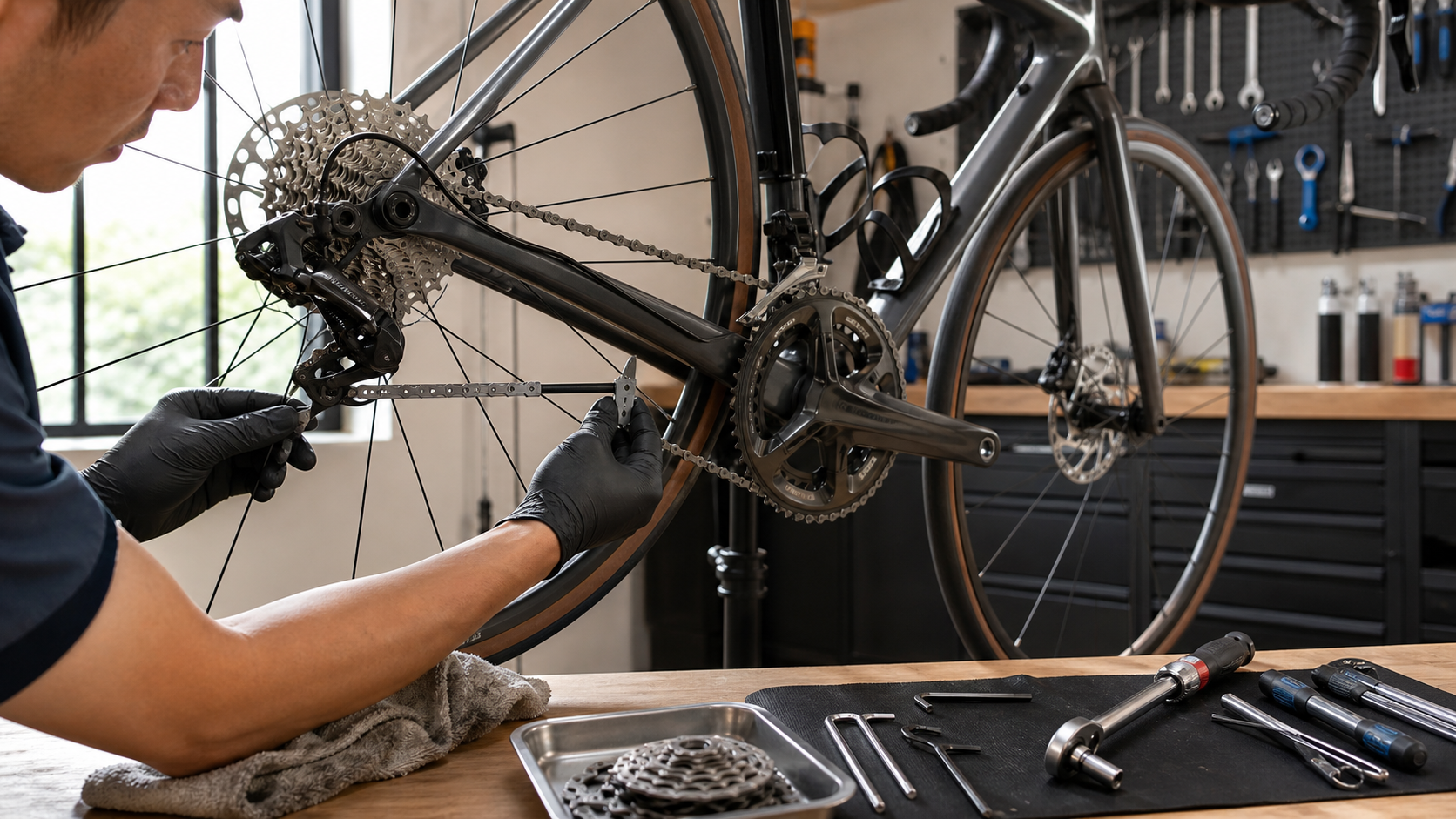
Annual Maintenance Checklist: 15 Comprehensive Bicycle Maintenance Tasks You Must Do Every Year
Introduction
Most riders perform basic chain lubrication and tire pressure checks on a regular basis, but for deeper component wear and system condition, they often wait until something “breaks before fixing it.” However, many bicycle components go through a period of “gradual degradation” before they completely fail—during this time, you may not notice anything unusual, but drivetrain efficiency and safety are already quietly declining. An annual comprehensive maintenance allows you to catch problems early and avoid surprises before long rides or important races.
When to Schedule Annual Maintenance
- Average riders (under 5,000 km/year): Once a year, ideally before the spring riding season
- High-intensity riders (5,000–10,000 km/year): Every six months
- After the rainy season: Perform a full inspection after the plum rain season ends
The 15-Item Annual Maintenance Checklist
Drivetrain (Items 1–5)
1. Chain Replacement Assessment
Use a chain wear indicator to check elongation:
- Below 0.5%: Normal, continue using
- 0.5–0.75%: Replacement recommended
- Above 0.75%: Replace immediately
Riders covering 5,000 km per year typically need to replace 1–2 chains annually.
2. Cassette Wear Inspection
Check the cassette teeth for a “shark tooth” shape (normal teeth are symmetrical trapezoids; after wear, one side becomes pointed). If the chain was only replaced after exceeding 1% elongation, the cassette will most likely also need replacement at the same time.
3. Chainring Inspection
Same as the cassette, visually inspect the tooth shape. Chainrings typically last about 2–3 chain lifetimes.
4. Shift Cable and Brake Cable Replacement
Steel cables are recommended to be replaced once a year (especially in Taiwan’s humid environment). Wear criteria:
- Outer housing has cracks or deformation
- Inner cable has broken strands or visible rust
- Brake lever feel is noticeably stiffer than when the cable was freshly installed
5. Rear Derailleur Hanger Replacement
Aluminum derailleur hangers are designed as consumable parts. If there is a history of crashes or impacts, replace it directly—do not attempt to bend it back into shape and continue using it.
Brake System (Items 6–7)
6. Brake Pad Thickness Check
| Type | Replacement Standard |
|---|---|
| V-brake pads | Grooves worn away, or thickness less than 1mm |
| Disc brake resin pads | Thickness below 1.5mm |
| Disc brake metallic pads | Thickness below 1mm |
7. Rotor Thickness Check
The minimum thickness specification is stamped on the edge of the rotor (usually 1.5mm or 1.8mm). Measure with a caliper; replace immediately if below the stated value. Rotors with uneven wear (visible grooves) also need replacement.
Wheelset System (Items 8–9)
8. Spoke Tension and Wheel Truing
Annual wheel truing:
- Use the pluck method to confirm spoke tension is roughly even (similar pitch)
- Mount the wheel on the bike and spin it to confirm there is no obvious lateral wobble or hop
- If obvious issues exist, true the wheel manually or take it to a bike shop
9. Hub Bearing Inspection
Perform the lateral play test (see the hub maintenance article). If there is noticeable play or a gritty feeling, clean or replace the bearings.
Frame and Headset (Items 10–11)
10. Headset Cleaning and Lubrication
Disassemble the headset at least once a year, clean the bearings, and apply fresh grease. In Taiwan’s rainy environment, every six months is recommended. (See the headset maintenance article for details.)
11. Carbon Fiber Structure Visual Inspection
Perform a thorough visual and tactile inspection of the carbon frame:
- Visual: Check for cracks, bubbling, or signs of delamination
- Tactile: Run your fingers over the bottom bracket, seat stays, and fork crown to check for any abnormal bumps or depressions
- Tap test: Lightly tap suspicious areas with a coin and listen for an even sound
Bottom Bracket and Seatpost (Items 12–13)
12. Bottom Bracket Noise Inspection and Maintenance
If you hear a rhythmic clicking sound while pedaling, the bottom bracket is the first suspect. During annual maintenance, remove the crankset, clean the bottom bracket shell threads, apply fresh grease, and reinstall. This can prevent noise from developing.
13. Seatpost Cleaning and Reapplication of Anti-Seize Compound
Annually remove the seatpost, clean the insertion end and the inside of the seat tube, reapply carbon anti-seize compound or grease, confirm sufficient insertion depth, and retighten to the specified torque.
Safety (Items 14–15)
14. Full-Bike Bolt Torque Verification
Use a torque wrench and check in the following order of priority:
| Component | Recommended Torque Range |
|---|---|
| Stem clamp (carbon steerer) | 4–5 Nm |
| Stem clamp (aluminum steerer) | 8–10 Nm |
| Handlebar face plate | 5–7 Nm |
| Seatpost clamp (carbon post) | 4–6 Nm |
| Pedals (left side is reverse-threaded) | 35–40 Nm |
| Front and rear quick releases (verify clamping force) | Verify by feel |
15. Overall Brake System Safety Test
Finally, perform a complete safety ride test:
- Stationary: Pull each brake lever individually and confirm the bike cannot be pushed forward or backward
- Low-speed riding: Test the braking effect of the front and rear brakes separately
- Shifting test: Confirm smooth shifting across all gears
Annual Maintenance Tool Checklist
- Torque wrench (0–15 Nm)
- Chain wear indicator
- Hex wrench set (2–8mm)
- Various specialized tools (prepare as needed)
- Carbon anti-seize compound, grease
- Degreaser, cleaning brushes
Conclusion
An annual comprehensive maintenance may sound complicated, but if you break it down across a few weekends, handling 3–4 items at a time, the whole process is actually quite manageable. You don’t need to do everything yourself—drivetrain replacement, wheel truing, and headset service can be left to your bike shop, while you handle daily cleaning and safety checks yourself. What matters most is establishing this annual review habit, keeping your beloved bike in a reliable, optimal condition at all times.
Related Reading
- Bicycle Maintenance Calendar: Every Ride, Every Month, Every Year Maintenance Items
- Bicycle Periodic Maintenance Schedule: A Complete Checklist from Daily to Annual
- Bicycle Repair and Maintenance Annual Plan: Complete SOP for Monthly, Quarterly, and Annual Maintenance
- Road Bike Annual Maintenance Checklist: Monthly, Quarterly, and Yearly Maintenance Items
2025 自行車錶排行榜 兩萬車友大數據 / Garmin Bryton 排名會大洗牌嗎? / 全新的碼表前身分析 /公路車 / CT Yeh
1 年前
碟煞公路車 銑面器 !? 原來銑完差這麼多! 降低蹭碟機率! | TIME 公路車 保養小記錄 | CT Yeh
3 年前
2022 前十五大自行車錶 !? 兩萬名車友大數據統計 | 你的上榜了嗎? | 菁英車友都用哪些錶? | Bryton Garmin 誰能拔得頭籌?| 車錶推薦 | 公路車 CT Yeh
4 年前
#公路車 #Fitting 靠人工智慧APP 幫你調整單車
6 年前
洗單車神器 吹水機! 實際洗車用用看 暴力洗鍊條大法 | 公路車 | CT Yeh
4 年前
高雄綠園道鐵路自行車道 / 外地人能輕鬆駕馭 還是整路崩潰? / 2025 全線開通 春節實地探索一次!(附GPS連結)/ 公路車 / CT Yeh
1 年前
2026 車錶排行榜!誰是最多車友正在使用?練家子最愛哪款?🏆 (2萬名車友數據) / 公路車 / CT Yeh
5 個月前
Canyon 公路車斷把手 五年老車特規還能修嗎? 維修保養全記錄 feat. 501單車監理站 | 公路車 | CT Yeh
4 年前