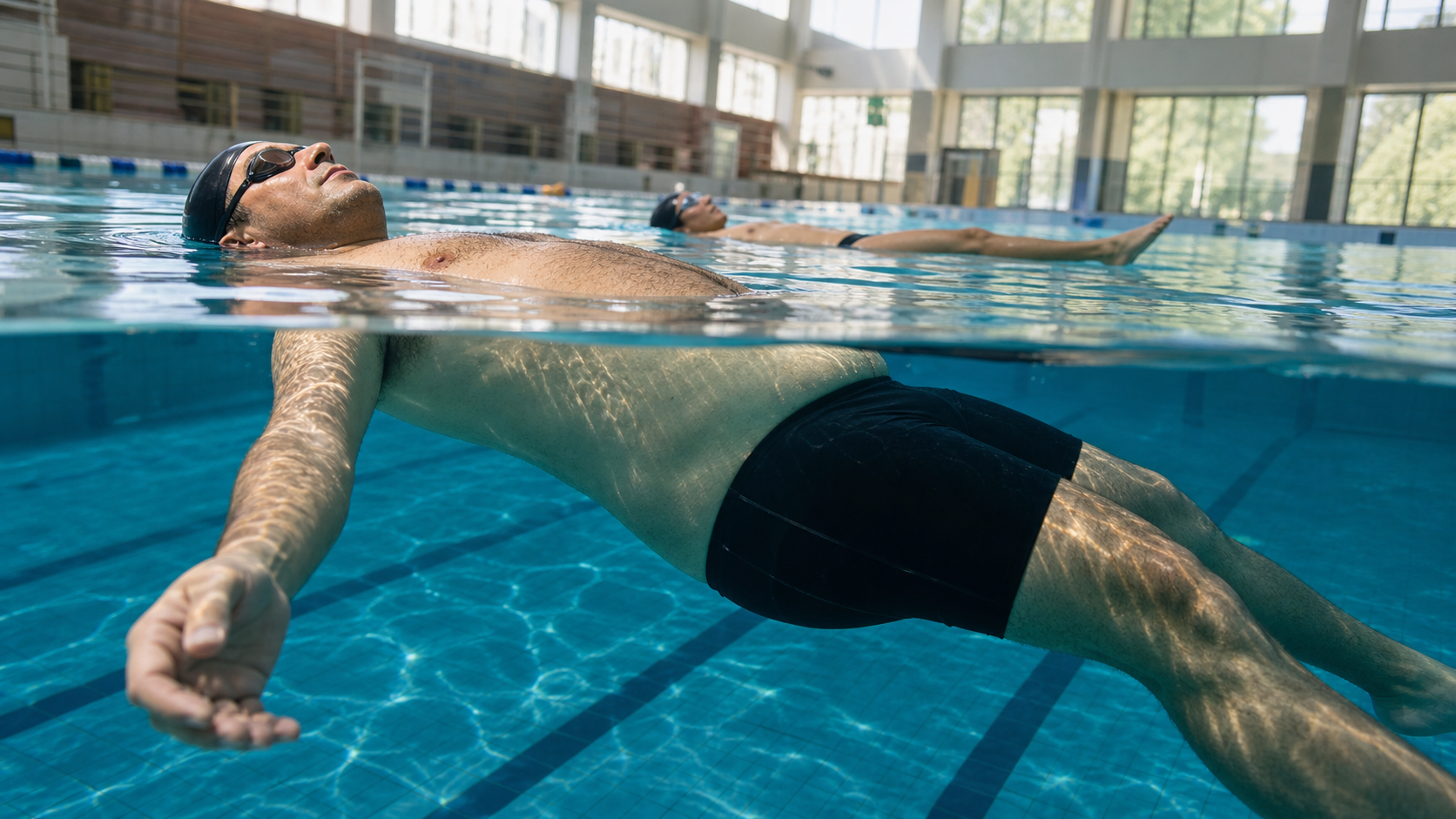
Buoyancy: Swimming’s Invisible Advantage
“Why do I sink the moment I relax, while my swim buddy floats with ease?” This is a common source of confusion for beginner swimmers. The answer comes from Archimedes’ Principle — buoyancy equals the weight of water displaced by an object — but the real difference lies in each person’s unique body composition. Understanding buoyancy can help swimmers build a technique strategy suited to their own body.
Archimedes’ Principle and Swimming Buoyancy
Archimedes’ Principle tells us that the buoyant force acting on a body in water equals the weight of the water it displaces. Take a person weighing 70 kg as an example:
- If their body volume displaces 72 kg of water, they will float
- If their body volume displaces only 68 kg of water, they will sink
- The key factor is whether average body density is lower than water (1.0 g/cm³)
Density Comparison of Body Tissues
| Tissue Type | Density (g/cm³) | Effect on Buoyancy |
|---|---|---|
| Fat tissue | ~0.9 | Positive (lighter than water, aids flotation) |
| Skeletal muscle | ~1.06 | Negative (heavier than water, reduces buoyancy) |
| Bone | ~1.5–2.0 | Strongly negative |
| Lungs (inflated) | ~0.3–0.5 | Strongly positive |
| Blood | ~1.04–1.06 | Slightly negative |
This table reveals why body composition has such a profound effect on swimming buoyancy.
The Key Role of Body Fat Percentage
Every 1% increase in body fat percentage lowers average body density by roughly 0.001–0.002 g/cm³. That may sound small, but in water it matters a great deal.
The practical effect of body fat percentage on buoyancy:
- Body fat < 10% (e.g., marathon runners, lightweight cyclists): average body density approaches or exceeds 1.05 g/cm³, tending to sink in water and requiring continuous kicking to maintain a horizontal position
- Body fat 10–18% (typical male athletes): body density around 1.02–1.04 g/cm³, requiring mild effort to stay afloat
- Body fat 18–25% (typical adult male): close to neutral buoyancy, relatively easy to float
- Body fat > 25%: body density below that of water, good natural buoyancy, but also relatively higher drag
Because of physiological fat-distribution patterns (thicker subcutaneous fat, especially around the hips and thighs), women on average have better buoyancy than men — part of the reason women often excel in elite long-distance swimming events such as the English Channel crossing.
The Double-Edged Effect of Muscle Mass
Muscle density (about 1.06 g/cm³) is heavier than water, so the more muscle mass a person has, the worse their buoyancy — creating an interesting paradox:
Advantages and disadvantages of high muscle mass:
- ✅ Greater propulsive force, especially pulling power in the arm stroke
- ✅ Higher metabolic rate, which aids long-distance endurance
- ❌ Poorer natural buoyancy, requiring more kicking energy to keep the body near the surface
- ❌ The lower body (where muscle mass is greatest) tends to sink, disrupting a streamlined body position
Triathletes, due to extensive cycling training, often carry high lower-body muscle mass (especially in the quadriceps), causing their legs to sink readily while swimming — a phenomenon that deserves particular attention.
The Lungs: The Most Powerful Buoyancy Organ
Many swimmers overlook the critical role the lungs play in buoyancy. Air-filled lungs have an extremely low density (about 0.3 g/cm³) and contribute enormously to overall buoyancy.
- After a deep inhale, chest cavity volume increases by roughly 3–4 liters
- This extra volume can provide about 3–4 kg of additional buoyancy
- This is why “it’s easier to float while inhaling, and easier to sink after exhaling”
Applying buoyancy to breathing strategy:
- When practicing a dead man’s float, keeping the lungs half-inflated is the most effortless state
- Breathing rhythm in competitive swimming should avoid exhaling too early, maintaining a certain lung volume
Ethnic and Genetic Factors
Research shows that bone density varies across different ethnic groups, affecting swimming buoyancy:
- People of African descent tend to have higher average bone density (roughly 5–10% higher), which may be one physiological factor behind the historically smaller number of elite Black swimmers (of course, social, cultural, and resource factors are equally important)
- East Asian populations tend to have relatively lower bone density, giving a slight buoyancy advantage
Swimming Strategies for Different Buoyancy Body Types
Strategies for low-buoyancy swimmers (muscular build, low body fat):
- Strengthen the kick: Use a two-beat kick (two kicks per arm stroke) to maintain surface height
- Extend the front reach: Lengthen the glide after hand entry so the body settles naturally into a horizontal position
- Use a kickboard for assisted training: Squeeze the board between the feet to artificially float the lower body while focusing on stroke technique
- Engage the core: Actively brace the abdomen to prevent excessive lumbar extension that causes the legs to sink
- Head position: Keep the head from lifting too high, maintaining a neutral cervical spine
Strategies for high-buoyancy swimmers (higher body fat):
- Make the most of natural buoyancy: There’s no need to over-kick — focus energy instead on stroke efficiency
- Watch for drag: A larger body volume creates more form drag, making a streamlined position even more important
- Long-distance advantage: High buoyancy is especially beneficial in long-distance swimming (such as triathlon or open water), since less energy is needed to maintain a horizontal position
A Practical Test: Assess Your Own Natural Buoyancy
- Static float test: After a deep inhale, relax completely and float face-down for 10 seconds, observing your foot position
- Feet near the surface = good buoyancy
- Feet at roughly a 45° angle = moderate buoyancy
- Feet sinking vertically = poor buoyancy
- Exhale test: Slowly exhale and observe how your body position changes — you can directly feel how much the lungs contribute to buoyancy
Conclusion
Buoyancy is not a pure gift of talent — it is a physiological parameter jointly determined by body fat percentage, muscle mass, bone density, and lung capacity. Only by understanding your own buoyancy characteristics can you build the swimming technique strategy best suited to you — rather than blindly imitating swimmers with a different body type. Low-buoyancy, muscular swimmers and high-buoyancy swimmers with more body fat need completely different technical adjustments, and that is exactly what lies at the heart of swimming science coaching.
Related Reading
- The Physics of Swimming Buoyancy: How Body Fat Percentage and Lung Capacity Affect Flotation
- Saltwater vs. Freshwater: How Buoyancy Differences Affect Open Water Swimming
- Swimming Training for Overweight Swimmers: Designing an Effective Fat-Loss Program Around a Buoyancy Advantage
- The Science of Drag in Swimming: Streamlined Technique and Energy Expenditure
靠單車減肥35公斤 心得分享與整理
7 年前
戰略) Zwift Race 如何咬在第一集團 如何評估自己要開多少推力 (請開1.5倍速看)
7 年前
一日北高/長距離團騎 常見問題補充篇 / 組團或跟團的眉角 / 壯車友容易被瘦車友慢性拉爆 / 原來屁股痛可能是這個原因...? / 風場配速法 / 公路車 / CT Yeh
2 年前
一日北高常見問題大集合 | 攻略 | 路線 | 訓練 | 補給 | 自行車 單車 | 一日雙城 | 雙塔 | TWB北高360 | 屁股痛
6 年前
Nepest NOVA 碳條輪組:輕量、空力、舒適一次滿足!/ 公路車 / CT Yeh
7 個月前
#公路車 #Fitting 靠人工智慧APP 幫你調整單車
6 年前
西進武嶺 免費訓練分析服務 Intervals | 練不夠還是練過頭?你哪一種類型選手?AI模型告訴你! | 備戰神器 | 公路車 訓練 | CT Yeh
4 年前
16/02/16 - 夜訪中社路 緩慢進步中
10 年前