Muscle Recruitment in Swimming: A Breakdown of the Primary and Assisting Muscle Groups in the Freestyle Arm Pull
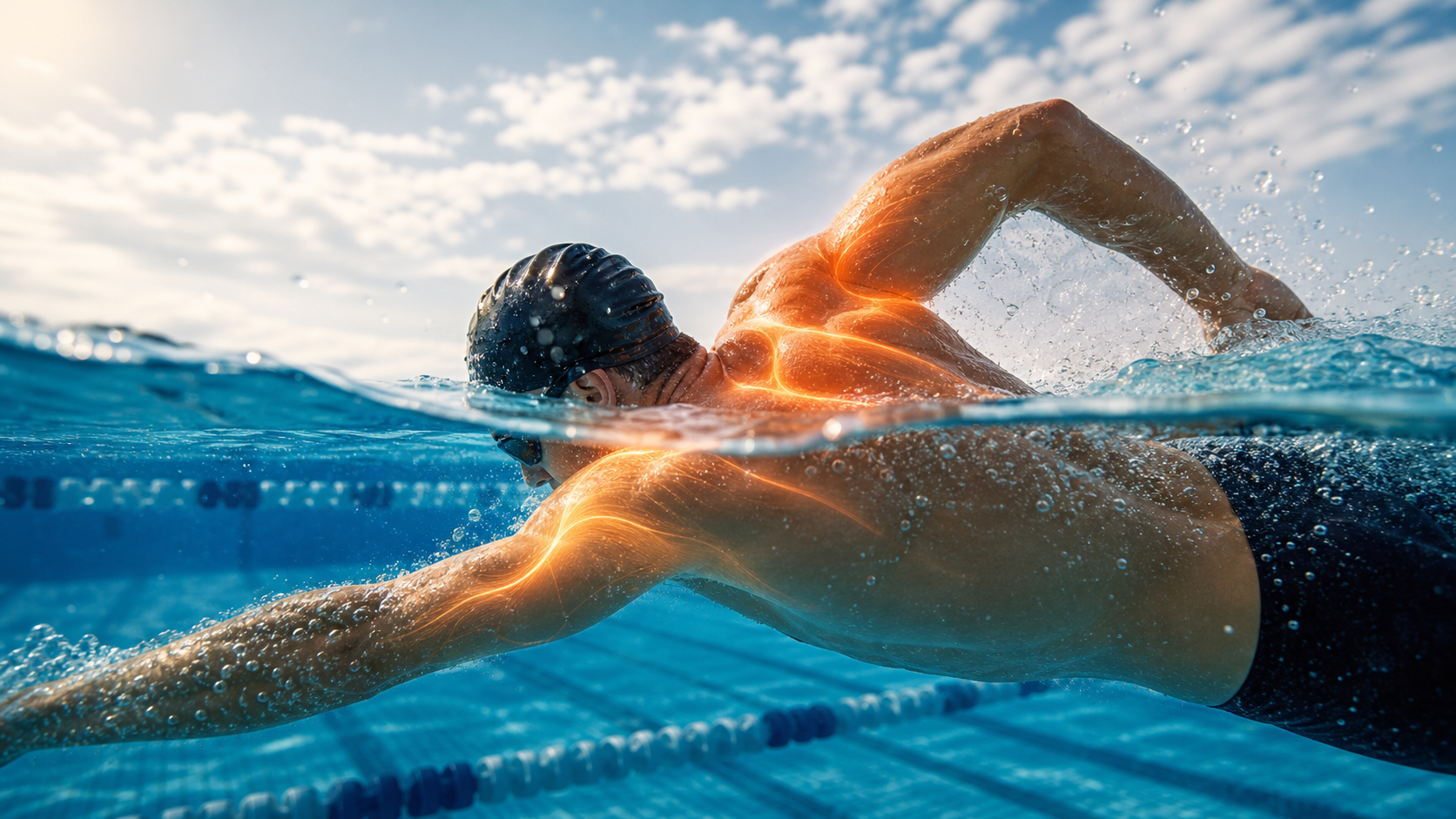
The Science of Swimming Muscles: Far More Complex Than It Looks
Many people assume swimming is mainly an arm exercise. In reality, a single complete freestyle arm-pull cycle involves the coordinated action of more than 20 major upper-body muscles, combined with core and lower-limb engagement, making swimming close to a full-body sport. Understanding which muscles fire at which moment is critical for improving training efficiency, preventing shoulder injuries, and designing effective dryland training programs.
The Four Biomechanical Phases of the Freestyle Arm Pull
| Phase | Name | Description | Approximate Duration |
|---|---|---|---|
| Phase 1 | Entry & Catch | Hand enters the water; elbow rises high in preparation to catch the water | About 15–20% |
| Phase 2 | Early Pull | Sensing water pressure and establishing the pull direction | About 10–15% |
| Phase 3 | Pull-through | Elbow flexes and the palm pushes water backward | About 30–35% |
| Phase 4 | Push & Exit | Palm pushes past the outer thigh and the arm exits the water | About 30–40% |
Key Muscle Groups by Phase
Phase 1: Entry & Catch
Primary muscles:
- Serratus Anterior: Responsible for scapular protraction, allowing the arm to reach fully forward. A weak serratus anterior is the main reason many swimmers cannot achieve a proper “front extension”
- Lower Trapezius: Assists in upward rotation and elevation of the scapula, providing a stable base for hand entry
- Rotator Cuff: The supraspinatus, infraspinatus, teres minor, and subscapularis work together to stabilize the shoulder joint
Common errors and their muscular causes:
- Elbow crossing the body’s midline on entry: usually caused by the anterior deltoid overdominating while the serratus anterior is underactive
- Insufficient entry depth (slapping the water): poor coordination between the serratus anterior and the rotator cuff
Phase 2: Catch (High Elbow Catch)
The High Elbow Catch (HEC) is central to modern freestyle technique and requires precise control from specific muscle groups.
Primary muscles:
- Flexor Carpi Radialis and Flexor Carpi Ulnaris: Maintain a slight wrist flexion so the palm faces directly backward
- Pronator Teres: Controls forearm pronation so the palm faces backward correctly rather than downward
- Brachioradialis: Assists elbow flexion to maintain the high-elbow position
- Middle Deltoid: Provides stability with the shoulder in an abducted position
Phase 3: Pull-through
This phase generates the greatest propulsive force in the entire arm pull and is also the point of highest energy expenditure.
Primary muscles (propulsion generators):
- Latissimus Dorsi: The dominant propulsive muscle, responsible for shoulder extension. Latissimus dorsi strength is one of the most important determinants of freestyle speed. Electromyography (EMG) studies show that latissimus dorsi activity during the pull-through can exceed 90% of maximum voluntary contraction (MVC)
- Pectoralis Major: Assists shoulder adduction, supplementing the propulsion generated by the latissimus dorsi. Its contribution peaks in the middle of the pull-through (roughly 40–60% MVC)
- Teres Major: The latissimus dorsi’s “little helper,” assisting shoulder extension and internal rotation
- Triceps Brachii: Handles elbow extension in the latter part of the pull-through, completing the push phase
Stabilizing muscles:
- Rotator Cuff: Remains active throughout the pull-through to prevent impingement of the humeral head in the subacromial space
- Rhomboids: Stabilize the scapula, providing the foundation on which the latissimus dorsi and pectoralis major act
Phase 4: Push & Exit
Primary muscles:
- Triceps Brachii: Responsible for full arm extension, completing the final push
- Posterior Deltoid: Assists in rotating the arm outward as it exits the water
- Upper Trapezius: Elevates the shoulder, initiating the arm’s exit from the water
The Core Muscles’ Role Throughout the Stroke
Core muscles are often overlooked in freestyle, yet they form the foundation of pulling efficiency throughout the stroke:
| Core Muscle | Function in Swimming |
|---|---|
| Transversus Abdominis | Stabilizes the spine and prevents excessive lumbar extension |
| Multifidus | Provides segmental stabilization of the lumbar spine, transmitting pulling force to the lower body |
| Obliques (internal and external) | Control the body’s axial rotation (roll), improving pull efficiency |
| Quadratus Lumborum | Stabilizes the pelvis, preventing excessive pelvic rotation during the kick |
Research shows that in swimmers with weaker core strength, the first technical breakdown to appear after fatigue is excessive lumbar extension (the legs sinking), which underscores the foundational role of the core in swimming.
Kicking and the Lower-Limb Muscles
Although the freestyle kick contributes relatively less propulsion than the arm pull (roughly 10–20%), the role of the lower-limb muscles should not be overlooked:
- Gluteus Maximus: Extends the hip and is the main source of power for the downbeat
- Hamstrings: Assist with slight knee flexion, generating the kick’s undulation
- Quadriceps: The primary muscle group for the upbeat (knee extension)
- Gastrocnemius and Soleus: Plantarflex the ankle, providing the final whip-like effect of the kick
The Most Common Swimming Muscle Injuries and How to Prevent Them
| Injury | Affected Muscles/Structures | Cause | Prevention Focus |
|---|---|---|---|
| Swimmer’s Shoulder | Rotator cuff, subacromial bursa | Strength imbalance between internal and external rotators | Strengthen the external rotators (antagonists to the subscapularis) |
| Posterior Neck Pain | Neck extensors | Excessive neck rotation during breathing | Breathing technique training, neck mobility work |
| Breaststroker’s Knee | Medial collateral ligament, adductors | Excessive valgus stress from the breaststroke kick | Reduce training volume, improve kick angle |
Dryland Training Recommendations
For swimming’s primary muscle groups, the following are the most effective dryland exercises:
- Pull-ups: Strengthen the latissimus dorsi, the functional movement closest to the freestyle pull
- TRX Row: Trains the back muscles, particularly the rhomboids and middle trapezius
- Lat Pulldown with Bands: Simulates the arm pull in an upright position, reinforcing the neuromuscular connection
- Side Plank: Strengthens the obliques, improving axial body rotation
- External Rotation Exercises: Prevent swimmer’s shoulder by balancing rotator cuff strength
- Serratus Push-up (Push-up Plus): Specifically targets the serratus anterior, improving front-extension capability
Conclusion
The muscle science of the freestyle arm pull tells us that swimming is never just an “arm exercise.” The precise coordination of the latissimus dorsi, pectoralis major, rotator cuff, core muscles, and kicking lower-limb muscles together produces a smooth, efficient freestyle stroke. Understanding the function of these muscle groups not only helps swimmers train technique more consciously, but also enables the design of targeted dryland programs that strengthen the muscular foundation for swimming performance even when out of the water.
Related Reading
- The Activation Sequence of Swimming Muscles: Coordinating the Shoulders, Lats, and Triceps
- Muscle Activation Patterns in Swimming: Which Muscle Groups Matter Most
- Muscle Adaptation in Swimming: Priority Development of the Lats, Deltoids, and Core
- A Complete Guide to Improving Freestyle Technique: Key Details from the Pull to the Kick
西進武嶺 免費訓練分析服務 Intervals | 練不夠還是練過頭?你哪一種類型選手?AI模型告訴你! | 備戰神器 | 公路車 訓練 | CT Yeh
4 年前
CT 喇低賽) 武嶺牽車 才是王道 西進牽車四小時內秘訣 攝手位置 如何判斷 防抽筋小秘訣
7 年前
一起升級!海鷗盃LSD團練...JJSC Zone2招待 騎到手抖 / 公路車 / CT Yeh
1 天前
2026 輪霸西濱200K 挑戰VLOG / 第一集團 / 首次參加..經驗不足、膀胱不足 /死守6H內 / AI戰鬥力顯示系統 / 公路車 / CT Yeh
4 個月前
一日北高/長距離團騎 常見問題補充篇 / 組團或跟團的眉角 / 壯車友容易被瘦車友慢性拉爆 / 原來屁股痛可能是這個原因...? / 風場配速法 / 公路車 / CT Yeh
2 年前
戰略) Zwift Race 如何咬在第一集團 如何評估自己要開多少推力 (請開1.5倍速看)
7 年前
西進武嶺 自製新版AI配速表產生器 x 賽前攻略 抱佛腳! 沒有功率計也可以產生配速表嗎?有什麼其他眉角賽前要注意的呢? | 西進武嶺 / 東進武嶺 KOM 攻略 | 公路車 | CT Yeh
4 年前
靠單車減肥35公斤 心得分享與整理
7 年前