Cold Water Adaptation in Swimming: Effects of Water Temperature on Heart Rate, Metabolic Rate, and Oxygen Consumption
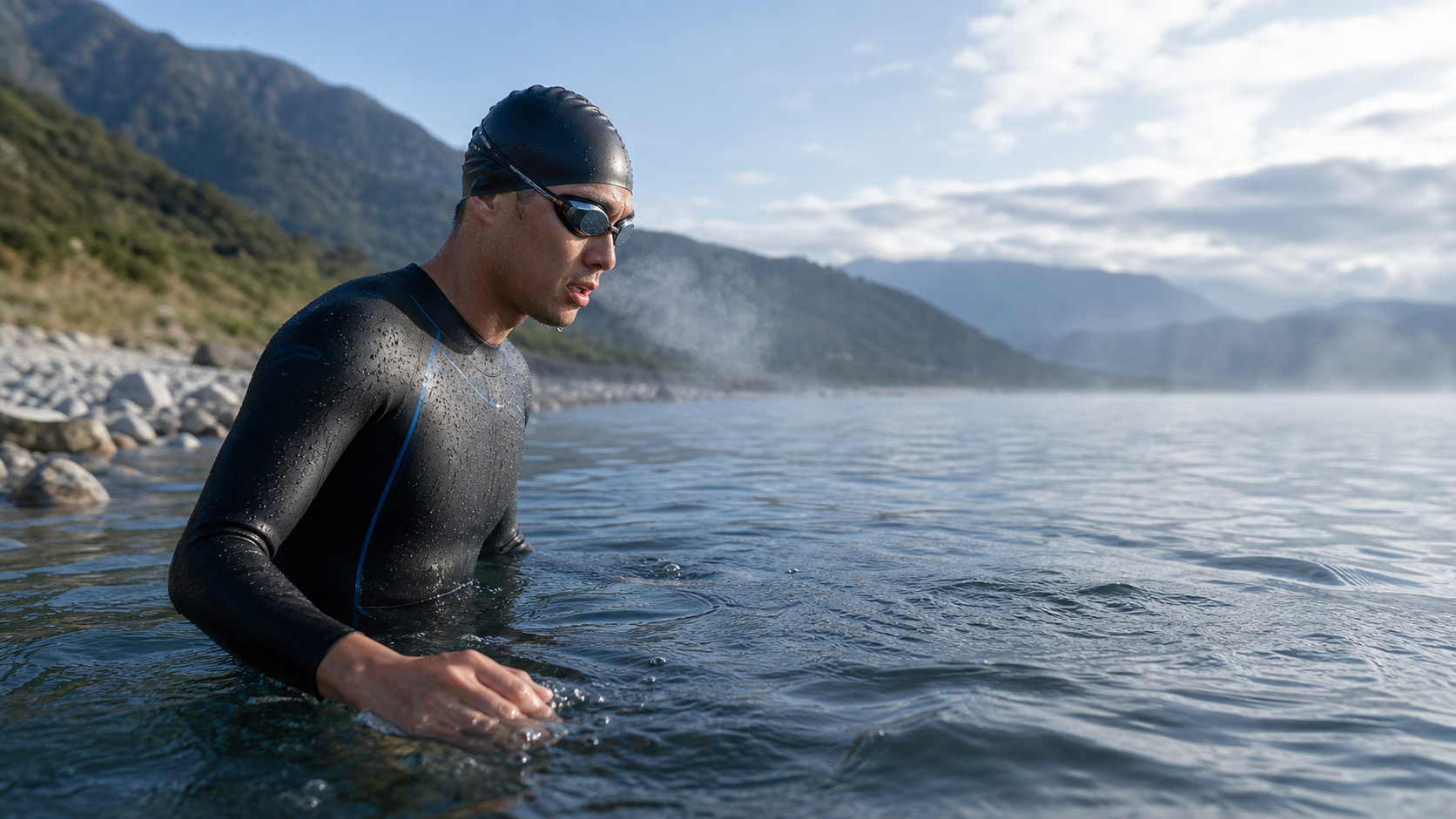
Cold Water Swimming: Challenges and Opportunities Coexist
In Taiwan, winter mountain stream water temperatures can drop to 14–18°C, and unheated pools in the north may hover around 22–24°C. For triathletes, open water swimming enthusiasts, and health-oriented swimmers, cold water swimming is an unavoidable training scenario. The human body’s physiological responses in cold water are far more complex than in warm water, involving multiple responses from the cardiovascular, metabolic, nervous, and thermoregulatory systems.
Water Temperature and Physiological Impact Classification
| Water Temp (°C) | Classification | Main Physiological Responses | Safety Recommendations |
|---|---|---|---|
| > 28 | Warm Water | Near-normal physiology, slightly lower heart rate | No special requirements |
| 24–28 | Comfortable Water Temp | Mild vasoconstriction | Acceptable for general training |
| 20–24 | Cool Water | Increased heart rate, increased respiratory rate | Warm up thoroughly before sessions |
| 16–20 | Cold Water | Significant cardiovascular responses, elevated metabolic rate | Brief exposure, wear cold water swimwear |
| 10–16 | Very Cold | Potentially dangerous, risk of hypothermia | Requires training adaptation, strict time limits |
| < 10 | Extremely Cold | Highly dangerous, cardiac risk | Only for highly experienced swimmers |
The Four Stages of Physiological Response to Cold Water Exposure
British exercise physiologist Mike Tipton’s research divides the physiological responses to cold water immersion into four stages:
Stage 1: Cold Shock Response (0–3 minutes)
This is the most dangerous stage, occurring within the first 1–3 minutes of entering the water:
- Involuntary Gasp: Cold thermoreceptors in the skin are rapidly activated, triggering a deep inhalation reflex
- Hyperventilation: Respiratory rate can reach 40–60 breaths/min (normal is 12–16), causing rapid CO₂ expulsion and leading to respiratory alkalosis
- Sudden Heart Rate Spike: Can rise immediately by 30–50 beats/min, increasing myocardial oxygen demand
- Sharp Blood Pressure Increase: Systolic pressure can temporarily rise by 40–80 mmHg, which is dangerous for those with cardiovascular disease
This is why, in drowning incidents, even in shallow water, cold shock alone can be fatal—if water is inhaled during hyperventilation, it immediately causes aspiration asphyxiation.
Stage 2: Swimming Failure (3–30 minutes)
- Skin and muscle temperatures continue to drop, reducing muscle strength and coordination
- Research shows that after 15 minutes of immersion in 15°C water, grip strength decreases by approximately 30%, and kicking power decreases by approximately 20–25%
- Arm function (fine motor skills) is impaired before core temperature drops (extremities cool first)
- This is the primary cause of open water swimming accidents: swimmers, not far from shore, are unable to complete the swim back due to muscle failure
Stage 3: Hypothermia (30 minutes to several hours)
- Core temperature (normally 37°C) must drop below 35°C to be defined as hypothermia
- In 15°C water, an average person without a wetsuit enters hypothermia in approximately 30–90 minutes
- People with higher body fat percentages and larger builds have better resistance to hypothermia
Stage 4: Circum-rescue Collapse
- Cardiac arrest caused by postural changes and blood pressure fluctuations during rescue
- Relatively rare, but it is important to be aware of its existence
The Effects of Cold Water on Heart Rate
Cold water has a bidirectional effect on heart rate, a phenomenon that confuses many swimmers:
| Mechanism | Effect on Heart Rate | Intensity |
|---|---|---|
| Cold shock (skin cold stimulation) | Rapid heart rate increase (sympathetic nervous system) | Strong |
| Diving reflex (facial cold stimulation) | Heart rate decrease (parasympathetic nervous system) | Moderate |
| Hyperventilation (caused by cold shock) | Heart rate increase | Strong |
| Whole-body cooling (core temperature drop) | Gradual heart rate decrease | Moderate |
Practical Observation: When swimming in cold water, heart rate during the first 1–3 minutes may be 10–20 beats/min higher than swimming at the same intensity in warm water, but after 10–15 minutes, if cooling continues, heart rate may begin to fall below that of warm water swimming.
Training Implications: In cold water (< 22°C), heart rate monitoring as a training intensity indicator may be inaccurate, and training intensity should not be judged by heart rate alone.
The Effects of Cold Water on Metabolic Rate
Cold water significantly elevates basal metabolic rate (BMR) and metabolic demands during exercise:
- Swimming in 20°C water increases metabolic rate by approximately 10–20% compared to 30°C water
- This is partly due to the energy expenditure of thermoregulation (shivering thermogenesis, non-shivering thermogenesis)
- Energy expenditure for long-distance cold water swimming (such as crossing the English Channel) is estimated at 500–800 kcal per hour, far higher than swimming the same distance in warm water
Potential Fat-Loss Effects of Cold Water Swimming: Due to elevated metabolic rate and activation of brown adipose tissue, regular cold water training may theoretically aid fat loss, but actual results vary from person to person and should not be relied upon as a standalone strategy.
Cold Acclimatization Training
The good news is: through repeated cold water exposure, the human body can develop “cold habituation,” which attenuates the cold shock response:
- 2–3 sessions per week, each involving 2–5 minutes of cold water immersion (or cold water swimming)
- After 4–6 consecutive weeks, the cold shock response (hyperventilation, heart rate spike) is significantly reduced
- This adaptation is primarily neurological habituation, rather than a metabolic core change
- Taiwanese triathletes are advised to begin cold acclimatization training 4–6 weeks before the racing season
Cold Water Risk Assessment for Open Water Swimming in Taiwan
Reference water temperatures for open water locations across Taiwan:
- Northern Taiwan (November–March): 18–22°C (moderate risk)
- Penghu, Xiaoliuqiu (winter): 20–24°C (safer)
- Eastern Taiwan (Pacific Ocean, year-round): 22–28°C (relatively safe)
- Sun Moon Lake (November–February): 16–20°C (caution required)
Practical Safety Recommendations for Swimming
- Gradual Entry: Do not jump straight in; give your body 60–90 seconds to respond to cold shock
- Slow Your Breathing After Entry: If you feel hyperventilation, deliberately slow your breathing rhythm (lengthen breaths) to overcome cold shock
- Wear Appropriate Thermal Protection: In waters below 22°C, wearing a wetsuit is recommended
- Never Swim Alone: Sudden incapacitation in cold water can occur within minutes
- Set Time Limits: Set a maximum swimming time based on water temperature and strictly adhere to it
Conclusion
The physiology of cold water swimming reveals an important truth: water temperature does not just affect comfort—it fundamentally alters the patterns of heart rate response, metabolic rate, and muscle function. Understanding the four stages of cold water response, especially the most dangerous “cold shock response,” is essential knowledge for every open water swimmer. Through systematic cold acclimatization training, swimmers can safely enhance their performance in low-temperature environments while minimizing risk.
Related Reading
- Seasonal Physiology of Swimming: The Effects of Cold vs. Hot Water on Performance
- Swimming Technique Adjustments at Different Water Temperatures: Physical Responses and Adaptation in Cold Water
- Water Temperature and Metabolism in Swimming: Caloric Expenditure and Core Temperature Regulation in Cold Water
- Physiological Adaptation to Cold Water Swimming: Coping with Winter Water Temperatures at Taiwan’s Northeast Coast
[防寒衣體驗] 鐵人魂 三鐵 防寒衣試穿會 於松運 深水游泳池 鯨魚池
8 年前
2016/05/13 單車 冷水坑下滑
10 年前
水金九不厭五分 10度寒流冷到不願停!feat. 卡卡 / 公路車 / CT Yeh
6 個月前
西進武嶺 免費訓練分析服務 Intervals | 練不夠還是練過頭?你哪一種類型選手?AI模型告訴你! | 備戰神器 | 公路車 訓練 | CT Yeh
4 年前
CT暗黑廚房) 車友必備 宇宙無敵鮮蚵湯 幫助訓練恢復 天然食補 好市多 超肥鮮蚵 破PR
7 年前
4K 東眼山 x 水蜜桃冰沙 百人單車約騎! 操完再吃冰 多爽快
7 年前
滑雪新手們慘摔學習全紀錄(請開字幕),滑雪好好玩 | Snowboard + Ski | 岩原 スキー場 | 滑雪APP使用 | GoPro Max
6 年前
秘境雪場 日本 八甲田 冰樹探險與滑雪體驗 ft. Q老師 & 運動生活
7 年前