The Science of Running Shoe Selection: Foot Type Analysis, Cushioning Needs, and Who Should Use Carbon-Plated Shoes
Introduction
Running shoes are the most critical investment in road running gear. With prices ranging from NT$3,000 to over NT$10,000, the technical jargon can be overwhelming—Stack Height, Drop, Carbon Plate, Rocker Geometry… Which numbers really matter? Which are just marketing hype? This article starts with basic foot type analysis and gradually builds a systematic framework for choosing the right shoes.
Foot Type Analysis: The First Step in Shoe Selection
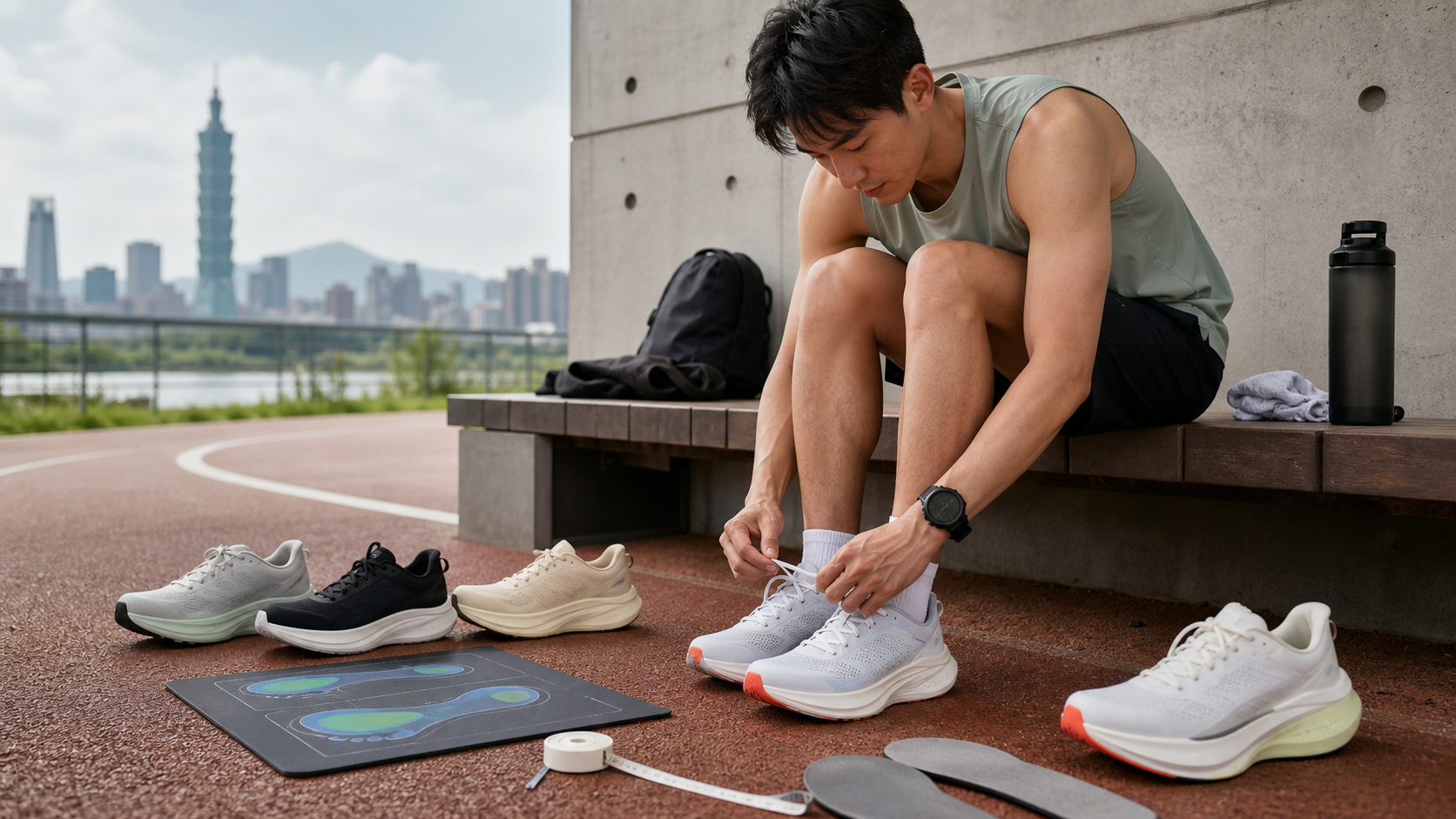
Understanding your foot type is the foundation of choosing shoes. Common assessment methods include:
- Wet footprint test: Step on a cardboard with wet feet and observe the completeness of the arch curve
- Professional in-store treadmill analysis: Most brand flagship stores offer gait analysis services, with video recording to observe foot strike angles
- Arch height assessment: Low arches (flat feet), neutral arches, and high arches each have corresponding support needs
| Foot Type | Characteristics | Recommended Shoe Category |
|---|---|---|
| Low arch (flat feet) | Footprint is nearly complete | Stability or motion control shoes |
| Neutral arch | Clear inward curve in the mid-footprint | Neutral cushioned shoes |
| High arch | Mid-footprint is nearly broken | Cushioned shoes, avoid excessive control |
Cushioning Needs: Balancing Mileage and Body Weight
Stack height directly affects leg fatigue. With Taiwan’s hot summer road surfaces and hard asphalt, cushioning needs are often more urgent than for runners in Europe or the US.
- Weekly mileage under 30 km: Medium cushioning (24–32mm heel height) is sufficient for most training
- Weekly mileage of 30–60 km: Consider high-cushion (33–40mm) training shoes as your primary pair
- Over 60 km: Rotate multiple pairs of shoes to prevent cushioning materials in a single pair from compressing and failing prematurely
- Runners weighing over 80 kg: Both cushioning and support need to be enhanced; do not prioritize lightweight construction alone
Heel-to-Toe Drop: The Key Number That Affects Your Landing Pattern
Drop determines the tendency of your center of gravity distribution while running:
- High Drop (8–12mm): Friendly to heel strikers, suitable for runners accustomed to landing on the rearfoot
- Medium Drop (4–8mm): A transitional choice with the widest applicability
- Zero Drop (0–4mm): Promotes forefoot landing and requires a longer adaptation period—do not switch abruptly
If you are used to a high drop and want to switch to a lower drop, plan a three-month transition period, gradually swapping out your weekly mileage to avoid overloading the posterior calf and Achilles tendon.
Carbon Plate Shoes: Who Are They Really For?
Carbon plate shoes have taken the road running world by storm in recent years, but they are not a necessity for every runner:
Suitable for:
- Runners with a full marathon finish time under 4 hours or a half marathon under 1 hour 55 minutes
- Runners whose form is already efficient and who land on the forefoot or midfoot
- Runners targeting a race-day PB and willing to maintain separate training shoes
Not suitable for:
- Beginners or those running under 50 km per month: The “energy return” benefit of carbon plate shoes requires a certain pace to be felt
- Runners still developing their form: High rebound may amplify poor landing habits and increase injury risk
- Those on a limited budget who want one pair for both training and racing: Carbon plate shoes typically last only 400–600 km, so value for money needs careful consideration
Additional Buying Tips for Taiwan’s Climate
- Breathable mesh: Taiwan’s summer heat and humidity make upper breathability more important than winter warmth
- Waterproofing needs: If you often train after typhoons or in the rain, consider water-repellent treatments, but fully waterproof Gore-Tex models have poorer breathability and are not the first choice for long distances
- Outsole durability: Taiwan’s asphalt roads cause significant wear; rubber outsole coverage affects lifespan. Models with a pure foam outsole are not recommended for daily training
Practical Advice
- When to try on shoes: Try them on in the evening, when your feet have swollen slightly from the day’s activity, closer to their true size after a long run
- Thumb-width rule: Leave about one thumb’s width of space between your toes and the front of the shoe
- Different foot sizes: Most people have different-sized feet; size based on the larger foot
- Brand size conversion: Last widths vary significantly between brands—always try shoes on in person; never buy based on size conversion alone
Conclusion
There is no “best shoe” in running shoe selection—only the shoe “best suited to this person and this stage of training.” Spending thirty minutes on a gait analysis at a professional store is far more valuable than chasing online reviews. Once you establish a sound shoe-selection framework, you will find that every equipment upgrade precisely hits your needs, rather than being led around by marketing talk.
Related Reading
- The Science of Running Shoe Selection: How to Choose Between Carbon Plate, Stability, and Cushioned Shoes
- Road Running Shoe Buying Guide: Correctly Matching Foot Types (Flat, Normal, High Arch) with Shoe Models
- Your First Pair of Road Running Shoes: Key Considerations and Fitting Methods for Beginners
- Beginner’s Guide to Running Shoes: Finding the Perfect First Pair for You
單車 一日北高 ( 雙城 ) 肥宅雙人瘋狂行 紀錄片 REACTO
10 年前
#公路車 #Fitting 靠人工智慧APP 幫你調整單車
6 年前
Unaas X50 全碳纖幅條輪 數據實測對比PK | Lun Hyper 的高階版 | 板輪爬坡也可以很厲害? ! 武嶺2小時大師一起親測! CP值超高 | 公路車 | CT Yeh
4 年前
2025 自行車錶排行榜 兩萬車友大數據 / Garmin Bryton 排名會大洗牌嗎? / 全新的碼表前身分析 /公路車 / CT Yeh
1 年前
多到選擇障礙... 換個單車把帶想一個小時 / BTP / 編織&軟木特有材質超吸睛! / 公路車 / CT Yeh
1 年前
2022 前十五大自行車錶 !? 兩萬名車友大數據統計 | 你的上榜了嗎? | 菁英車友都用哪些錶? | Bryton Garmin 誰能拔得頭籌?| 車錶推薦 | 公路車 CT Yeh
4 年前
Garmin Edge 1050 旗艦車錶 全台首測!/ 環法冠軍指定 / 對比Edge 1040改進哪些? / 公路車 / CT Yeh
2 年前
3D 列印車褲墊 / 舒適改善? / 無痕 x 分區壓縮 / ATK & Decider系列 / JE22黑科技 / #公路車 #CTYEH
11 個月前