Introduction
“Is optical heart rate good enough? Or do I really need a heart rate strap?” This is a common question many runners face when upgrading their gear. The answer isn’t an either-or choice—it depends on your training goals, pace zones, and the margin of error you can accept. This article starts from the underlying principles and provides a clear decision-making framework.
Differences in Principles: Why Accuracy Differs
Optical heart rate (PPG optical sensing):
The watch uses LED lights to illuminate the skin and senses blood flow changes to estimate heart rate. The core limitation lies in motion artifacts at the sensing location (the wrist)—arm swing and watch displacement during running both affect reading accuracy.
Heart rate strap (ECG electrode sensing):
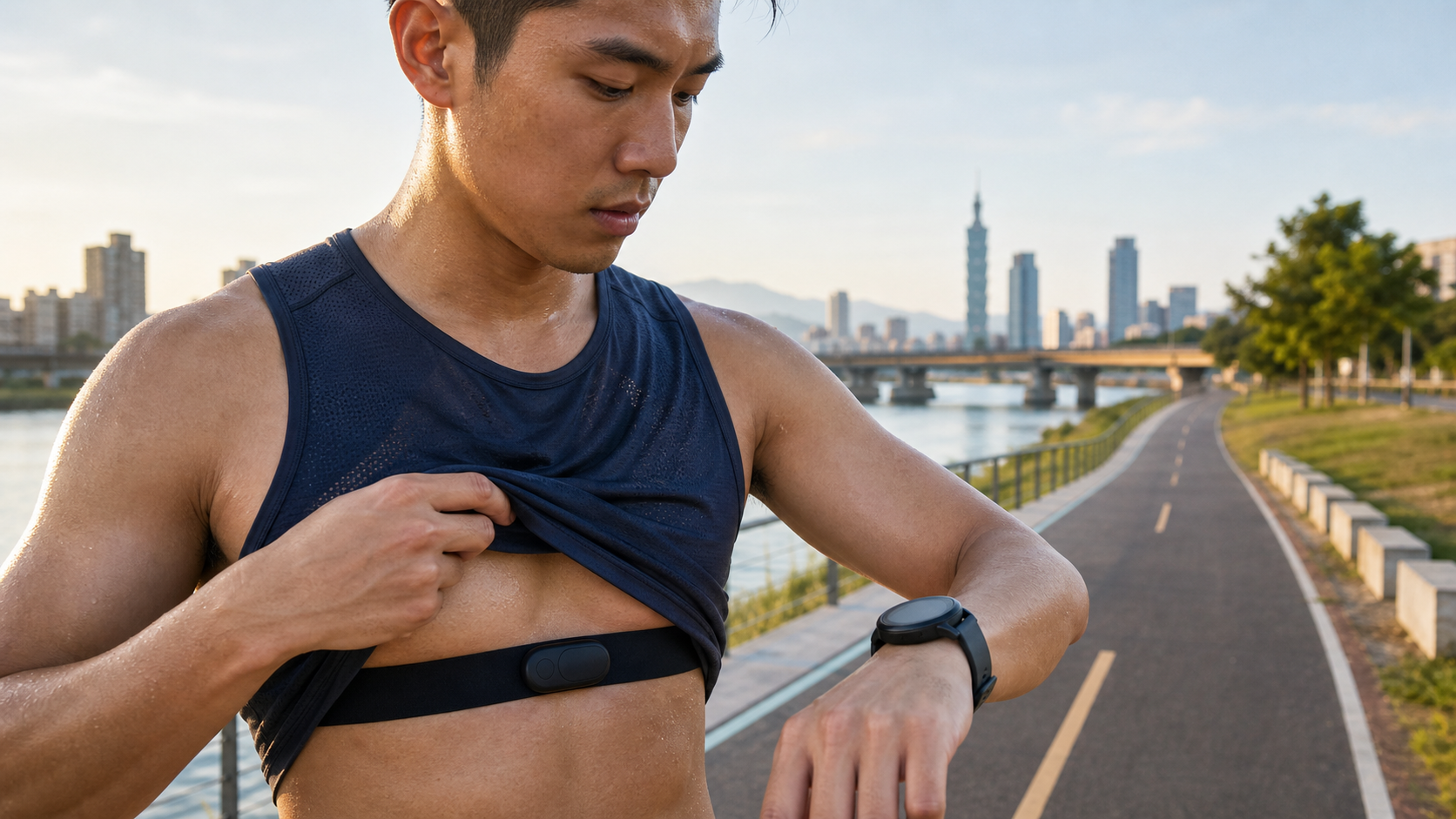
Positioned close to the chest, it directly detects the heart’s electrical signals. This is a simplified version of a medical-grade ECG, virtually unaffected by motion artifacts, and is currently the most accurate heart rate monitoring method available to consumers.
Accuracy Comparison: How Big Is the Real Difference
| Use Case | Optical Heart Rate Error Range | Heart Rate Strap Error Range |
|---|---|---|
| Steady-pace jogging (low intensity) | ±3–5 bpm | ±1–2 bpm |
| Moderate-pace training | ±5–10 bpm | ±1–2 bpm |
| Interval sprints (high-intensity transitions) | ±10–20 bpm (significant lag) | ±1–3 bpm |
| Climbing sections (large arm swing) | ±8–15 bpm | ±1–2 bpm |
Key finding: During steady-pace aerobic jogging, optical heart rate performs quite well; however, in interval training or workouts requiring precise heart rate zones, the lag and deviation issues of optical heart rate become quite apparent.
Comparison of Common Heart Rate Strap Types
| Type | Representative Brand | Comfort | Water Resistance | Connectivity |
|---|---|---|---|---|
| Hard chest strap | Polar H10 | Medium | Excellent (IPX7) | ANT+/Bluetooth |
| Soft chest strap | Garmin HRM-Pro Plus | High | Good | ANT+/Bluetooth |
| Arm optical heart rate | Polar Verity Sense | Excellent | Good | Bluetooth |
| Vest-integrated | Polar OH1 (arm sleeve) | Very good | Good | Bluetooth/USB |
Soft chest straps use soft, breathable materials, making them more comfortable than traditional hard-style straps for long summer runs in Taiwan.
When You Need a Heart Rate Strap: A Clear Decision Framework
Runners who should invest in a heart rate strap:
- Runners executing an aerobic base training phase: they need to precisely maintain aerobic heart rate (e.g., the MAF 180 method); a 10 bpm deviation from optical heart rate could invalidate the entire workout plan
- Serious runners doing interval training: optical heart rate lags severely during high-intensity segments, making it impossible to accurately assess training intensity
- Runners targeting a marathon finish time under 4 hours: heart rate zone training requires high precision to be meaningful
- Runners with cardiovascular monitoring needs (as recommended by their physician)
Runners for whom optical heart rate is sufficient:
- Recreational runners running less than 30 km per week
- Beginners who primarily control pace by “perceived exertion”
- Runners who only need to record overall heart rate trends afterward rather than real-time precise heart rate
Wearing Comfort: Additional Considerations for Summer
Taiwan’s summer heat causes heavy sweating, which significantly affects the wearing experience of heart rate straps:
- Chest strap: Increased sweating actually improves conductivity, making detection more stable; however, prolonged wear may leave red marks on the chest
- Arm heart rate (optical, worn on the upper arm): Completely replaces watch optical heart rate, with greatly improved accuracy and no chest discomfort—suitable for those who dislike chest straps
- Position adjustment: If using watch optical heart rate, ensure the band is one notch tighter than usual and move the watch head back about one finger-width behind the radial bone prominence to improve reading accuracy
Practical Recommendations
- When on a limited budget, first confirm whether your training requires precise heart rate data before deciding whether to invest in a heart rate strap
- Recommended entry-level options: Polar H10 or Garmin HRM-Dual—broad compatibility and stable performance
- When using optical heart rate, wet the sensor area with cold water before running to help improve initial reading stability
- When any heart rate device will not be used for an extended period, remove the battery (heart rate strap) to prevent leakage from damaging the sensor components
Conclusion
A heart rate strap is not essential for everyone, but for runners with systematic training needs, it is one of the few equipment investments that can genuinely change training quality. Once you understand the differences in principles between the two technologies, you can make rational decisions based on your training stage—rather than being persuaded by the marketing of “precision heart rate training” into buying gear you’ll never use.
Related Reading
- Running Heart Rate Strap vs Optical Heart Rate: Choosing by Accuracy and Use Case
- Running Heart Rate Monitoring: In-Depth Accuracy Comparison Between Heart Rate Straps and Optical Heart Rate
- Heart Rate Strap vs Optical Heart Rate Watch: Which Is More Accurate for Running Training?
- GPS Watch Optical Heart Rate vs Heart Rate Strap: Which Is More Accurate? A Practical Guide for Taiwanese Runners
Garmin Edge 1050 旗艦車錶 全台首測!/ 環法冠軍指定 / 對比Edge 1040改進哪些? / 公路車 / CT Yeh
2 年前
西進武嶺 免費訓練分析服務 Intervals | 練不夠還是練過頭?你哪一種類型選手?AI模型告訴你! | 備戰神器 | 公路車 訓練 | CT Yeh
4 年前
首發 Garmin Edge 850 車錶 深入開箱!? / 公路車 / CT Yeh
10 個月前
Apple Watch 3 值得 買嗎!? 實測 單車車錶 遙控相機 Zwift 心律連線 Apple Pay 全聯買菜 GoPro 遙控
8 年前
全台首發神車錶! iGPSPORT iGS630 兩趟一日北高的續航! 超強導航、功率訓練、超人性APP! Garmin & Bryton 有對手了嗎? | 公路車 |CT Yeh
3 年前
#公路車 #Vo2Max #最大攝氧量 測驗 體驗 | 心肺測試
6 年前
雷達尾燈 雷不雷? 邁金L508 智慧雷達尾燈 情境考驗實測 | 同場加映 2千元等級的專業車錶 C406 Pro | 公路車 | CT Yeh
3 年前
2022 前十五大自行車錶 !? 兩萬名車友大數據統計 | 你的上榜了嗎? | 菁英車友都用哪些錶? | Bryton Garmin 誰能拔得頭籌?| 車錶推薦 | 公路車 CT Yeh
4 年前