Introduction
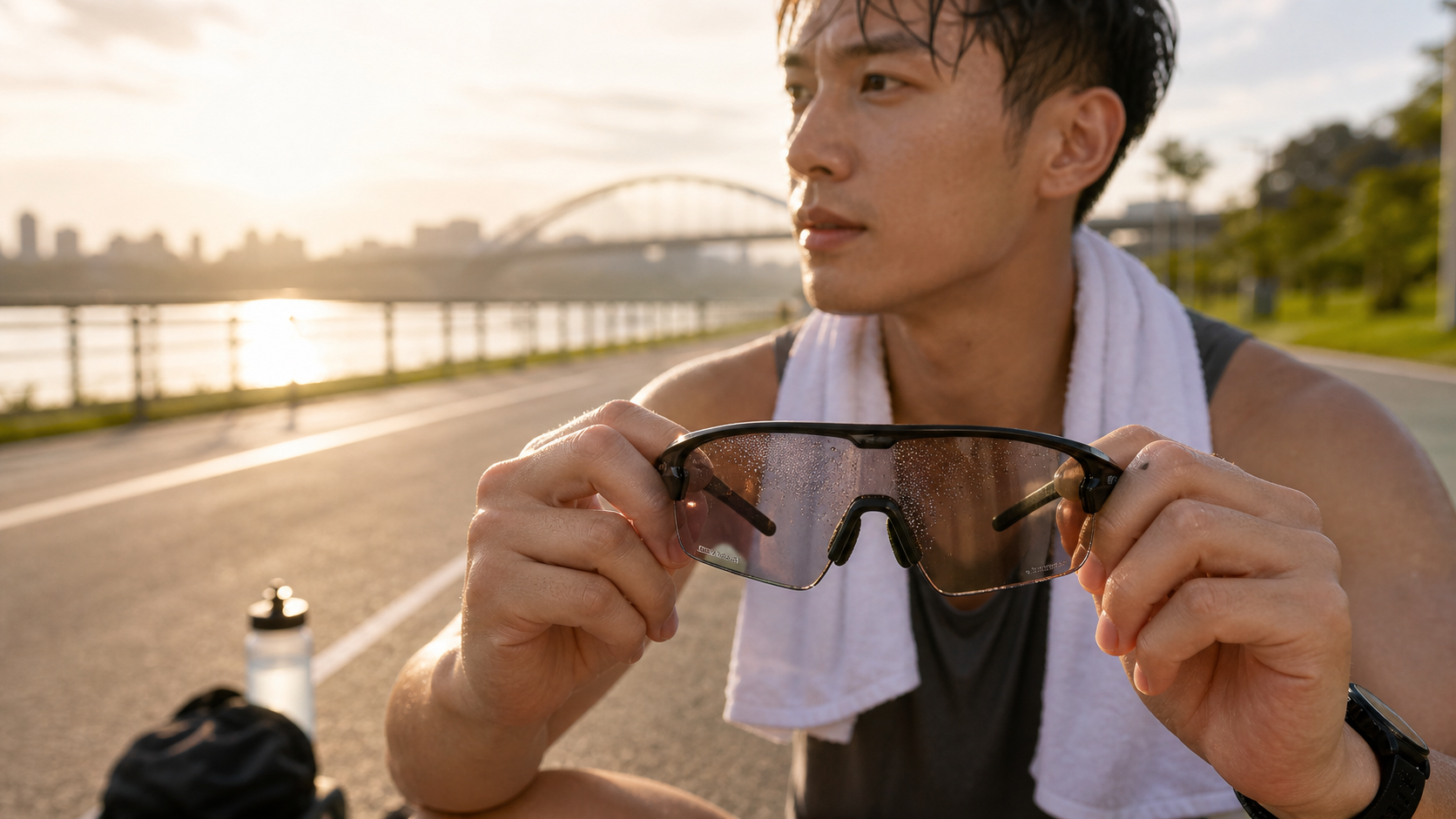
Many runners are used to substituting cheap, off-the-shelf sunglasses for running-specific eyewear. But running has its own particular demands — frame stability under intense movement, fogging caused by prolonged sweating, and effective UV protection — which is why running-specific sunglasses have a real reason to exist. This article evaluates the full logic of choosing running sunglasses, from vision protection to functional design.
UV400 Protection: The Most Basic Standard for Eye Protection
UV400 is the minimum standard for running sunglasses (and indeed all outdoor eyewear). It means the lens blocks all ultraviolet light at wavelengths of 400 nanometers or below (including both UVA and UVB).
Important points to understand:
- Lens darkness does not equal sun protection: Dark lenses without a UV filter actually cause the pupil to dilate, letting in more ultraviolet light — making them more dangerous than wearing no glasses at all
- How to check: Look for a UV400 or “100% UV Protection” label when purchasing
- Polarized lenses: These eliminate glare reflected off water or asphalt, offering extra benefit in Taiwan’s environment of frequent waterways and reflective road surfaces — but they are not a safety necessity
Comparing Lens Materials
| Material | Weight | Impact Resistance | Optical Quality | Price |
|---|---|---|---|---|
| Polycarbonate (PC) | Light | Excellent (top choice for sports) | Good | Low to Mid |
| Nylon (Grilamid TR) | Extremely Light | Excellent | Good to Very Good | Mid to High |
| Glass | Heavy | Poor (shattering risk) | Best | Mid to High |
| Triacetate (TAC) | Medium | Medium | Good | Low |
Sports sunglasses should almost always use polycarbonate or nylon lenses. Glass lenses carry a risk of shattering and injuring the eyes during a fall or collision, making them unsuitable for running.
Anti-Fog Design: A Necessary Consideration for Taiwan’s Heat and Humidity
In Taiwan’s high-humidity summer conditions, stepping out of an air-conditioned space or a rise in body temperature from sweating can easily cause lenses to fog up. The main anti-fog technologies include:
- Anti-Fog Coating: A lens surface coating that reduces moisture condensation; its effectiveness gradually diminishes with use
- Ventilation Channels: A frame design that channels airflow behind the lens to reduce heat buildup, with better long-term performance than coatings alone
- Interchangeable Lens Systems: Some higher-end models offer clear lenses for overcast conditions or tunnel sections, avoiding the frustration of being forced to wear dark lenses even after they’ve fogged up
Frame Stability: The Annoying Problem of Slipping While Running
The most essential design difference in running-specific sunglasses lies in how securely the frame stays in place:
- Rubber Nose Pads: Non-slip rubber nose pads stay in place even after sweating, and are basic equipment for running sunglasses
- Wrap-Around Arms: Rubberized temple tips increase grip around the ears
- Shield Lens: A large single-piece lens with no nose bridge offers a wider field of view and less frame material, reducing the problem of slippage from sweat
- Frame Wrap Angle: A larger wrap angle (typically 6–8 degrees) provides better peripheral vision and more effectively blocks airflow to the lens
Brief Reviews of Well-Known Running Sunglasses Brands
- Oakley: The Sutro Lite / Radar EV series has the highest market acceptance in Taiwan, with optical quality that sets the industry benchmark
- Rudy Project: An Italian brand known for its interchangeable lens systems and strong customization services
- Tifosi: An American brand offering high value for money, a popular choice for entry-level running sunglasses
- ROKA: Extremely lightweight, with an excellent silicone retention system, suitable for runners whose glasses tend to slip easily
Prescription Considerations: Solutions for Nearsighted Runners
Taiwan has an extremely high rate of myopia, and many runners face a dilemma between “wearing contact lenses with regular sunglasses” or “getting prescription sports sunglasses”:
- Contact Lenses + Running Sunglasses: The most flexible option, allowing different lenses to be swapped in; the downside is that prolonged running with contacts in can cause dry-eye discomfort
- Custom Prescription Running Sunglasses: Convenient since it’s a single pair for regular use; typically costs upward of NT$3,000–8,000
- Clip-on Lens Inserts: Some models accept a prescription clip-on insert, offering relatively more flexibility
Practical Recommendations
- Given Taiwan’s intense summer sunlight, gray or brown lenses are recommended (closest to natural color perception); green lenses suit overcast weather
- Check whether the lenses are interchangeable — given the difference between Taiwan’s bright summer sun and overcast/tunnel conditions, models with swappable lenses are highly practical
- During a fitting, do a quick head-shake test to confirm the nose pads and temple arms don’t slip during movement
- Rinse the lenses with clean water after every run — long-term salt residue from sweat can corrode the anti-fog coating
Conclusion
The core purpose of running sunglasses is eye protection, not fashion. UV400 protection is the baseline, while anti-fog performance and frame stability determine day-to-day satisfaction. Taiwan’s intense sunlight and high humidity make both of these features especially important — try on multiple pairs in person and find the one that stays truly secure and comfortable during dynamic running.
Related Reading
- Best Sports Sunglasses Recommendations: Optical Technology for Cycling and Running
- Choosing Cycling Sunglasses: A Complete Buying Guide to UV Protection, Lens Color, and Anti-Fog Performance
- Sun Protection Gear for Running: Choosing Sun-Protective Clothing, Arm Sleeves, and Sunscreen for Taiwan’s Summer
- Running Sun Hats and Sunglasses: Protective Gear You Can’t Ignore for Summer Road Running in Taiwan
開箱) 近視車友 也可以很帥的 Envis Transform 太陽眼鏡開箱 翔鷹 配近視框超便宜秘訣
7 年前
再快都跟的上!? 單車跟隨攝影機之王 HOVERAir X1 PROMAX 全面實測 / 唯一!8K畫質&自行車專用模式和跟蹤信標&前後避障 / DJI Neo 可參考/ 公路車 / CT Yeh
1 年前
雷達尾燈 雷不雷? 邁金L508 智慧雷達尾燈 情境考驗實測 | 同場加映 2千元等級的專業車錶 C406 Pro | 公路車 | CT Yeh
3 年前
[教學] Premiere 影片 手震 修正 教學 防抖 單眼 影像 GoPro 穩定 Video Stabilization
8 年前
單車 一日北高 ( 雙城 ) 肥宅雙人瘋狂行 紀錄片 REACTO
10 年前
開場流量密碼! / Insta360 X4 AI全景攝影機 實測 / 公路車 / CT Yeh
2 年前
Garmin Edge 540/840 Solar 台灣首發開箱!完整車錶功能 道路實測 / ClimbPro 爬坡提示超級牛 / 強大續航實測 / 公路車 / CT Yeh
3 年前
Vision Metron RS 37碳幅條輪組 (非SL)官網沒有的 低調開箱 / 這重量太銷魂了 / 公路車 / CT Yeh
6 個月前