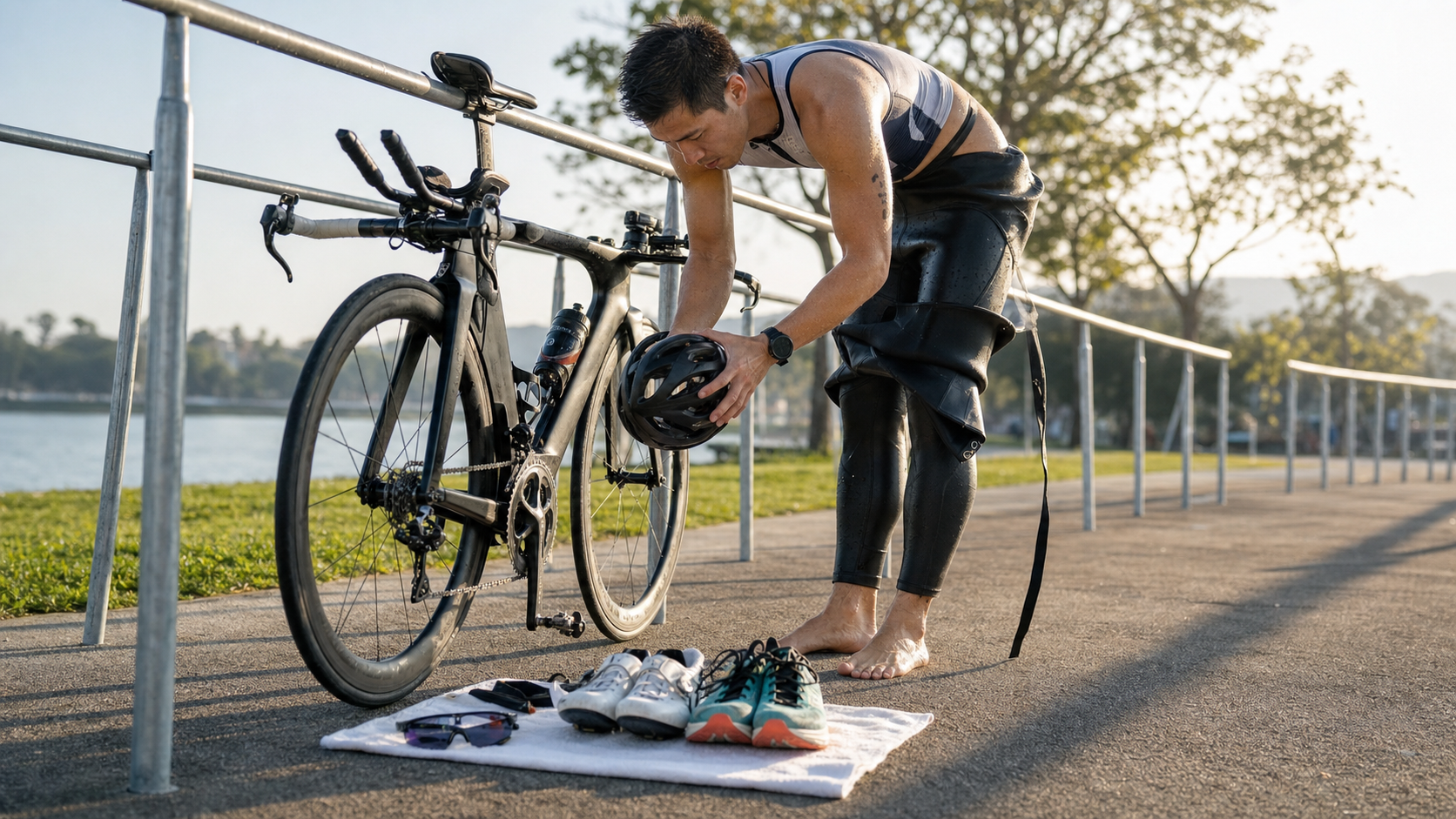
The Transition Area: The Underrated Fourth Discipline
Triathlon isn’t just three sports—it actually consists of five segments: swimming, T1 transition, cycling, T2 transition, and running. Many age-group athletes spend 3 to 8 minutes in T1 and T2, while elite athletes can complete their transitions in under 1 minute. For an Olympic-distance athlete finishing in 3 hours, saving 2 minutes in transition is equivalent to improving your run pace by a full 20 seconds/km—a significant gain.
T1 Transition (Swim→Bike) Process Analysis
Standard T1 Sequence
| Step | Action | Target Time |
|---|---|---|
| Exit Water | Pull down the upper half of the wetsuit, jog to the transition area | 20–30 sec |
| Locate Bike | Confirm your rack position, reach your bike | 5–10 sec |
| Remove Wetsuit | Fully remove and stow it | 15–30 sec (depending on wetsuit use) |
| Put on Helmet | Take helmet and buckle it | 5–8 sec |
| Put on Sunglasses | Can be pre-mounted on the helmet | 2–3 sec |
| Put on Cycling Shoes | Or use straps to pre-attach them to the pedals | 10–20 sec |
| Run with Bike | Mount only after crossing the mount line | 5–10 sec |
| Total | 60–111 sec |
T2 Transition (Bike→Run) Process Analysis
Standard T2 Sequence
| Step | Action | Target Time |
|---|---|---|
| Enter Transition Area | Unclip feet early, glide with feet on top of shoes | 200m before entry |
| Stop | Rack the bike on the designated rack | 5–8 sec |
| Remove Helmet | Remove helmet before cycling shoes (safety rule) | 5 sec |
| Change into Run Shoes | Slip on and quickly fasten (elastic laces recommended) | 10–20 sec |
| Grab Hat / Nutrition | Put on run cap, grab energy gels | 5–10 sec |
| Start Running | Run out of the transition area | Immediately |
| Total | 25–43 sec |
Key Techniques to Shorten T1 Time
1. Quick Wetsuit Removal
After exiting the water, peel the upper half of the wetsuit down while jogging. By the time you reach your bike, the wetsuit should be down to your waist—just squat and pull it off your legs.
Practice method: Simulate removing the wetsuit while wet in the bathroom or pool, aiming to complete it within 20 seconds.
2. Prepare Your Helmet in Advance
Place the helmet on the handlebars with the opening facing forward for a quick fit. Sunglasses can be clipped onto the vents beforehand, so you can put them on while grabbing the helmet.
3. Leave Cycling Shoes on the Pedals
Advanced technique: Pre-attach your cycling shoes to the pedals, secured horizontally with rubber bands. After leaving the transition area, slide your feet into the shoes while riding, then tighten the straps. This technique saves 15–25 seconds but requires practice.
Key Techniques to Shorten T2 Time
1. Unclip Early (Flying Mount/Dismount)
200–300 meters before entering the transition area, pull your feet out of the cycling shoes and glide with your feet resting on top of them. After stopping, simply lift your feet off—the shoes stay on the pedals, eliminating the need to remove them in transition.
2. Elastic Laces Are a Must-Have
Replace your running shoe laces with elastic laces (e.g., Lock Laces). Adjust the tension beforehand during practice, then just slip your feet in on race day—saving the 15–20 seconds traditional laces cost.
3. Plan Your Position in Advance
Visit the transition area before the race to familiarize yourself: the distance from the swim exit to T1, and the path from the bike racks to the T2 exit. Mentally rehearse the full sequence 3–5 times.
How to Incorporate Transition Training into Your Schedule?
It’s recommended to add 10–15 minutes of transition-specific drills after each brick workout:
- Simulate T2: Wearing cycling gear (helmet, cycling shoes), perform the full sequence of “rack bike → change shoes → start running,” timing and logging each attempt.
- Do at least 1 full transition rehearsal per week.
- In the final 4 weeks before race day, add timed transitions to every brick workout, progressively closing in on your target times.
Practical Tips
-
Have a fixed layout for your transition area items: Research the race organizer’s rules beforehand—you’re usually only allowed a helmet, glasses, running shoes, and nutrition in the transition area. Keep items neatly and consistently arranged for quick access.
-
Practice in race gear: Don’t practice transitions in training attire. Simulate with the full kit you’ll wear on race day to uncover potential issues (e.g., a wetsuit zipper cord that’s too short).
-
Deliberately simulate fatigue: Transition practice after a brick is far closer to race conditions than practicing from a rested state. Train your fingers to quickly operate buckles and straps at a heart rate of 160.
Conclusion
The transition area is the segment of triathlon where you can improve fastest through practice. You don’t need better fitness—just better preparation and proficiency. Shave 5 seconds off your T1 and 5 seconds off your T2 in each practice session, and over an Olympic-distance race you’ll save nearly 10 seconds; but if T1 takes 5 minutes and T2 takes 3 minutes, that’s 8 minutes of needless loss. The transition area is an investment in yourself, with clearly visible returns.
Related Reading
- Triathlon Transition (T1/T2) Guide: Transition Techniques Where Every Second Counts
- Triathlon Transition Strategy: How to Save Every Second in T1 and T2
- Triathlon Transition (T1/T2) Speed-Up Techniques, Course Planning, and Gear Selection Complete Guide (Series 378)
- Triathlon Transition (T1/T2) Speed-Up Techniques and Course Planning: From Zero to Advanced (Series 3)
西進武嶺 免費訓練分析服務 Intervals | 練不夠還是練過頭?你哪一種類型選手?AI模型告訴你! | 備戰神器 | 公路車 訓練 | CT Yeh
4 年前
2019 夏季KOM 5小 完賽心得 準備攻略 東進武嶺 夏季登山王之路 Taiwan KOM Challenge
7 年前
FTL 與 SYB 車隊專訪 西進武嶺 實用攻略分享! 2小時 如何練?!你不知道的眉角!新手準備武嶺必看 EP1 | 實力派女車友 | 精華版 | 公路車 | CTYeh
4 年前
福隆鐵人團練隨拍
8 年前
CT 喇低賽) 武嶺牽車 才是王道 西進牽車四小時內秘訣 攝手位置 如何判斷 防抽筋小秘訣
7 年前
單車AI教練!全新 ChatGPT4o 幫你分析訓練成果!排武嶺課表,分析騎車姿勢! 太神了! / 公路車 / CT Yeh / feat. 緯緯
2 年前
#東進武嶺 全程實況錄影 5小時半 #夏季KOM #太魯閣 Taiwan KOM Challenge Reality Video Taroko scenery
7 年前
一日北高前的高裝檢 | 北高 360 | 挑戰11小時的裝備 | 一日雙塔 | 補給
6 年前