Tour de Taiwan Complete Guide: Course Analysis and Past Champions Review
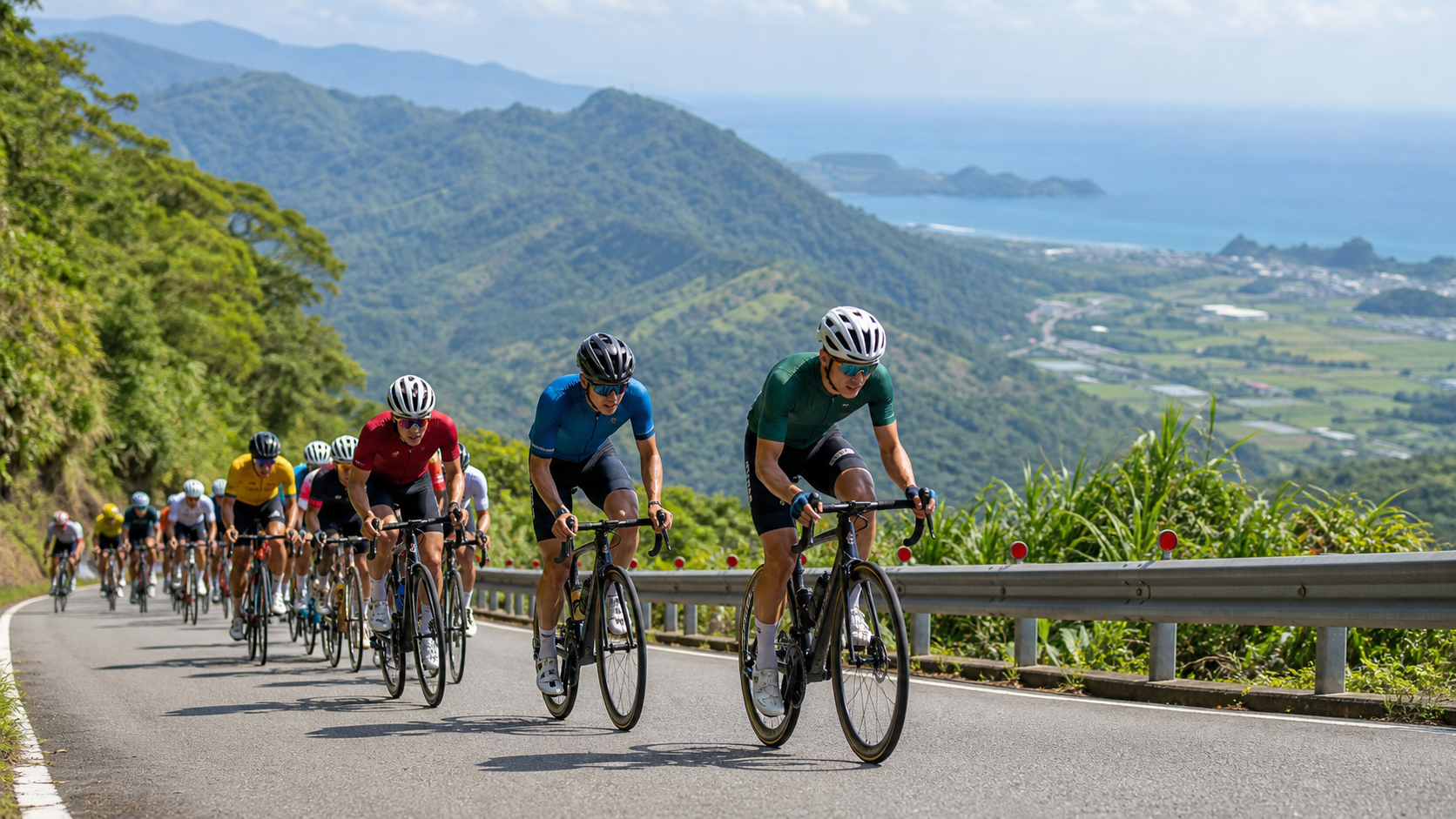
Every spring, a special scene unfolds on Taiwan’s roads: professional riders from Europe, the Americas, Australia, and Asia, escorted by police cars and motorcycles, race at speeds exceeding 50 km/h across Taiwan’s mountains and plains. This is the Tour de Taiwan, one of Asia’s premier UCI continental road races and the most internationally anticipated sporting event in Taiwan’s cycling calendar each year.
Basic Event Information
| Item | Details |
|---|---|
| Year Founded | 2004 |
| UCI Classification | 2.1 (Continental Pro) |
| Timing | Mid to late March annually |
| Participating Teams | Approximately 18–20, including invited WorldTeams |
| Number of Stages | Typically 6–8 stages |
| Total Distance | Approximately 800–1,000 km |
Since its inception, the Tour de Taiwan has become a “must-race” event on the Asian cycling calendar. Due to Taiwan’s unique mountainous terrain, excellent road quality, and the organizer’s continuously improving capabilities, many European teams include the Tour de Taiwan in their spring schedule as a warm-up test before heading to the Grand Tours.
Typical Course Design Analysis
The Tour de Taiwan’s course is slightly adjusted each year, but several fixed elements appear in almost every edition:
Flat Sprint Stages:
Usually set on the Chianan Plain or western coastal highways, the terrain is flat, often making it the domain of sprinters. Crosswinds are particularly noticeable along Taiwan’s western coastline, and even on flat roads, gusts can cause the race to split into echelons.
Mountain Pass Stages:
Wuling (elevation 3,275 meters) is the highest mountaintop finish in Tour de Taiwan history and one of the highest finishes in Asian road racing. Additionally, passes like Hehuanshan, Taipingshan, and Xueshan have also appeared on the route. These climbs often feature sustained gradients and significant elevation gains, serving as the decisive battleground for the General Classification (GC).
City Circuit Stages:
Some stages are held on closed-loop circuits in cities like Taipei and Taichung, suited for sprinters and allowing more citizens the opportunity to watch the race up close.
Past Champions Overview (Recent Years)
| Year | Champion | Nationality | Team |
|---|---|---|---|
| 2024 | Biniam Girmay | Eritrea | Intermarché-Wanty |
| 2023 | Mathieu van der Poel | Netherlands | Alpecin-Deceuninck |
| 2022 | Not held (post-COVID recovery) | — | — |
| 2019 | Jakub Mareczko | Italy | CCC Team |
| 2018 | Jakub Mareczko | Italy | CCC Sprandi Polkowice |
It is worth noting that in recent years, the Tour de Taiwan has attracted top riders like Mathieu van der Poel (MvdP) and Biniam Girmay, significantly boosting the race’s international visibility and competitive level.
Spectator Guide: How to Experience the Tour de Taiwan Live
Watching the Tour de Taiwan live is a very special experience, completely different from television broadcasts:
Spectator Tips:
- Check the Official Route Map: The Chinese Taipei Cycling Association (CYCLING ASSOCIATION ROC) publishes the complete route annually; it is recommended to check one week in advance.
- Choose Mountaintop Finish Stages: Mountaintop finish stages (such as near Wuling) are the most popular viewing spots, but you need to arrive early to secure a spot, as mountain roads may be closed.
- Flat Sprint Stages Suit General Spectators: City circuits or flat sprint stages are easier to access and allow you to see the riders pass multiple times.
- Bring Binoculars: The high speed of professional racing means the peloton flashes by in an instant; binoculars help identify jersey numbers.
- Understand the Race Format: First learn to read the points classification and time gaps to truly feel the suspense of the race live.
The Significance of Taiwan’s Home Advantage
The Tour de Taiwan’s significance to Taiwan’s cycling ecosystem extends far beyond the competitive aspect:
- Brand Exposure: Giant and Merida, as local Taiwanese brands, receive particular attention at their home race.
- Opportunities for Young Riders: The Taiwanese national team participates as a wildcard entry, allowing local riders to compete in front of a home crowd, which is highly motivating.
- Tourism and Economic Benefits: Accompanying foreign journalists, sponsors, and fans bring considerable tourism revenue.
- Course Infrastructure Recognition: Positive feedback from professional teams on Taiwan’s road quality enhances the international image of Taiwanese road cycling.
Conclusion
The Tour de Taiwan is the most direct link between Taiwan and the world of professional cycling. Whenever professional riders pedal hard on Taiwan’s mountain roads, it is not just a race, but a declaration of Taiwan’s cycling culture to the world: we have the capability to host top-tier events, and we have riders who walk this path. In spring, go to the scene and feel that energy.
Related Topic Reads
- Tour de Taiwan Complete Spectator Guide
- Tour de Taiwan Spectating and Participating Full Guide: An In-Depth Experience of Taiwan’s Highest-Caliber Road Cycling Event
- Tour de Taiwan Spectator Complete Guide: How to Appreciate Professional Cycling
- Tour de Taiwan’s Positioning in the UCI: An Analysis of the International Status of Asian Regional Events
2024 如來神掌 百人約騎挑戰!feat. 秘境單車社團 / 神人們太可怕 / 全程錄影 x 完整坡度解析 / 公路車 / CT Yeh
2 年前
2023桃園團體繞圈賽/環台賽等級拍攝/賽事精華/ 10人一隊缺一不可!50隊廝殺大場面 / 第三屆 海鷗繞圈賽 /公路車/CT Yeh
2 年前
日本公路最高登山賽,台灣首位YT挑戰實錄,乘鞍登山賽40週年,賽前篇完整版,請到我的YT收看 #公路車 #cycling
10 個月前
2023桃園團體繞圈賽 / 海鷗繞圈賽 | 全程空拍數據版 | 公路車 | CT Yeh
2 年前
2025 乘鞍 KOM 登山賽挑戰實錄 / 日本公路最高 ! 賽前探路篇 / 比富士山厲害,無敵絕景!/ 40週年 / 中文YT首發 / 公路車 / CT Yeh #乘鞍ヒルクライム
10 個月前
2023自行車展!與環台賽選手一同表演賽 / 全自動AI Fitting?/ TIME新車發表/神秘充電桌等 精華分享 VLOG | CT Yeh | 公路車
3 年前
2024 春季KOM 賽事精華版 / 太魯閣 / 貓捉老鼠精彩追擊 / 錄影剪輯版 / 東進武嶺 / 公路車 (請開啟字幕)
2 年前
2025 海鷗團體繞圈賽 / 前八強賽事精華!/ 環台賽等級拍攝 / 國手菁英隊伍較勁 / CT Yeh #公路車
8 個月前