Treadmill vs. Outdoor Running: The Science Behind the 1% Incline Compensation and Training Differences
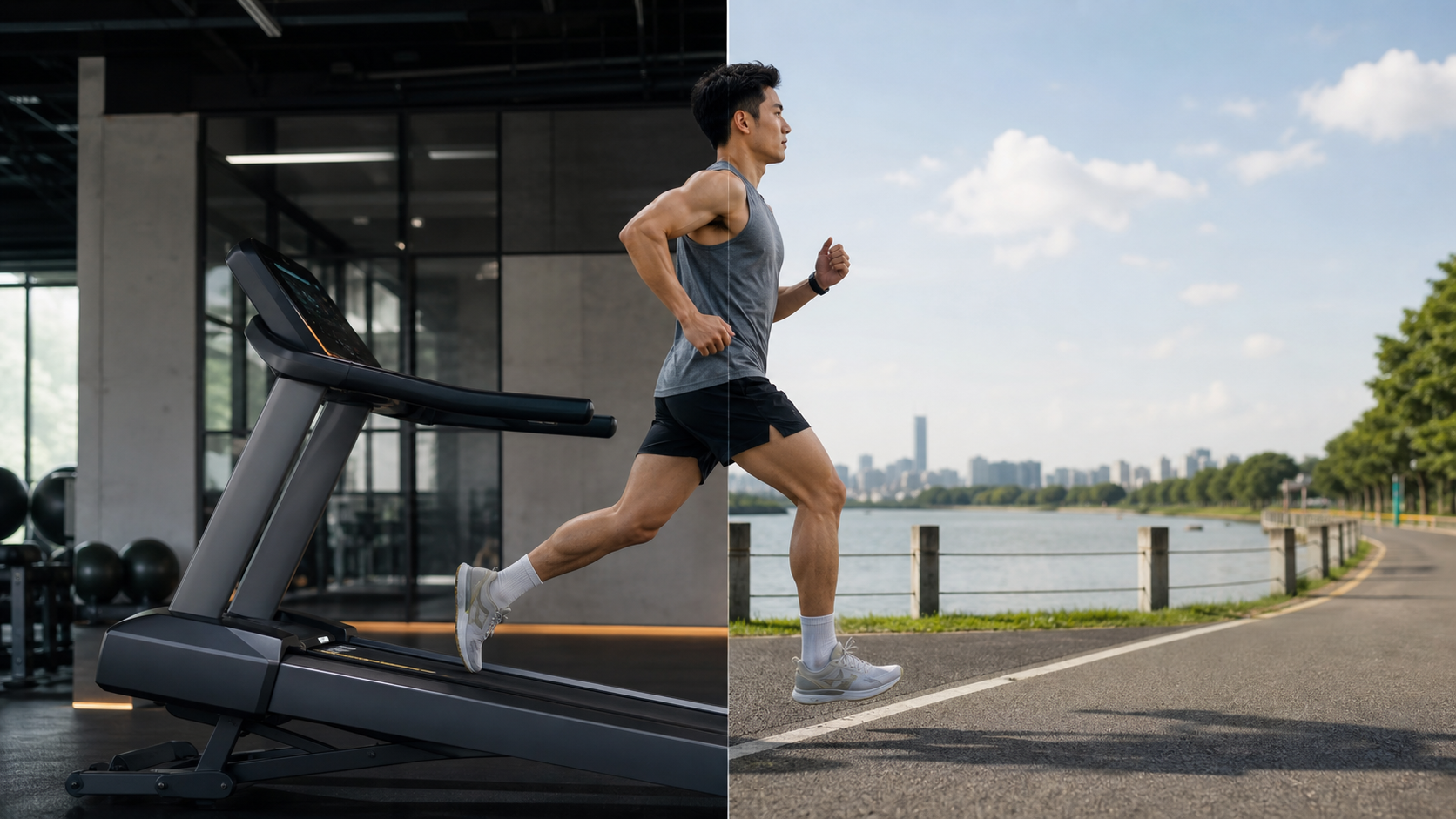
Treadmill vs. Outdoor Running: The Science Behind the 1% Incline Compensation and Training Differences
Introduction
Taiwanese runners are fortunate to have a rich outdoor running environment, yet treadmill training in the gym remains common — driven by rain, heat, and nighttime safety concerns. The advice to “set a 1% incline to match outdoor running” has been around for a long time, but where did it come from? And how large are the biomechanical differences between treadmill and outdoor running really? This article uses scientific data to answer these questions.
The Scientific Origin of the 1% Incline Compensation
In 1996, Andrew Jones and Jonathan Doust of Loughborough University in the UK published a key study (in the Journal of Sports Sciences) that recruited 8 male runners and had them run at the same speeds on a treadmill (at 0% and 1% incline) and on an outdoor track, comparing oxygen consumption (i.e., running economy).
Findings:
- Treadmill 0% incline vs. outdoors: The difference in oxygen consumption was not significant at paces slower than 3.5 min/km; but at higher speeds (2.5–3.5 min/km pace), the treadmill was noticeably less demanding.
- Treadmill 1% incline vs. outdoors: There was no significant difference in oxygen consumption at any of the tested speeds.
Conclusion: Setting a 1% incline compensates for the difference caused by outdoor air resistance and the treadmill belt assisting forward motion (no need to overcome air resistance), making the training effect equivalent.
Why Is the Treadmill Inherently Less Demanding?
The treadmill differs from outdoor running in several fundamental physical ways:
| Factor | Outdoor Running | Treadmill 0% Incline | Treadmill 1% Incline |
|---|---|---|---|
| Air resistance | Present (more significant at higher speed) | Almost none | Almost none |
| Belt assistance | None | Belt moves forward assisting push-off | Compensation added |
| Environmental obstacles | Terrain variation, changing wind direction | Completely uniform | Completely uniform |
| Psychological stimulation | Rich (scenery, other runners) | Sparse | Sparse |
Belt assistance is the core reason the treadmill is less demanding: as the treadmill belt moves backward, it effectively assists the push-off motion of the ankle and lower leg, reducing the net energy required for propulsion. The 1% incline approximately compensates for this effect by adding a gravitational component.
A Detailed Comparison of Biomechanical Differences
Even though oxygen consumption is equivalent at a 1% incline, subtle biomechanical differences between treadmill and outdoor running still exist:
Ground contact time:
- Treadmill belts have more give (especially on home models), and the rebound on landing differs from outdoor hard pavement.
- Some studies have found ground contact time is slightly longer on treadmills (about 5–10ms), meaning slightly lower demand for rapid Achilles tendon rebound.
Muscle activation patterns:
- A 2001 study by Wank et al. showed that gluteus maximus and hamstring EMG activity is slightly higher during outdoor running than on a treadmill, reflecting differences in outdoor push-off mechanics.
- Quadriceps activity on the treadmill is relatively slightly higher, possibly because belt assistance changes the timing of push-off.
Cadence and stride length:
- Most studies show that the same runner has a slightly lower cadence on a treadmill (about 3–5 spm) with a slightly longer stride. This may be related to differences in optic flow and belt assistance.
Trunk movement:
- Uneven outdoor terrain requires more lateral stabilization; the uniform treadmill surface reduces this demand, resulting in slightly less training stimulus for the gluteus medius.
Advantages of Treadmill Training
- Precise pace control: Pace can be set and maintained precisely, which is very effective for tempo runs, interval training, and other workouts that require exact intensity control.
- Coping with Taiwan’s heat: During the hot July–September months, outdoor heat is the biggest training obstacle, and an air-conditioned gym treadmill helps maintain training quality.
- Continuous training in rain: During Taiwan’s plum rain season, the treadmill safeguards training consistency.
- Knee protection: The cushioned belt reduces impact, making it a good transitional option during acute knee discomfort.
- Easy data collection: With the same environment and fixed pace, heart rate and perceived effort data are less confounded for comparison.
Disadvantages of Treadmill Training
- No air resistance training: Runners who train exclusively on a treadmill for long periods tend to have weaker adaptation to outdoor headwinds.
- Insufficient terrain adaptation: It cannot train the proprioception and dynamic stability needed to handle changes in road surface.
- Lower psychological intensity: Without outdoor scenery and competitive stimulation, rate of perceived exertion (RPE) tends to be higher (it feels more boring), making it harder to sustain the same pace.
- Insufficient gluteus medius stimulation: The uniform surface reduces opportunities for lateral stability training.
- Lower heat dissipation efficiency: Without natural airflow indoors, body temperature rises faster at the same speed — using a fan during treadmill training is recommended.
Best Practices for Treadmill Training
- Bad weather or late at night: Replace outdoor running entirely with the treadmill, setting a 1% incline for equivalent compensation
- Intensity training (intervals): The treadmill’s precise pace control makes interval training easier to execute
- Easy runs and aerobic base building: Outdoor training is more beneficial, but the treadmill is a fully viable substitute when weather does not permit
- Late-stage race preparation (3–4 weeks out): Prioritize outdoor training as much as possible to adapt to actual race conditions
Conclusion
The treadmill’s 1% incline compensation is a scientifically grounded, practical recommendation, but subtle biomechanical differences between the two environments still remain. For Taiwanese runners, the best strategy is to treat both as complementary tools: use the treadmill for quality control (intensity training, bad weather) and as a safe backup, while outdoor running provides richer sensorimotor stimulation and race-condition adaptation. There’s no need to fixate on “which is better” — instead, let each training mode play its own role in your plan, and you’ll develop into a more complete runner.
Related Reading
- Treadmill vs. Outdoor: Mechanical Differences, Incline Compensation, and Proper Usage
- The Science of Treadmills: A Guide to Speed Calibration and Transitioning Outdoors
- Treadmill vs. Outdoor Running: Scientific Comparison and Optimal Training Combination Strategy
- Strength Differences Between Treadmill and Outdoor Running: The Real Impact of Incline Settings and Wind Resistance
單車 梅山36灣 坡度介紹 路段介紹 空拍 (相關遊記影片,請參考說明或我的頻道喔,歡迎訂閱)
6 年前
ThinkRider 智騎 XXPRO 訓練台,高階機種功能 只要 1/3價格!? 實測功率對比、噪音實測 / 公路車 / CT Yeh
1 年前
#公路車 #Fitting 靠人工智慧APP 幫你調整單車
6 年前
#公路車 #Vo2Max #最大攝氧量 測驗 體驗 | 心肺測試
6 年前
靠單車減肥35公斤 心得分享與整理
7 年前
一個測試有沒有認真練車的方法😂 #公路車
10 個月前
大家都在開箱的...單車用藍芽對講耳機真的有幫助嗎? SENA BiKom 20 長距離旅遊 & 海鷗繞圈賽 實際體驗心得 / 公路車 / CT Yeh
9 個月前
2019 柯P 超越北高 第一集團實錄 (11小時實錄請參考另一部影片) 一日雙城 一日北高 NeverStop Taiwan Long Distance Cycling Challenge
7 年前