Blood Lactate Response in Swimming: The Relationship Curve Between Speed and Lactate Concentration
Lactate: The Most Misunderstood Exercise Metabolite
Lactate has long been viewed as the “culprit” behind exercise fatigue and muscle soreness, even being labeled a “metabolic waste product.” However, modern exercise physiology has completely rewritten this understanding: lactate is not a metabolic waste product, but rather an important energy source and signaling molecule. Understanding the blood lactate response curve at different swimming speeds is a core tool for designing scientific training plans.
The True Physiological Role of Lactate
- Rapid Energy: Lactate can be directly oxidized as an energy substrate by the heart, slow-twitch muscle fibers, and the brain
- Gluconeogenic Precursor: Lactate can be converted into glucose in the liver, replenishing blood sugar
- Signaling Molecule: Lactate activates specific gene expression, promoting mitochondrial adaptation
- What Actually Causes Fatigue Is H⁺ (Protons): Lactate synthesis happens to coincide with H⁺ production, and the two are often confused
Basic Shape of the Lactate Curve
The Blood Lactate Curve describes the relationship between swimming speed (or intensity) and blood lactate concentration. Its basic characteristics:
- Low-Intensity Zone (Z1–Z2): Lactate concentration remains at 1–2 mmol/L (resting value approximately 0.8–1.2 mmol/L), with aerobic metabolism dominating
- Lactate Threshold (LT1): The turning point where lactate begins to rise continuously, approximately 2 mmol/L, corresponding to the “aerobic threshold”
- Lactate Turnpoint (LT2 / MLSS): The second turning point where lactate accumulates rapidly, approximately 4 mmol/L, corresponding to “maximal lactate steady state”
- High-Intensity Zone: Lactate rises exponentially, reaching 12–18 mmol/L after a 200m sprint
| Training Zone | Swimming Speed (Relative to Max Speed) | Blood Lactate Concentration | Primary Metabolic System |
|---|---|---|---|
| Z1 Recovery | < 60% | < 2 mmol/L | Aerobic (fat oxidation) |
| Z2 Aerobic Base | 60–70% | 2–3 mmol/L | Aerobic (carbohydrates) |
| Z3 Tempo | 70–80% | 3–5 mmol/L | Upper aerobic |
| Z4 Threshold | 80–90% | 5–8 mmol/L | Aerobic + anaerobic glycolysis |
| Z5 VO₂max | 90–95% | 8–12 mmol/L | Anaerobic glycolysis dominant |
| Z6–Z7 Anaerobic | 95–100% | 12–18 mmol/L | Phosphocreatine + anaerobic glycolysis |
Measuring the Two Key Lactate Thresholds
Lactate Threshold 1 (LT1, Aerobic Threshold)
- Definition: The speed at which lactate begins to rise noticeably above baseline values
- Corresponding Intensity: Approximately 65–75% VO₂max
- Training Significance: Speeds below LT1 constitute the “truly aerobic” training zone, where large volumes of Z2 training are performed
- Estimation in Swimming: Usually corresponds to a speed at which you can “easily hold a conversation while swimming”
Maximal Lactate Steady State (MLSS)
- Definition: The highest speed at which blood lactate can be maintained without continued accumulation over time (usually corresponding to approximately 4 mmol/L)
- Also Known As: Lactate Threshold 2 (LT2), Anaerobic Threshold (AT), Critical Swim Speed (CSS)
- Corresponding Intensity: Approximately 80–90% VO₂max
- Training Significance: MLSS speed is a key target for long-distance events (400–1500m) and is the core speed for “threshold training”
Practical Method for Determining CSS (Critical Swim Speed)
Without laboratory equipment, swimmers can estimate CSS using the following method:
TI Method (Two-Test Protocol):
- After a full warm-up, swim 400m all-out and record the time (T400)
- Rest for 30 minutes, then swim 200m all-out and record the time (T200)
- CSS = (400 - 200) / (T400 - T200), in m/s
Example: If T400 = 320 seconds and T200 = 140 seconds, then CSS = 200 / (320-140) = 200/180 ≈ 1.11 m/s (i.e., 100m pace of approximately 1:30)
The training zone corresponding to CSS is the target speed for Z4 threshold training.
The Effect of Training on the Lactate Curve
Regular training changes the shape of the lactate curve and is the most intuitive indicator of training adaptation:
| Adaptation Effect | Before Training | After Training | Significance |
|---|---|---|---|
| Lactate curve shifts right | LT2 at speed V₁ | LT2 at speed V₁ + 5% | The same lactate concentration corresponds to a faster speed |
| Lactate slope decreases | Lactate rises sharply as speed increases | Lactate rises more gradually | Improved aerobic metabolic capacity |
| Faster post-exercise lactate clearance | Lactate declines slowly after high intensity | Accelerated lactate clearance | Improved interval training capacity |
Effects of Different Swimming Training on Lactate Response
Z2 Aerobic Base Training
- Long-term accumulation raises LT1, allowing higher speeds at low intensity without entering glycolytic metabolism
- Increases the muscle’s lactate oxidation capacity (improving “lactate shuttle efficiency”)
- Suitable for high-volume accumulation in the early season
Z4 Threshold Training (CSS Training)
- Most effective at improving MLSS speed
- Typical training: 3–5×400m (at CSS speed), with 30–45 seconds rest
- Suitable for 8–12 weeks before competition
Z5–Z6 VO₂max/Anaerobic Training
- Improves lactate buffering capacity (tolerance to H⁺)
- Typical training: 8–12×50m (all-out), with 60 seconds rest
- Increases the ceiling for explosive speed in short-distance events
Feasibility of Lactate Testing in Taiwan
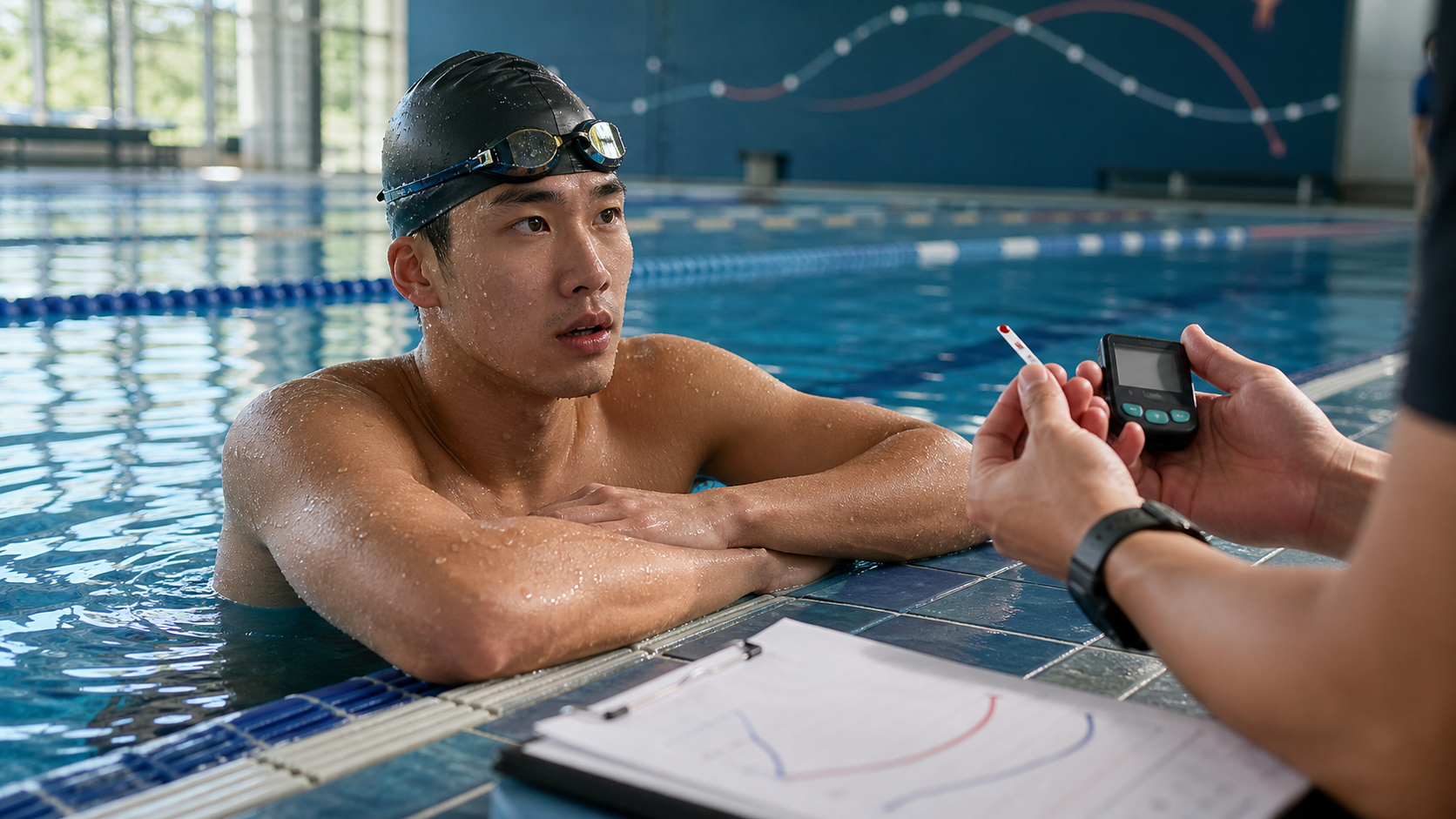
Traditional lactate testing requires a fingertip (or earlobe) blood sample analyzed with a lactate analyzer. Equipment costs approximately NT$15,000–30,000, making it difficult for the average fitness swimmer to access.
Feasible alternatives:
- Heart Rate Calculation: The lactate threshold roughly corresponds to 80–85% of maximum heart rate, allowing a rough estimation of training zones via heart rate
- Rating of Perceived Exertion (RPE): Threshold training corresponds to RPE 6–7/10, “hard but not all-out”
- CSS Testing: As described above, an estimation method that requires no blood testing
- Pace Monitoring: Modern swimming smartwatches (such as the Garmin Swim 2) can record pace and help manage threshold training intensity
Lactate Management Before Competition
- 48 hours before competition: Avoid high-intensity training to allow muscle lactate buffering capacity to recover
- Pre-race warm-up: Include a small amount of threshold-intensity warm-up swimming to activate aerobic metabolism and boost pre-race lactate clearance enzyme activity
- Race pacing: Base pacing on MLSS speed, adjusted according to race distance (the shorter the distance, the greater the allowable margin above MLSS)
Conclusion
The blood lactate curve is a core tool for the scientific approach to swim training. From LT1 to MLSS, each lactate turnpoint corresponds to specific training goals and race strategies. In Taiwan, even without laboratory equipment, swimmers can reasonably define their individual lactate training zones through CSS testing, heart rate monitoring, and perceived exertion. Bringing lactate science from the laboratory into every swimming pool is the most efficient path to improving swimming performance.
Related Reading
- Lactate Dynamics: An In-Depth Analysis for Cyclists
- The Truth About Lactate Threshold and Anaerobic Threshold: Lactate Is Not Waste but Fuel
- Cycling Lactate Testing: Application of Blood Lactate Concentration in Training Zone Setting
- Lactate Dynamics and Buffering Capacity: The Lactate You Misunderstood
西進武嶺 免費訓練分析服務 Intervals | 練不夠還是練過頭?你哪一種類型選手?AI模型告訴你! | 備戰神器 | 公路車 訓練 | CT Yeh
4 年前
一起升級!海鷗盃LSD團練...JJSC Zone2招待 騎到手抖 / 公路車 / CT Yeh
1 天前
#公路車 #Vo2Max #最大攝氧量 測驗 體驗 | 心肺測試
6 年前
福隆鐵人團練隨拍
8 年前
一日北高/長距離團騎 常見問題補充篇 / 組團或跟團的眉角 / 壯車友容易被瘦車友慢性拉爆 / 原來屁股痛可能是這個原因...? / 風場配速法 / 公路車 / CT Yeh
2 年前
靠單車減肥35公斤 心得分享與整理
7 年前
CT暗黑廚房) 車友必備 宇宙無敵鮮蚵湯 幫助訓練恢復 天然食補 好市多 超肥鮮蚵 破PR
7 年前
戰略) Zwift Race 如何咬在第一集團 如何評估自己要開多少推力 (請開1.5倍速看)
7 年前