The Propulsive Efficiency of Kicking in Swimming: The Dual Role of Kicking in Propulsion and Drag
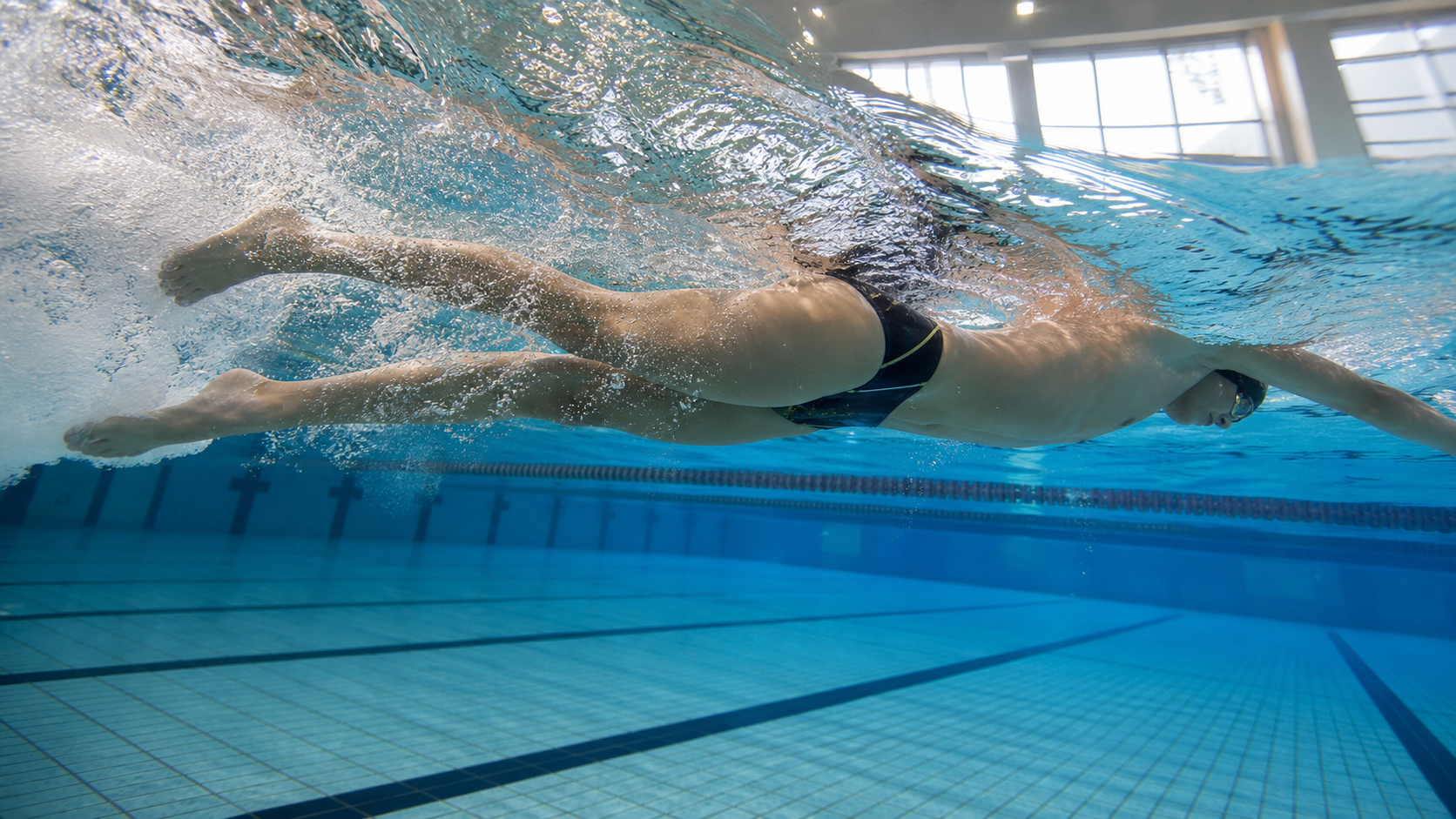
Kicking: The Most Misunderstood Technical Element in Swimming
Ask a beginner swimmer “what should your legs do when swimming?”, and most will answer “kick hard.” However, sports science research reveals a surprising fact: the direct contribution of the freestyle kick to propulsion may only be 10–30%, yet it consumes a significant amount of energy (oxygen consumption). To make things more complex, improper kicking can actually increase drag, offsetting the propulsion generated by the arm stroke. Understanding the fluid dynamics of kicking is the key to finding a kicking strategy that is both efficient and effective.
Research on Kicking Propulsion: Surprising Data
Review of Classic Studies
Multiple studies using dynamometers and flow velocity measurements show:
| Research Method | Estimated Kick Propulsion Contribution | Notes |
|---|---|---|
| Covering the arms with paddles, measuring speed using kicks only | 10–20% (at peak speed) | Direct measurement, but alters the movement pattern |
| Electromagnetic flow meters measuring water flow around the feet | 15–25% | Measured during normal swimming |
| Computational fluid dynamics (CFD) models | 10–30% (depending on kick rate) | Related to stroke rate and swimming speed |
Conclusion: The kick’s contribution to direct propulsion is relatively limited in most swimming scenarios, but this does not mean kicking is unimportant—it serves other critical functions.
The Multiple Biomechanical Functions of Kicking
1. Maintaining a Horizontal Body Position (Drag-Reduction Function)
This is one of the most important functions of kicking, yet it is also the most overlooked. Due to the high density of muscles and bones in the legs, they naturally sink without kicking. For every 10° the legs sink, the frontal cross-sectional area increases by approximately 20–30%, significantly raising form drag.
Therefore, the primary task of kicking is to “avoid adding drag,” not to “add propulsion.”
Research shows that compared to no kicking, appropriate kicking:
- Improves body horizontal alignment, reducing drag by approximately 15–25%
- Is equivalent to adding 15–25% of “net propulsion”
2. Counterbalancing Arm-Stroke Rotation (Stabilization Function)
With each arm stroke, the body naturally rotates (rolls). Kicking (especially the 6-beat kick) provides a counter-rotational torque through the cross-body action of the opposite leg, stabilizing the body’s lateral rotation within the optimal range (approximately 40–50°).
If the kicking force is insufficient, body rotation may become excessive (> 60°), increasing lateral drag; if kicking is too strong, it may inhibit shoulder rotation, limiting stroke efficiency.
3. Rhythmic Coordination (Tempo Function)
The kick rhythm provides a metronome function for the entire stroke cycle:
- 6-beat kick: High tempo, suited for short-distance sprints and high stroke rates
- 4-beat kick: Moderate tempo, a balance between sprinting and endurance
- 2-beat kick: Low tempo, highest energy efficiency, suited for long-distance swimming
4. Direct Propulsion (Auxiliary Function)
In a few situations, the kick’s direct propulsion contribution is more significant:
- At lower swimming speeds (< 1.2 m/s), the relative proportion of arm-stroke propulsion decreases
- The direct propulsion contribution of the breaststroke kick and dolphin kick (butterfly) is higher than that of the freestyle kick
- During the start sprint of the swim leg in triathlon, the propulsion contribution of the 6-beat kick becomes more important
Energy Efficiency Comparison of Different Kick Rhythms
| Kick Rhythm | Oxygen Consumption per Kilometer | Direct Propulsion Contribution | Suitable Distance |
|---|---|---|---|
| 2-beat kick | Lowest (baseline) | Lowest (approx. 10%) | Long distance (1500m+, triathlon) |
| 4-beat kick | Moderate (+8–12%) | Moderate (approx. 15%) | Mid-long distance (400–800m) |
| 6-beat kick | Highest (+20–30%) | Highest (approx. 20–30%) | Short distance (50–200m) |
Key Insight: The 6-beat kick consumes 20–30% more oxygen than the 2-beat kick, but the increase in direct propulsion is far from proportional. Long-distance swimmers adopting the 2-beat kick is a scientifically sound choice for conserving energy.
Fluid Dynamics Details of Kicking Technique
Ideal Kick Amplitude
- Research recommendation: Vertical ankle displacement of approximately 25–35 cm (roughly equal to shoulder width)
- Excessive kick amplitude (> 40 cm): Increases drag, disrupts the flow field, and consumes more energy
- Insufficient kick amplitude (< 15 cm): Fails to effectively maintain body horizontal alignment, and the legs still sink
The Importance of Ankle Flexibility
The range of ankle plantar flexion (pointing the foot downward) directly determines kicking efficiency:
- Flexible ankles (plantar flexion > 50°): The foot can present a large surface area to the water, creating a whip-like effect similar to a fish tail, resulting in high propulsive efficiency
- Stiff ankles (plantar flexion < 30°): The foot is nearly vertical, presenting a small surface area to the water, resulting in low efficiency
- Research shows that for every 10° increase in ankle plantar flexion, kicking efficiency improves by approximately 6–10%
Ankle flexibility training:
- Daily ankle rotations (20 circles in each direction)
- Kneeling sit (Japanese seiza position) to stretch the ankles, 1–2 minutes per session
- Slow swimming with fins to force the ankles to work through a large range of motion
The Origin Point of the Kick
Modern research consistently recommends that the kick should be initiated from the hips (hip joint), not from the knee joint:
- Correct: Hip drive → thigh → lower leg → ankle (wave-like transmission)
- Incorrect: Kicking after excessive knee flexion (“bicycle-style kicking”), which increases drag
- Recommended knee flexion angle: < 30° (slight bend, not a large flexion)
Kicking Strategies for Special Scenarios
Triathlon Swim Leg
- Since the swim is immediately followed by the bike leg, excessive kicking causing lower-limb fatigue will severely impact cycling performance
- Recommendation: Use a 2-beat kick for the first portion (75%) to conserve leg energy, then switch to a 6-beat kick for the final 100–200m to activate the legs
Open Water Swimming
- Environments with waves and uneven currents require more flexible kick adjustments
- Increase kick rate when swimming against a current (for greater stability); reduce kicking when riding with waves (to conserve energy)
Kick Drills in Training
- Kickboard drill: Isolates the kicking motion, focusing on ankle action and hip initiation
- Backstroke kicking: Since the face is upward, the ankle action can be observed, making it an excellent way to correct technique
- Slow swimming with fins: The propulsion from the fins allows swimmers to feel the “propulsive sensation” of an effective kick
- Pull buoy swimming: Place a pull buoy between the ankles and swim using only the arms, feeling the speed difference without kicking, to understand the kick’s true contribution
Conclusion
The science of kicking tells us that the primary value of the legs in swimming is not “generating propulsion” but “avoiding added drag”—maintaining body horizontal alignment and counterbalancing arm-stroke rotation. For long-distance swimmers, adopting the energy-efficient 2-beat kick while focusing on optimizing stroke technique is the most rational efficiency strategy. For short-distance competitive swimmers, the rhythmic coordination and additional propulsion of the 6-beat kick remain meaningful, but they must be built on the technical foundation of ankle flexibility and hip initiation to prevent kicking from becoming a black hole of energy expenditure.
Related Reading
- The Science of Freestyle Kicking: How to Choose Between 2-Beat, 4-Beat, and 6-Beat? Leg-Saving Strategies for Long-Distance Swimming and Triathlon
- The Mechanics of Swimming Propulsion: Hand Surface Area, Pulling Angle, and Propulsive Efficiency
- Freestyle Stroke Rhythm: Applicable Scenarios and Training Strategies for 2-Beat, 4-Beat, and 6-Beat Kicking
- Elastic Tendon Training for Swimming: The Relationship Between Ankle Flexibility and Propulsion
西進武嶺 免費訓練分析服務 Intervals | 練不夠還是練過頭?你哪一種類型選手?AI模型告訴你! | 備戰神器 | 公路車 訓練 | CT Yeh
4 年前
洗單車神器 吹水機! 實際洗車用用看 暴力洗鍊條大法 | 公路車 | CT Yeh
4 年前
CT 喇低賽) 武嶺牽車 才是王道 西進牽車四小時內秘訣 攝手位置 如何判斷 防抽筋小秘訣
7 年前
西進武嶺 8000名單車友數據分析 PART1 | 從新手到高手數量/瓦數/推力比/FTP推力比/功率計使用率 大解析 | 公路車 | CTYeh
5 年前
西進武嶺 自製新版AI配速表產生器 x 賽前攻略 抱佛腳! 沒有功率計也可以產生配速表嗎?有什麼其他眉角賽前要注意的呢? | 西進武嶺 / 東進武嶺 KOM 攻略 | 公路車 | CT Yeh
4 年前
戰略) Zwift Race 如何咬在第一集團 如何評估自己要開多少推力 (請開1.5倍速看)
7 年前
靠單車減肥35公斤 心得分享與整理
7 年前
詳測) 小米 電動打氣筒 公路車胎要充多久? 值得買嗎? 米家充氣寶 小心燙手!
7 年前