Climbing Pedaling Technique: Comparing Power Output Between Seated Climbing and Standing Sprints
Introduction
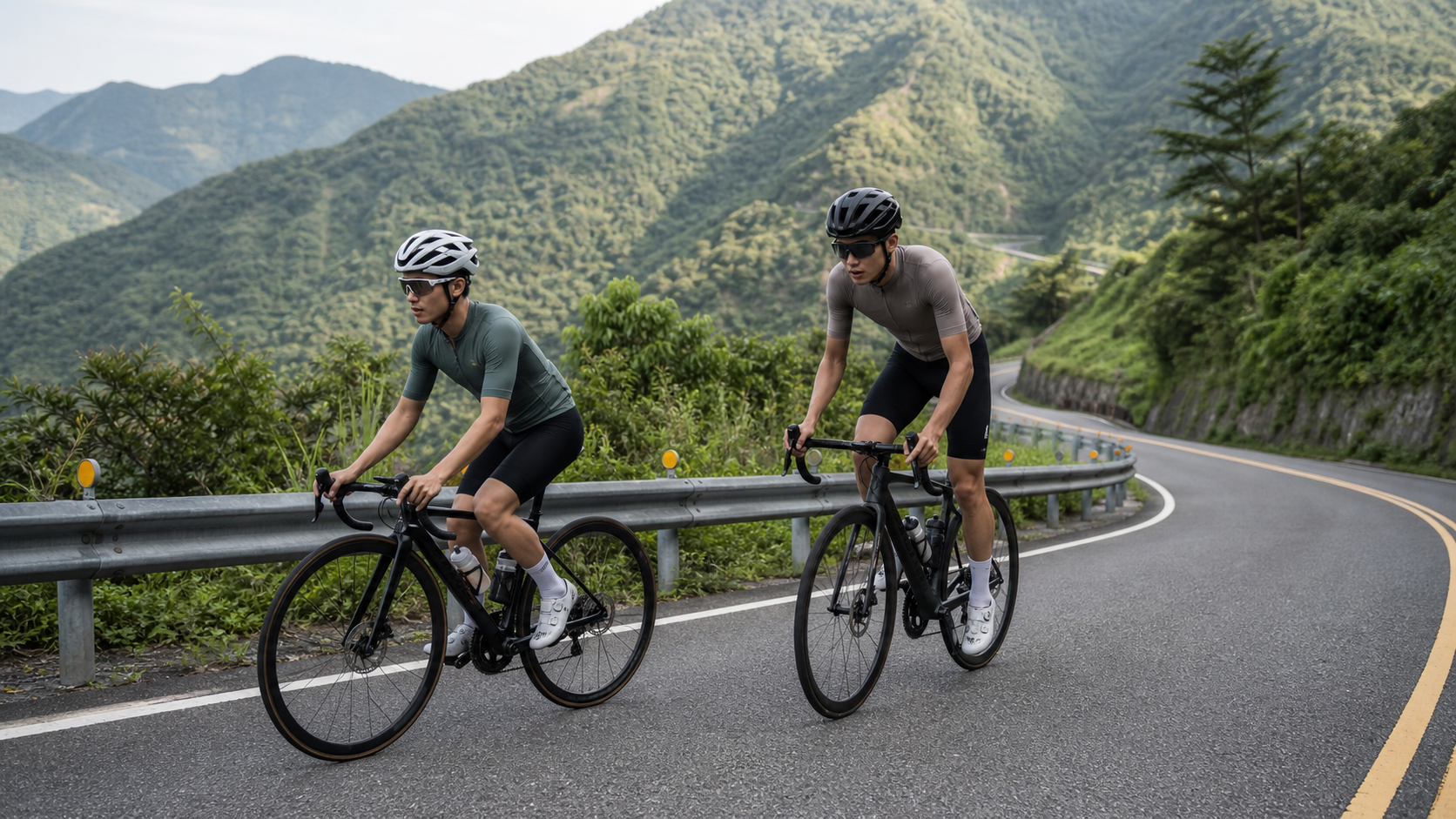
Taiwan’s mountain routes are renowned for their steep slopes and sharp turns, from the relentless climbs of the Beiyi Highway to the nearly 3,000-meter elevation gain of Wuling. Climbing technique is a core skill every road cyclist must master. On long climbs, “Should I stay seated or stand up and sprint?” is a question many riders have faced. This article will delve into the differences between these two climbing postures from three perspectives: power output, muscle activation, and practical application.
Physiological Characteristics of Seated Climbing
Seated climbing is the primary posture for most long climbs, and its core advantage lies in energy efficiency. Studies indicate that at the same power output, seated climbing reduces oxygen consumption by approximately 5–8% compared to standing. The main reasons include:
- Stable center of gravity: Sitting transfers body weight through the saddle to the frame, eliminating the need to continuously engage upper-body muscles for balance
- Steady pedaling rhythm: It’s easier to maintain a high cadence of 80–95 rpm, reducing the explosive force required per pedal stroke
- Lower cardiorespiratory strain: A fixed upper body helps stabilize breathing, making it suitable for sustained output in the Z3–Z4 heart rate zones
Situations suited for seated climbing: gradients below 8%, climb lengths exceeding 3 km, and before reaching the final summit push.
Power Advantages of Standing Out-of-the-Saddle
Standing out of the saddle can unleash higher peak power in a short period, with the mechanism involving:
- Body weight added to the pedal stroke: When standing, body weight can contribute to the downward force, especially effective for pushing big gears
- Full extension of the quadriceps: The knees can extend further, increasing the effective range of the pedal stroke
- Upper body assists with power: Pulling on the handlebars with both arms allows the torso muscles to help boost overall power
However, the cost of standing out of the saddle is a higher heart rate (typically 8–12 bpm higher than seated) and greater lactate accumulation, making it unsuitable for prolonged continuous use.
Power Comparison Table of the Two Postures
| Metric | Seated Climbing | Standing Out-of-the-Saddle |
|---|---|---|
| Average power output | Moderate and steady (85–95% of FTP) | High peak (100–120%+ of FTP) |
| Oxygen consumption efficiency | High (less oxygen per watt) | Low (more oxygen per watt) |
| Primary muscle groups | Quadriceps, gluteus maximus | Quadriceps, gastrocnemius, core |
| Suitable gradient | 4–10% | 10–15%+ or acceleration sections |
| Duration | Can sustain for dozens of minutes | Recommended 30–90 seconds |
| Heart rate response | Stable | Rapid rise of 8–12 bpm |
Hybrid Strategy: Optimizing Long-Climb Performance
Professional riders don’t rely purely on a single posture in competition; instead, they adopt a “sit-stand alternation” strategy:
- After 5–8 minutes of continuous seated climbing, switch to standing for 30–60 seconds to give the sit bones and core muscles a brief rest
- When accelerating out of corners, briefly stand to regain speed, then return to seated to maintain rhythm
- In the final 200–500 meters to the summit, switch to standing for an all-out sprint
Take the Wuling climb as an example: from Cingjing Farm to the Wuling summit is roughly 17 km. It’s recommended to stay seated for the first 12 km to control heart rate, then in the final 5 km, incorporate short standing intervals depending on your energy levels.
Practical Tips
- When practicing seated climbing, deliberately drop one gear easier and maintain a cadence above 85 rpm to train aerobic efficiency
- When practicing standing, find a short 8–12% slope (100–200 meters) and repeat sprints for 5–8 sets to build explosive power
- Use a power meter to record the NP (Normalized Power) of both postures and compare efficiency differences on the same section of road
- Ensure correct saddle height: when seated climbing, a saddle that’s too low will overburden the quadriceps
Conclusion
Seated climbing is a choice of efficiency; standing out of the saddle is a display of power. Truly skilled climbers know how to switch freely between the two, making the best judgment based on gradient, energy levels, and race strategy. Practice both techniques on the Beiyi Highway, Yangmingshan, or Wuling, and let your body memorize the muscle sensations of each scenario—that is the fundamental way to improve your climbing ability.
Related Reading
- Seated vs. Standing Climbing: Criteria for Deciding When to Get Up
- Transitioning Between Seated and Standing Climbing: When Standing to Pedal Is Most Efficient
- Switching Between Seated and Standing Climbing: When Standing to Pedal Is Most Effective
- Complete Analysis of Road Bike Climbing Techniques: Helping You Conquer Every Mountain with Ease
CT 喇低賽) 武嶺牽車 才是王道 西進牽車四小時內秘訣 攝手位置 如何判斷 防抽筋小秘訣
7 年前
如果Pogačar騎西進武嶺可以多快?會破2嗎?各種情況深度推估探討 / 公路車 / CT Yeh
2 年前
一日北高/長距離團騎 常見問題補充篇 / 組團或跟團的眉角 / 壯車友容易被瘦車友慢性拉爆 / 原來屁股痛可能是這個原因...? / 風場配速法 / 公路車 / CT Yeh
2 年前
Stages功率計 和 智騎 X7 Pro 訓練檯同時騎兩個 Rouvy 角色會一起進終點嗎?最後來點數據分析 | 公路車
5 年前
Never Stop 西進武嶺 前後雙機 完整全程錄影 訓練台 實境
8 年前
大禹嶺 到 武嶺牌樓 全程前後實況錄影 | 北進武嶺 | 東進武嶺 | KOM | 訓練台 | 坡度分析 | Taiwan KOM Last 10 km HARD | 公路車
6 年前
單車 梅山36灣 坡度介紹 路段介紹 空拍 (相關遊記影片,請參考說明或我的頻道喔,歡迎訂閱)
6 年前
風櫃嘴 | 全台最多大砲的單車路線 | 尋寶網攝影師告訴你怎麼擺拍起來才好看 | 熱門攝影地點巡禮
6 年前