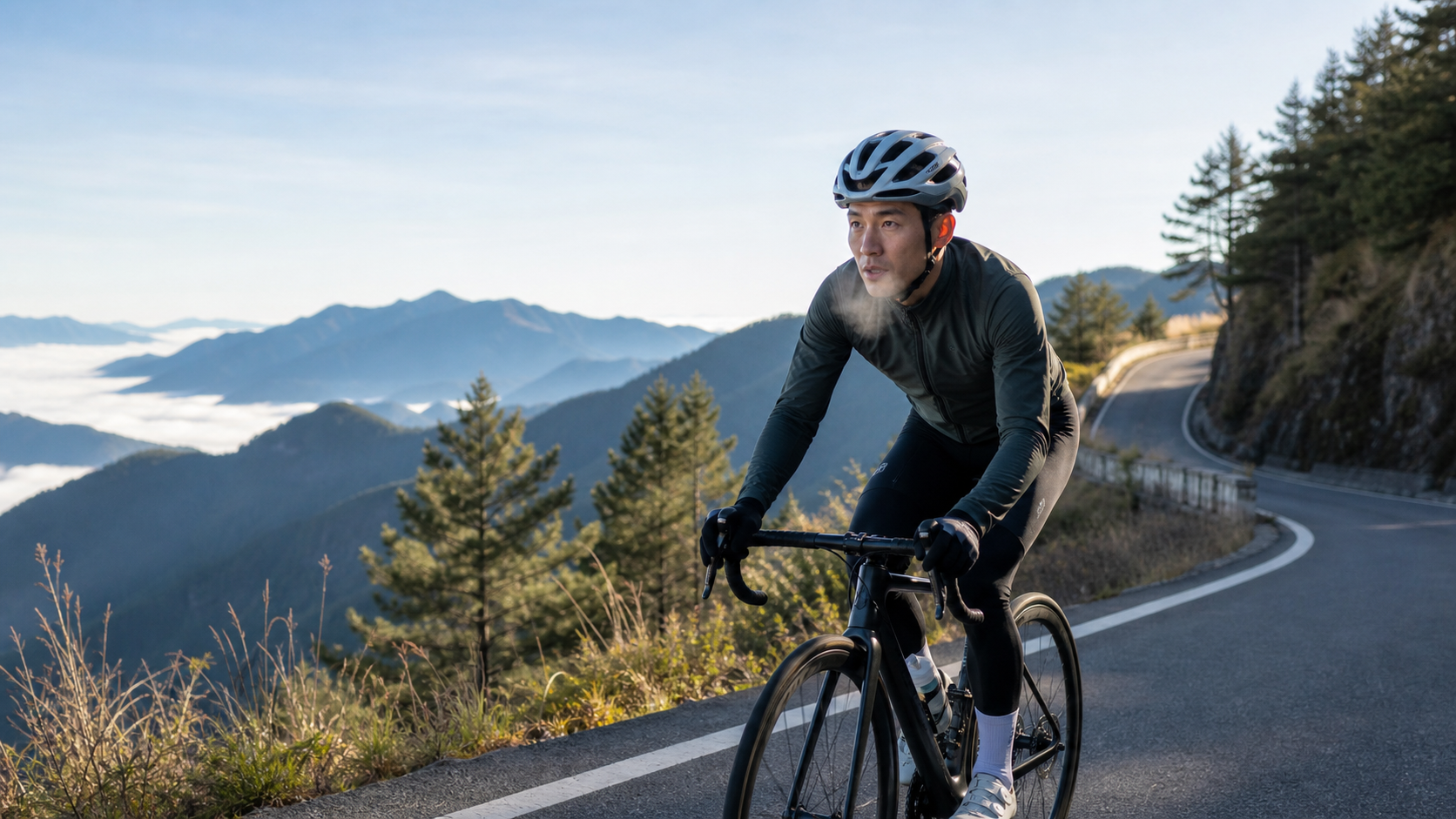
Introduction
When you’re gasping for air on Hehuan Mountain Road, or your heart feels like it’s about to burst on the steep grades of Beiyi Highway, have you ever wondered, “Is my breathing technique correct?” Breathing is one of the key physiological factors affecting climbing efficiency, yet it’s the most overlooked aspect of training. This article explains how to apply the core principles of the 4-7-8 breathing method to long climbs, helping you manage your aerobic output more effectively.
The Physiological Mechanism of Breathing While Climbing
When climbing, the body’s demand for oxygen increases dramatically, placing dual pressure on the respiratory system:
- Increased ventilation: Muscles need more oxygen, and carbon dioxide production also rises, requiring both higher breathing frequency and depth
- Respiratory muscle oxygen consumption: During high-intensity climbing, the respiratory muscles themselves can consume up to 10–15% of total oxygen intake
- Thin air at high altitude: Above 3000m on Hehuan Mountain, the oxygen intake per breath is about 30% less than at sea level
Inefficient breathing (shallow and rapid, mouth gasping) accelerates respiratory muscle fatigue and disrupts blood carbon dioxide balance, triggering a “feeling of breathlessness” that causes riders to give up early or slow down.
The Principles of the 4-7-8 Breathing Method
The 4-7-8 breathing method originates from the yogic technique of “Pranayama,” with its basic form being:
- Inhale for 4 seconds
- Hold for 7 seconds
- Exhale for 8 seconds
In static meditation, this rhythm can effectively lower heart rate and activate the parasympathetic nervous system. However, during climbing, we cannot directly apply such a long breath-hold time. Instead, we apply its core principles:
- Exhalation longer than inhalation: This helps expel more carbon dioxide, keeping blood pH stable
- Consistent rhythm: A regular breathing cadence helps stabilize heart rate and avoid hyperventilation
- Diaphragmatic breathing first: Allow the diaphragm to work fully, increasing the volume of each inhalation
Climbing-Specific Breathing Rhythm Design
Based on different climbing intensities, here are recommended breathing rhythms:
| Climbing Intensity | Recommended Breathing Rhythm | Breathing Method | Description |
|---|---|---|---|
| Z2 (Easy long climb) | Inhale 3 pedal strokes: Exhale 4 pedal strokes | Inhale through nose, exhale through mouth | Best for maintaining aerobic state |
| Z3 (Steady moderate intensity) | Inhale 2 pedal strokes: Exhale 3 pedal strokes | Nose and mouth combined | Balances efficiency and ventilation |
| Z4 (Threshold climb) | Inhale 2 pedal strokes: Exhale 2 pedal strokes | Inhale and exhale through mouth | Rapid gas exchange |
| Z5 (Short climb sprint) | Natural and fast | Full mouth breathing | No forced rhythm |
In Practice: Applying on Taiwan’s Mountain Routes
Beiyi Highway (Gentle to Moderate Grades)
Beiyi Highway’s grades fluctuate between 4–10%, making it ideal for practicing Z3 rhythmic breathing. On the climb from Shiding to Pinglin, deliberately practice the “inhale 2 pedal strokes: exhale 3 pedal strokes” rhythm, using pedal cadence to anchor your breathing and helping your brain focus on the movement rather than fatigue.
Wuling High-Altitude Section (Coping with Thin Air)
Above 2500m on Wuling, many riders instinctively speed up their breathing rate due to the feeling of hypoxia, which ironically triggers hyperventilation (low blood CO₂). In this situation, you should:
- Forcefully slow your breathing rhythm to “inhale 2 pedal strokes: exhale 3 pedal strokes”
- Deliberately deepen each inhalation, feeling your abdomen expand
- Gently draw in your abdomen during exhalation to ensure complete expulsion of waste air
Diaphragmatic Breathing Training Methods
You can practice breathing training in daily life without waiting until you’re on a climb:
- Supine diaphragmatic breathing: Practice for 5 minutes before bed each night, feeling the full range of diaphragm movement
- Standing breathing training: Place hands on your abdomen, practice pushing the abdomen outward on inhalation and drawing it inward on exhalation
- Mindful training while riding: On flat sections, perform 1 minute of deliberate deep breathing every 10 minutes
Practical Tips
- Avoid breathing heavily through your mouth throughout an entire climb; this is a precursor to hyperventilation
- When you feel like you’re about to run out of breath, shift to an easier gear first to give your breathing a chance to stabilize
- Practice deliberately extending exhalation time on easy sections (exhale 1–2 seconds longer than inhale)
- The day before high-altitude riding, do light breathing adjustment exercises to avoid pushing high intensity on the first day
- Record your breathing sounds during climbing training and listen back to check if it’s too rapid or irregular
Conclusion
Breathing is one of the few physiological parameters you can actively control while climbing. Starting today, add 10–15 minutes of rhythmic breathing practice to each training session, and you’ll be surprised to find that even in the thin air at the summit of Wuling, you can discover a sense of composure in your breathing. When your breathing is steady, your heart rate is steady, and the road beneath your wheels carries you further.
Related Reading
- Breathing Rhythm for Cycling Climbs: Optimization Strategies for Oxygen Uptake Efficiency
- Breathing Control While Climbing: The Climbing Benefits of Diaphragmatic and Rhythmic Breathing
- Climbing Breathing Techniques: Synchronizing Diaphragmatic Breathing Rhythm with Pedal Stroke
- Breathing Rhythm on Wuling Climbs: Power Output Differences Between 4-4 vs 3-3 vs Natural Breathing
一日北高/長距離團騎 常見問題補充篇 / 組團或跟團的眉角 / 壯車友容易被瘦車友慢性拉爆 / 原來屁股痛可能是這個原因...? / 風場配速法 / 公路車 / CT Yeh
2 年前
CT 喇低賽) 武嶺牽車 才是王道 西進牽車四小時內秘訣 攝手位置 如何判斷 防抽筋小秘訣
7 年前
公路車 爬坡 破PR 紀錄 小技巧 分享
6 年前
西進武嶺 自製新版AI配速表產生器 x 賽前攻略 抱佛腳! 沒有功率計也可以產生配速表嗎?有什麼其他眉角賽前要注意的呢? | 西進武嶺 / 東進武嶺 KOM 攻略 | 公路車 | CT Yeh
4 年前
西進武嶺 免費訓練分析服務 Intervals | 練不夠還是練過頭?你哪一種類型選手?AI模型告訴你! | 備戰神器 | 公路車 訓練 | CT Yeh
4 年前
台北闊瀨陡坡 騎旅 / 日本單車雜誌編輯車友臨時加入!/ 髮香才是最強的 / feat. 北迴歸線小隊 / 公路車 CT Yeh
6 個月前
#公路車 #西進武嶺 配速配瓦實驗 坡度分析 四小時內攻略 建大盃 NeverStop #西進武嶺攻略
6 年前
大禹嶺 到 武嶺牌樓 全程前後實況錄影 | 北進武嶺 | 東進武嶺 | KOM | 訓練台 | 坡度分析 | Taiwan KOM Last 10 km HARD | 公路車
6 年前