Introduction
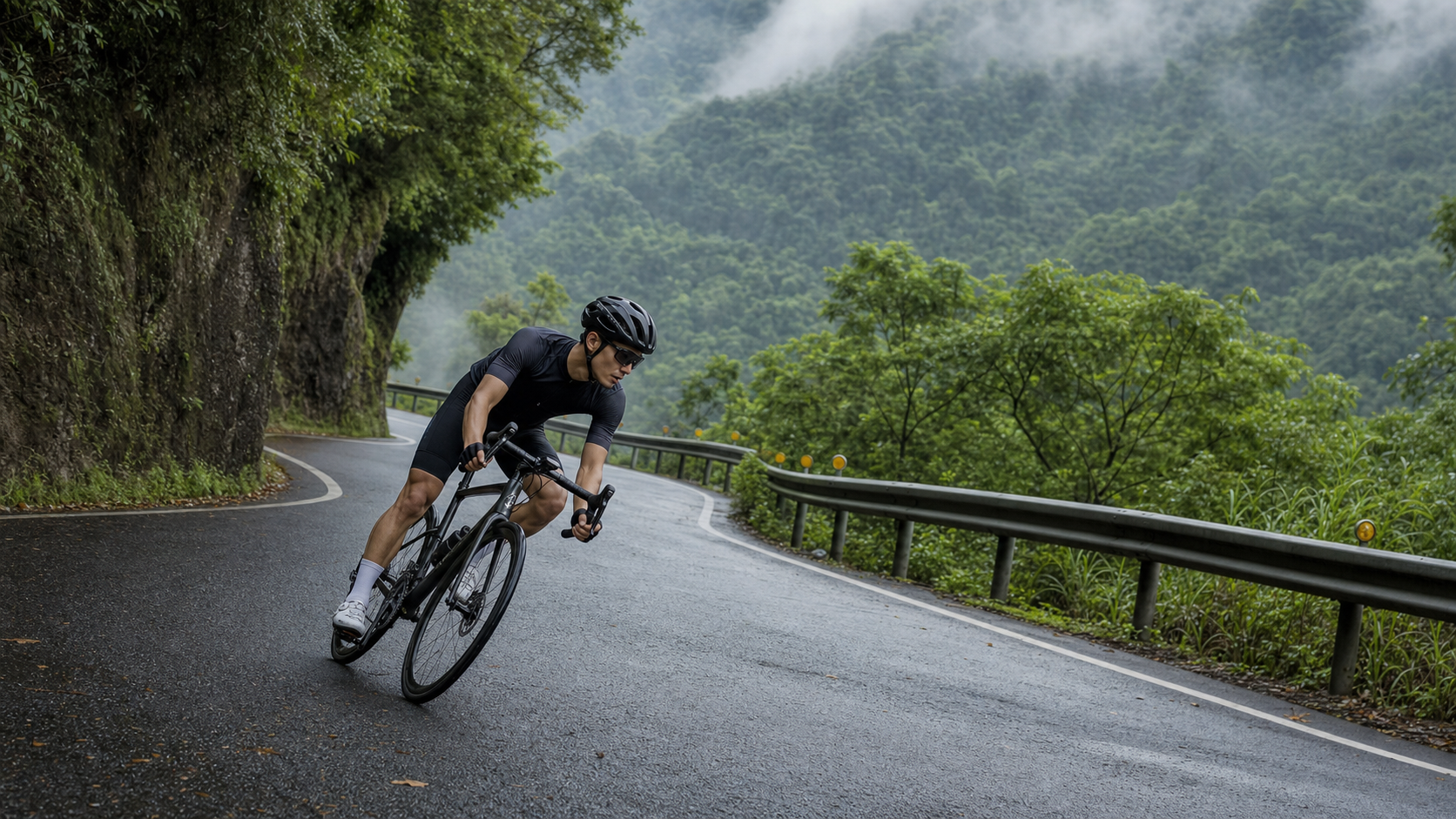
The Beiyi Highway (Provincial Highway 9), stretching approximately 38 kilometers from Shiding in New Taipei City to Jiaoxi in Yilan, with an elevation gain of about 700 meters, is renowned for its dense curves and undulating gradients. This route tests not only physical stamina but also technical skill—particularly in braking judgment before corners, cornering angles, and the rhythm of accelerating out of turns. This article provides an in-depth analysis of cornering techniques on the Beiyi Highway, helping you ride faster and safer on this classic route.
Terrain Characteristics of the Beiyi Highway
The uphill direction of the Beiyi Highway (Shiding → Pinglin → Jiaoxi) features the following characteristics:
- Significant Undulations: Gradients frequently alternate between 4–14%, requiring constant gear adjustments.
- Dense Curves: Especially around Pinglin, hairpin turns and sweeping curves appear in succession.
- Limited Visibility: Mountain walls often obscure the exit point of many corners.
- Risk of Slippery Road Surfaces: Frequent fog and rain often leave gravel or water patches on the road.
These characteristics make the Beiyi Highway an excellent place to practice cornering techniques, while also making it one of the most dangerous routes for riders lacking technical proficiency.
Techniques for Judging Braking Points
The most critical decision before a corner is “when to start braking and how much force to apply.” Below is a systematic method for judging braking points:
Visual Reference Point Method
Before entering a corner, your eyes should locate the following reference points:
- Turn-in Point: The position where you begin to steer the handlebars.
- Apex: The innermost point of the cornering trajectory.
- Exit Point: The position where you finish steering and begin to accelerate.
“Waiting to see the exit before braking” is a common misconception among beginners—in reality, you should begin braking 5–10 meters before reaching the turn-in point.
Brake Distribution Principles
| Riding Condition | Front Brake Ratio | Rear Brake Ratio | Explanation |
|---|---|---|---|
| General Downhill Corner | 70% | 30% | Front brake has strong stopping power but watch for locking risk |
| Slippery Road Corner | 50% | 50% | Balanced distribution reduces the risk of skidding |
| Steep Uphill Corner | 60% | 40% | Light tap on rear brake first, then steady pressure on front |
| Sharp Corner (<90°) | 80% | 20% | Complete all braking before entering the corner |
Important Principle: “No braking in the corner”—all braking should be completed before entering the turn. Applying brakes while in a corner is the most common cause of crashes.
Center of Gravity Transfer Techniques
Gravity control determines how fast and safely you can navigate a corner:
Inner Pedal Position
- Downhill Corner: Place the inner pedal at the highest point (12 o’clock) to prevent the pedal from striking the ground.
- Uphill Corner: If the speed is slow, you can let the inner foot press down slightly to increase the sense of balance.
Body Tilting Technique
- Look toward the corner exit (do not stare at the center of the corner).
- Apply force to the outer pedal, letting the outer leg act as a pillar to support your center of gravity.
- Tilt your upper body with the bike, but keep your hips stable on the saddle.
- Relax your hands (do not grip the handlebars tightly), allowing the handlebars to steer naturally.
Technique and Timing for Accelerating Out of Corners
Accelerating out of a corner is the segment of climbing technique that best demonstrates a rider’s skill:
Correct Exit Acceleration Process:
- After passing the apex, begin to release the brakes.
- Return your body’s center of gravity to the neutral position, with your gaze already shifted to the next target.
- As the bike returns to an upright position, begin to increase pedaling force.
- Use a brief out-of-the-saddle “exit sprint” to recover the speed lost during cornering.
Beiyi Highway Specific Techniques:
- For the continuous curves near Pinglin, learn to “link the corners”—do not accelerate fully between corners; maintain a smooth rhythm.
- After exiting an uphill corner, immediately shift to a heavier gear to utilize momentum for acceleration.
Practical Advice
- When challenging the Beiyi Highway for the first time, it is recommended to follow an experienced rider at a slower pace to familiarize yourself with the characteristics of each corner.
- Every corner is different; it is recommended to practice on the same road multiple times to build “muscle memory” for each turn.
- Avoid the Beiyi Highway on rainy days, or significantly reduce your speed; braking distance can increase by 30–50% on wet surfaces.
- The Beiyi Highway has heavy traffic on weekends; be aware of oncoming vehicles and do not cut corners into the opposing lane.
- Before departing, check the condition of your brake pads; brake pads worn beyond the wear line may fail during emergency braking in sharp turns.
Conclusion
The Beiyi Highway is one of the best climbing technique training grounds in Taiwan. Its challenge lies in the fact that it tests not only your physical strength but also your judgment and technique. By mastering the three core techniques of braking point judgment, center of gravity transfer, and exit acceleration, every training session on the Beiyi will be smoother and faster than the last. Approach it with a learning mindset, and the Beiyi Highway will be your best teacher.
Related Topic Reading
- Analysis of the 4km Pinglin Section of Beiyi Highway: A Climbing Testing Ground for Taipei Riders
- Beiyi Highway (Provincial Highway 9) Riding Guide: Gradient Analysis of the “9 Bends and 18 Turns”
- Yilan Beiyi Highway Riding Guide: The Challenging Route from Taipei to Yilan Over the Snow Mountain Range
- Beiyi Highway’s 9 Bends and 18 Turns: A Reverse Cycling Challenge on the Motorcycle Mecca
台北闊瀨陡坡 騎旅 / 日本單車雜誌編輯車友臨時加入!/ 髮香才是最強的 / feat. 北迴歸線小隊 / 公路車 CT Yeh
6 個月前
單車 梅山36灣 坡度介紹 路段介紹 空拍 (相關遊記影片,請參考說明或我的頻道喔,歡迎訂閱)
6 年前
大武山後門26%歡樂陡坡!JJSC南台灣單車行Day2 / 被颱風追著跑 / 公路車 / CT Yeh
2 年前
北宜騎車⋯好刺激 差點被🐒尻 / 露營單車旅 / 公路車後背攜車架開箱!/ 百人大團露 / YAKIMA 設備開箱儀式感都來了 / 公路車 / CT Yeh
12 個月前
一日北高/長距離團騎 常見問題補充篇 / 組團或跟團的眉角 / 壯車友容易被瘦車友慢性拉爆 / 原來屁股痛可能是這個原因...? / 風場配速法 / 公路車 / CT Yeh
2 年前
#北橫 + #北進武嶺 最硬的員工旅遊 EP1 | #公路車 #拉拉山 | 明池 | 武嶺 | 武陵農場 | 雲海 | Taiwan Cycling Route Wulin
6 年前
大禹嶺 到 武嶺牌樓 全程前後實況錄影 | 北進武嶺 | 東進武嶺 | KOM | 訓練台 | 坡度分析 | Taiwan KOM Last 10 km HARD | 公路車
6 年前
單車 一日北高 ( 雙城 ) 肥宅雙人瘋狂行 紀錄片 REACTO
10 年前