Introduction
At swimming pools across Taiwan, the phrase coaches shout most often to swimmers is: “High elbow on the entry!” However, many swimming enthusiasts only have a superficial understanding of the “high-elbow entry,” unclear about why this movement is so important or how to execute it correctly. High Elbow Entry is one of the most influential movements in freestyle technique. From a biomechanical perspective, it directly determines catch efficiency and the strength of propulsive pull force.
The Biomechanics of High-Elbow Entry
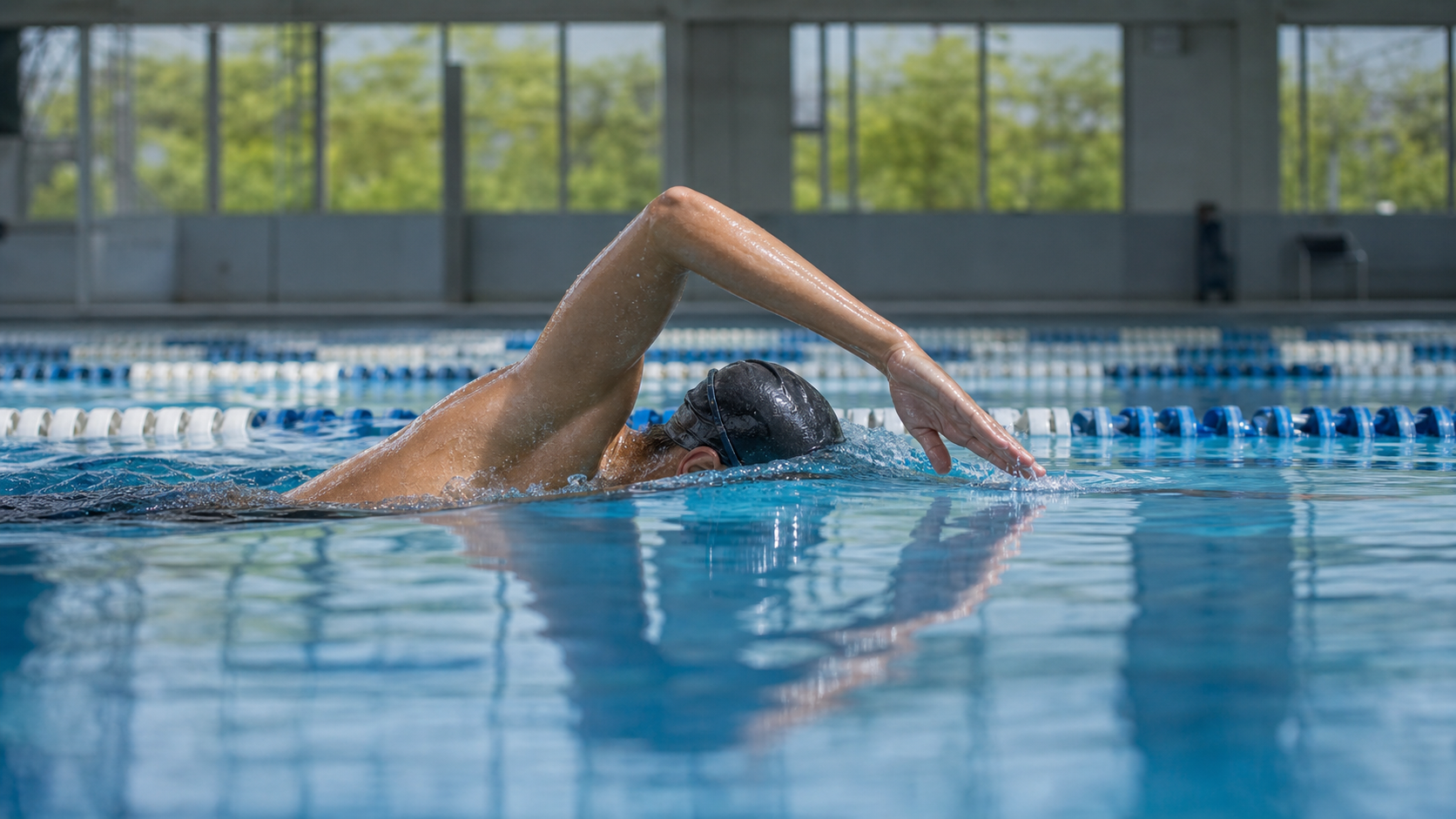
So-called high-elbow entry refers to the arm extending forward over the head and entering the water with the elbow joint maintained above the wrist, with the thumb side or middle fingertip touching the water first, rather than the entire palm slapping the surface. This movement appears simple, but it is backed by profound biomechanical logic.
Reduced Entry Drag: When the arm cuts into the water at a streamlined angle, the entry surface area is minimized, producing the least splash and turbulence. In contrast, entering with a flat palm not only creates an obvious “slapping sound” but also forms a bubble layer on the surface, greatly increasing friction during the subsequent catch.
Shorter Time to Catch: After a high-elbow entry, the arm naturally extends forward into the “glide and stretch” position. At this point, only a slight downward press of the wrist is needed to quickly initiate the Early Vertical Forearm (EVF) catch, significantly shortening the time lag from entry to propulsion.
Reduced Shoulder Joint Stress: A correct high-elbow entry allows the shoulder to rotate along the body’s longitudinal axis rather than over-abducting, helping to protect the rotator cuff muscles and lowering the risk of Swimmer’s Shoulder.
Common Entry Errors and Comparison
| Entry Style | Entry Drag | Catch Efficiency | Shoulder Joint Stress | Suitability |
|---|---|---|---|---|
| High-elbow entry (correct) | Low | High | Low | Highly recommended |
| Flat palm slap entry | High | Low | Medium | Not recommended |
| Crossing the body midline entry | Medium | Low | High | Not recommended |
| Elbow-first entry | Medium | Medium | High | Not recommended |
At many community pools in Taiwan, the common “crossing the midline” problem can be observed in beginners—the arm crosses the body’s longitudinal axis upon entry, causing the body to sway side to side. This not only wastes energy but also increases the risk of shoulder injury.
Training Methods for High-Elbow Entry
1. Dry-Land Imitation Drills
Stand in front of a mirror and alternately simulate the pulling motion with both arms. Key points to check:
- When the arm extends forward, the elbow is slightly higher than the wrist
- Fingers are naturally together, not deliberately spread
- Entry angle is approximately 30–45 degrees in front of the shoulder line
2. Slow-Paced Technique Swimming
At swimming centers in Taipei or at Taichung’s Qingshui Swimming Pool, choose a lane with few people and swim freestyle at half speed, focusing on feeling the elbow position at each entry. It is recommended to use an underwater mirror or have a coach film underwater video for corrections.
3. Single-Arm Drill
Hold a kickboard with one arm while performing a full pulling motion with the other, slowing down to repeatedly confirm the entry details. This drill is quite common in training programs at swimming clubs across Taiwan.
4. Fingertip Drag Drill
On the recovery, drag your fingertips along the water’s surface, forcing the elbow to stay high and naturally guiding the fingers to enter the water first.
Training Progression Recommendations
- Initial phase (1–2 weeks): Dry-land imitation + slow technique swimming, 200–400 meters per session
- Intermediate phase (3–4 weeks): Add single-arm drills, total distance 600–800 meters
- Consolidation phase (after 5 weeks): Swim at normal pace, consciously maintaining a high elbow, and record video regularly to confirm
Practical Tips
- Combine with breathing practice: Rotate the body when breathing rather than turning the head excessively, which helps maintain the high-elbow position during entry
- Avoid over-reaching: There is no need to force the arm completely straight when extending; a slight bend can reduce shoulder tension
- Choose an appropriate training venue: Swimming clubs offering underwater video services are available in northern, central, and southern Taiwan; regular video recording is the fastest way to improve technique
- Train in warm water: Pool water temperatures in Taiwan are low in winter, and stiff muscles can affect movement quality. It is recommended to choose warm-water pools above 28°C for technique training
Conclusion
High-elbow entry is not just a minor detail—it is the starting point of the entire freestyle technique chain. Only by optimizing entry quality can the subsequent catch and pull phases achieve maximum effectiveness. The next time swimming enthusiasts in Taiwan hit the water, try slowing down and focusing on the quality of each entry—you will discover that a small postural adjustment can make swimming easier and faster.
Related Reading
- Freestyle Pull “High-Elbow Entry” Technique: The Effect of Elbow Angle on Pull Efficiency
- Freestyle High-Elbow Catch: The Core Key to Feel for the Water
- Freestyle Pull Technique: Modern Perspectives on High-Elbow Entry and the S-Shaped Pull
- Freestyle High-Elbow Catch: The Most Important Pulling Technique
CT 喇低賽) 武嶺牽車 才是王道 西進牽車四小時內秘訣 攝手位置 如何判斷 防抽筋小秘訣
7 年前
西進武嶺 自製新版AI配速表產生器 x 賽前攻略 抱佛腳! 沒有功率計也可以產生配速表嗎?有什麼其他眉角賽前要注意的呢? | 西進武嶺 / 東進武嶺 KOM 攻略 | 公路車 | CT Yeh
4 年前
抖肩舞 台灣x日本交流版 (台灣 vs 前橋) 赤城山登山賽 coincidance
8 年前
西進武嶺 免費訓練分析服務 Intervals | 練不夠還是練過頭?你哪一種類型選手?AI模型告訴你! | 備戰神器 | 公路車 訓練 | CT Yeh
4 年前
風櫃嘴 衝刺慢動作回放!
8 年前
[教學] Premiere 影片 手震 修正 教學 防抖 單眼 影像 GoPro 穩定 Video Stabilization
8 年前
NEKO's Fun 高美濕地團練
8 年前
多機位拍片神器 DJI Action 2 拍出速度張力感 | 類空拍機視角 4陣列麥克風超強降風噪 實測! | 公路車 | CT Yeh
3 年前