Freestyle Body Roll Technique: The Relationship Between Hip Rotation Angle and Stroke Efficiency
Introduction
At swimming schools across Taiwan, instructors often say “you need to rotate your body in freestyle,” but “how much rotation is correct” is rarely explained clearly. Hip rotation is the most underestimated aspect of freestyle technique among amateur swimmers—too little rotation results in insufficient stroke power; excessive rotation causes the body to snake side to side, increasing drag instead. Finding your optimal rotation angle is a key step toward improving freestyle efficiency.
Biomechanics of Hip Rotation
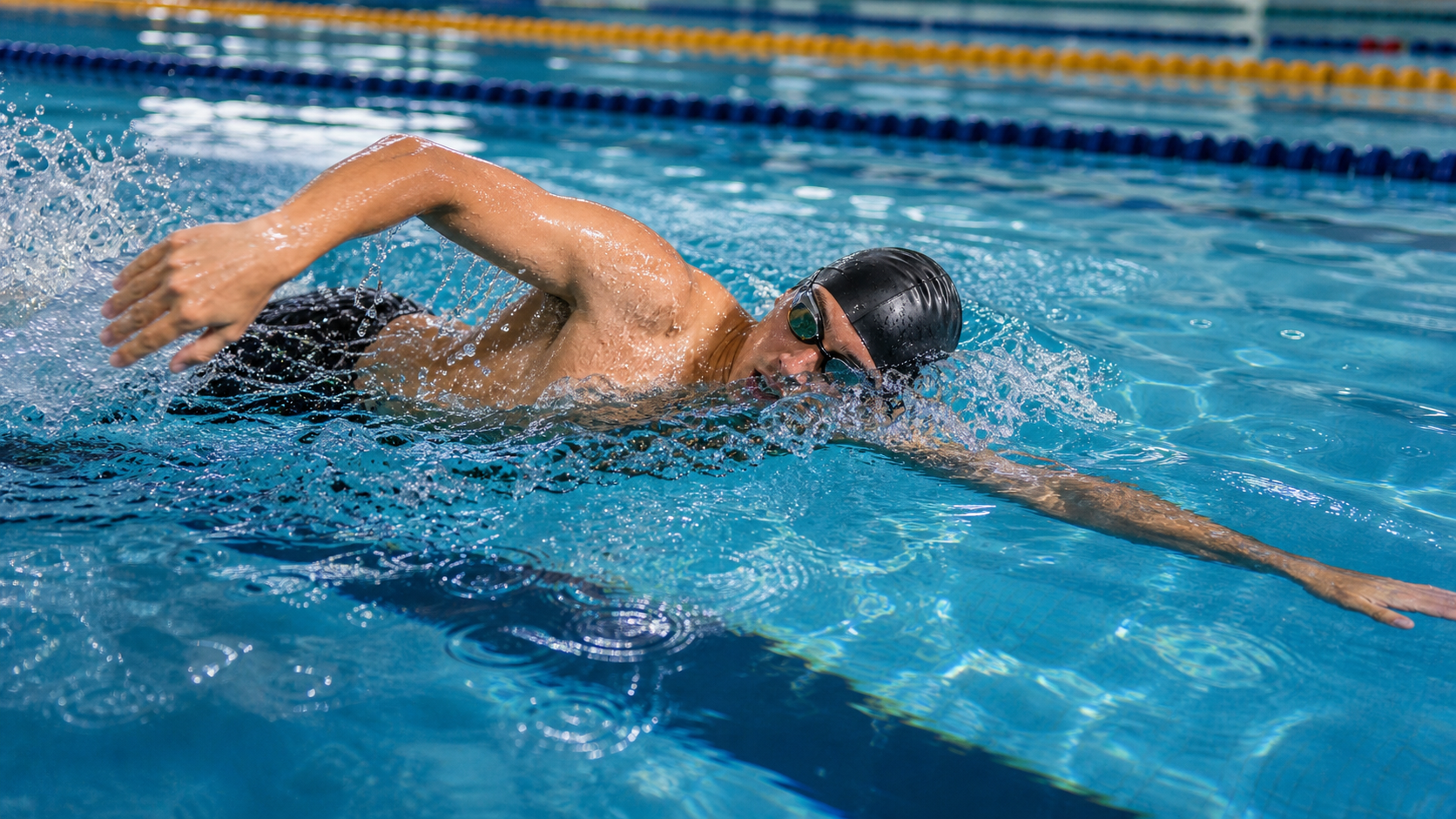
The propulsive force in freestyle primarily comes from large muscle groups such as the latissimus dorsi and teres major, and effective activation of these muscles requires coordinated hip rotation. As the body rotates from one side to the other, the stroking arm can “borrow” the momentum generated by the rotation, making the push phase more complete and powerful.
Three key benefits of body rotation:
- Increased stroke depth: As the body rotates toward the stroking side, the arm can reach deeper into the water, extending the effective propulsion distance
- Reduced frontal drag: The lateral cross-sectional area of the body is far smaller than the frontal area; rotation significantly lowers resistance
- Assists breathing: Rotation naturally lifts the mouth on the breathing side above the water, reducing the need to lift the head during breaths
Optimal Rotation Angle Analysis
| Rotation Angle | Effect Description | Suitable Scenario | Potential Issues |
|---|---|---|---|
| Below 30° | Shallow stroke, insufficient propulsion | None | Slow speed, prone to fatigue |
| 30°–45° | Balances drag and propulsion | Long-distance swimming (1500m+) | Requires appropriate stroke rate |
| 45°–60° | Maximizes propulsion | Mid-distance racing (200–400m) | Requires solid core control |
| Over 60° | Increased drag, snaking side to side | None | Wasted energy, speed decreases |
Research shows that elite freestyle swimmers typically rotate between 40°–55°, a range that achieves the optimal balance between propulsion and drag.
The Hips Lead the Arms, Not the Arms Lead the Hips
Many amateur swimmers get the rotation sequence wrong—they use the force of their arm pull to “drive” the body’s rotation. In reality, it should be the opposite: hip rotation drives the shoulders, and the shoulders drive the arms. This bottom-up kinetic chain is the foundation of efficient freestyle.
The Correct Kinetic Chain Sequence:
- Kick → Hip initiates rotation → Shoulders follow → Arm pulls
At swimming schools in Taiwan, some coaches ask swimmers to “feel the waist rotation before pulling,” which is precisely about building awareness of the correct kinetic chain.
Rotation Technique Training Drills
Drill 1: Side Kicking
Lie on your side (one arm extended forward, the other resting against the thigh), propelling yourself with kicking only, and feel the water flowing along the side of your body. This drill helps swimmers get comfortable with the side-lying position and establishes a sense of “both ends” of the rotation.
Recommended distance: 2–4 × 50 meters per session, half on each side.
Drill 2: 6-1-6 Drill
Kick 6 times → take one stroke → switch sides and kick 6 times, forcing yourself to slow down and feel the angle and timing of each rotation. This drill is commonly found in basic technique classes of swimming training teams across Taiwan’s cities and counties.
Drill 3: “Rotation Rod” Imagery
Imagine your body’s longitudinal axis is a rotation rod; as you swim, your body rotates around this rod from side to side, rather than rolling the entire body over. This imagery effectively prevents over-rotation.
Drill 4: Timed Technique Swimming
In a standard 25-meter pool in Taiwan, swim one length with normal technique and count your strokes. Then try another length with increased rotation amplitude and compare the stroke count—when rotation improves, the stroke count typically decreases (greater distance per stroke).
Common Rotation Mistakes
- Head rotates along with the body: The head should remain relatively fixed (or only turn during breathing), not sway side to side with the body
- Incorrect rotation timing: Rotation should begin as the hand enters and extends, not halfway through the pull
- Upper body rotates while the lower body stays still: Correct rotation should originate from the hips and drive the entire body, avoiding “upper-lower separation”
Practical Tips
- When swimming in open water at Chengcing Lake in Taichung, rotation is key to swimming in a straight line; excessive rotation tends to veer you to one side
- If you have the chance to swim in clear waters such as Liyu Lake, ask a companion to observe your rotation angle from the side
- Schedule at least one “technique day” per week, focusing entirely on rotation at low speed without chasing pace
- Record your stroke count per 100 meters in a swimming log; this number will decrease as your rotation technique improves
Conclusion
Hip rotation is the amplifier of freestyle efficiency. Mastering the correct rotation angle and timing allows you to swim faster and with less effort—without needing more strength. For swimming enthusiasts in Taiwan, improving this technique often delivers the most immediate speed gains—worth practicing deliberately every time you get in the water.
Related Reading
- Freestyle Body Rotation: The Hidden Key to Efficiency
- Freestyle Body Rotation: The Impact of Axial Rotation on Stroke Power Transfer Efficiency
- Backstroke Stroke Rhythm and Shoulder Rotation: The Overlooked Efficiency Code
- Freestyle Roll Breathing: Breathing-Side Rotation Angle and Drag-Minimization Technique
Insta 360 One 超級防手震技術實測
7 年前
CT 喇低賽) 武嶺牽車 才是王道 西進牽車四小時內秘訣 攝手位置 如何判斷 防抽筋小秘訣
7 年前
如何把 GoPro 影片 翻轉 批次 轉正?
6 年前
近視雷射三個月後悔嗎?單車族/工程師必看,Smart TransPRK 術後血淚史與後遺症全公開 / CT Yeh
4 個月前
靠單車減肥35公斤 心得分享與整理
7 年前
抖肩舞 台灣x日本交流版 (台灣 vs 前橋) 赤城山登山賽 coincidance
8 年前
2023桃園團體繞圈賽 / 海鷗繞圈賽 | 全程空拍數據版 | 公路車 | CT Yeh
2 年前
2016 彰化經典百K - 風景宜人精華版
10 年前