Optimizing Breaststroke Kick Angle: Propulsion Differences Between Outward V-Shaped Kick and Straight-Line Kick
Introduction
Breaststroke is the most commonly learned swimming stroke among people in Taiwan. From children’s swimming classes to adult self-learning, breaststroke is almost always the first choice for beginners. However, the kick technique in breaststroke is often oversimplified—many people only know that “the feet should kick like a frog,” without understanding the profound impact that kick angle has on propulsion. Which is truly better: the Whip Kick or the Narrower Kick? The answer is not an either-or proposition, but rather depends on the structural characteristics of an individual’s hip, knee, and ankle joints.
Basic Mechanics of the Breaststroke Kick
Breaststroke propulsion comes entirely from the kicking motion. Unlike freestyle, the arm pull in breaststroke contributes relatively little to propulsion. Kick propulsion is determined by three factors:
- Surface area of the foot’s pushing plane: The instep, heel, and arch together form the pushing plane; the flatter and larger it is, the better
- Kick direction: The most effective kick direction should be as close to directly backward as possible, minimizing wasted lateral force components
- Kick speed: The acceleration (snap) in the final phase determines the explosive power of propulsion
Whip Kick vs. Straight-Line Kick Comparison
| Feature | Whip Kick | Narrow Kick |
|---|---|---|
| Kick trajectory | Heels open outward, kicking backward in an arc | Heels stay narrower, kicking straight backward |
| Propulsion efficiency | High (good acceleration effect from the arc) | Moderate |
| Resistance phase | Shorter (legs recover quickly) | Longer |
| Suitable joints | Those with good hip external rotation mobility | Those with tighter knees or limited hip rotation |
| Competitive application | Mainstream among elite swimmers | Common in recreational swimming |
| Knee risk | Risk if knee valgus angle is excessive | Relatively lower |
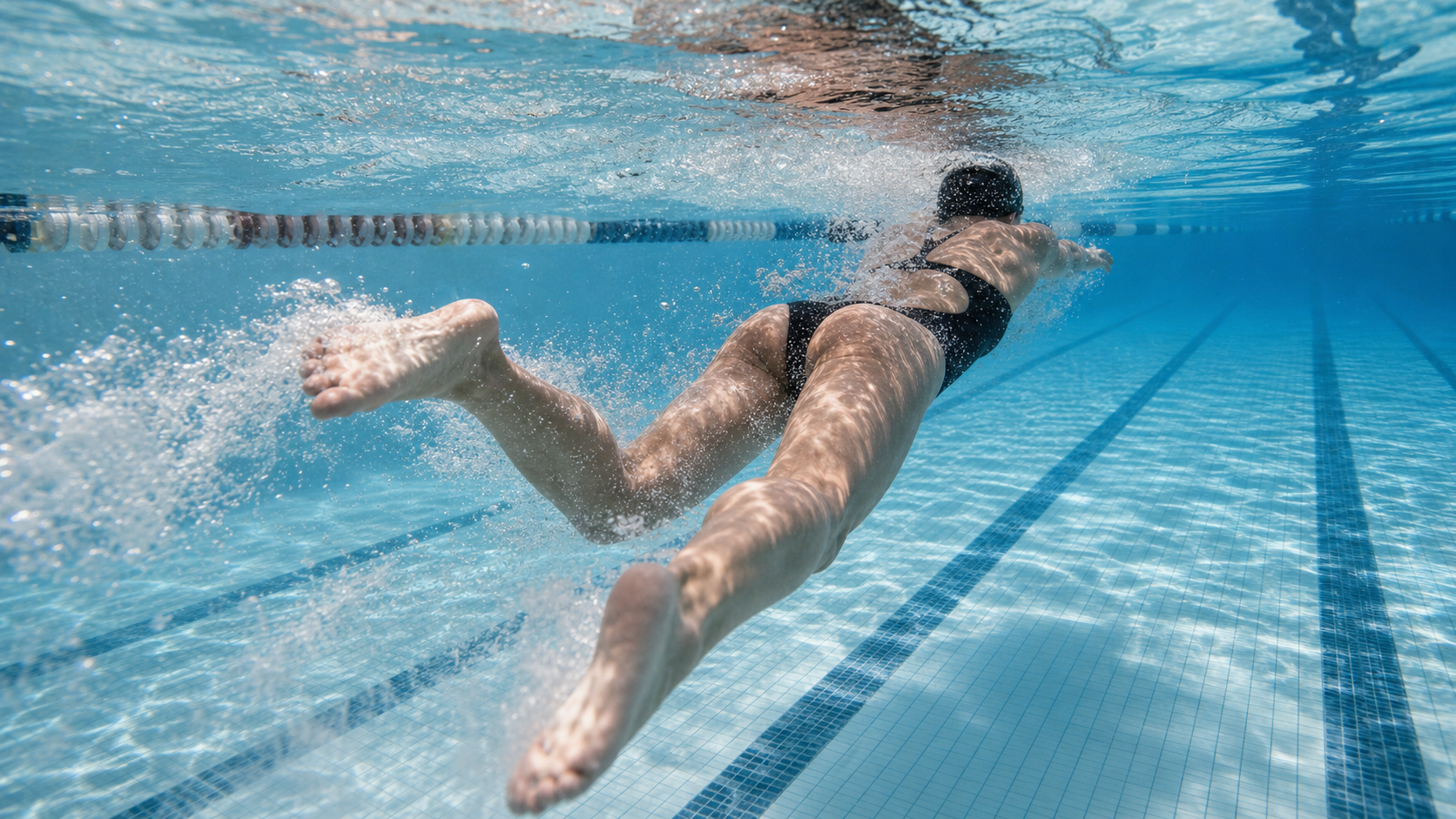
In modern competitive breaststroke, the Whip Kick is the mainstream technique. The “whip” effect of the Whip Kick generates a powerful acceleration at the end of the kick, which is why the kicks of top breaststroke swimmers look like they are “flicking” their feet.
Personalized Kick Angle Selection
Hip External Rotation Test
Sit on the floor with both legs extended straight in front of you, then try to turn both heels outward (toes pointing outward). Those who can externally rotate more than 45° are generally suited to the Whip Kick; for those with weaker external rotation ability, forcibly imitating the Whip Kick may instead create lateral stress on the knees.
Ankle Flexibility
The final phase of the breaststroke kick requires the feet to quickly internally rotate (toes turning inward). Ankle flexibility directly affects the efficiency of this “legs together” motion. This can be gradually improved through seated ankle circles while holding the ankle, ankle stretching, and other methods.
Application in Taiwan’s Swimming Environment
Breaststroke instruction in many community swimming classes in Taiwan is still based on the “straight-line kick,” primarily for teaching safety and simplicity. If you train at swimming clubs or school swim teams in Taiwan, it is recommended that you proactively ask your coach for a personalized kick angle assessment.
Kick Efficiency Improvement Drills
Drill One: Wall Push-Off Feel Drill
Stand with your back to the wall, and slowly push off the wall using the breaststroke kick motion, feeling the amount of pressure different foot angles exert on the wall. Find the angle that produces the greatest pressure—that is your optimal kick angle.
Drill Two: Kickboard Breaststroke Kick
Hold a kickboard with both hands and propel yourself using only the kick, focusing on feeling the glide distance after each kick. With ideal technique, each kick should produce a noticeable forward glide.
Recommended training volume: 4–6 × 50 meters, counting the number of kicks per lap, with the goal of gradually reducing the count (kicking farther each time).
Drill Three: Slow-Motion Kick Breakdown
In the deep end (or holding onto the pool edge), slowly perform the complete kick motion, paying special attention to:
- When recovering the legs, the knees should not be wider than the hips
- The heels should be drawn toward the buttocks, not opened outward
- At the end of the kick, quickly bring the legs together and extend them
Common Kick Errors
- Knees dragging downward: The knees drop during leg recovery, increasing drag. The correct position is to draw the knees toward the chest, maintaining a streamlined shape
- Legs not closing after the kick: The feet fail to quickly come together and extend after the kick, creating continuous drag
- Kick direction angled downward: Force is directed downward rather than backward, failing to produce effective propulsion
- Leg recovery too fast and too wide: Rushing the kick but making the recovery motion too large, increasing water resistance
Practical Advice
- Dedicate one training session per week to a “kick-only day,” focusing on correcting kick technique
- If you experience pain on the outside of the knee during breaststroke practice, stop immediately and assess whether you have a knee valgus issue
- When swimming breaststroke in open water across Taiwan (such as Taitung Living Lake), kick efficiency matters more than speed; energy conservation is key to long-distance swimming
- Refer to technique videos recommended by the Taiwan Swimming Association to compare your own movements
Conclusion
There is no single universally correct answer for the breaststroke kick. The optimal kick angle must be tailored to each individual’s joint structure. By understanding the mechanical differences between the Whip Kick and the Straight-Line Kick, and through systematic testing and practice, you can find the breaststroke kick method that suits you best—allowing every stroke to take you farther with less effort.
Related Reading
- Breaststroke Ankle Turnout: Biomechanical Analysis of “Toes In” vs. “Toes Out”
- Advanced Breaststroke Technique: Speed Differences and Technical Choices Between Narrow and Wide Kicks
- Biomechanics of the Breaststroke Leg Action: A Scientific Analysis of External Rotation and Propulsive Thrust
- Rebuilding Feel for the Water in the Breaststroke Kick: The Science of Hip External Rotation Angle and Propulsive Efficiency
CT 喇低賽) 武嶺牽車 才是王道 西進牽車四小時內秘訣 攝手位置 如何判斷 防抽筋小秘訣
7 年前
訓練台體驗) 2019台北自行車展 三大家 訓練台體驗 Tacx Neo Flux 2 Xepdo Apx Wahoo Kickr
7 年前
戰略) Zwift Race 如何咬在第一集團 如何評估自己要開多少推力 (請開1.5倍速看)
7 年前
抖肩舞 台灣x日本交流版 (台灣 vs 前橋) 赤城山登山賽 coincidance
8 年前
風櫃嘴 | 全台最多大砲的單車路線 | 尋寶網攝影師告訴你怎麼擺拍起來才好看 | 熱門攝影地點巡禮
6 年前
單車 梅山36灣 坡度介紹 路段介紹 空拍 (相關遊記影片,請參考說明或我的頻道喔,歡迎訂閱)
6 年前
Live) 備戰2019彰化經典百K 賽前攻略 (已完賽請看新影片
7 年前
2016/05/13 單車 冷水坑下滑
10 年前