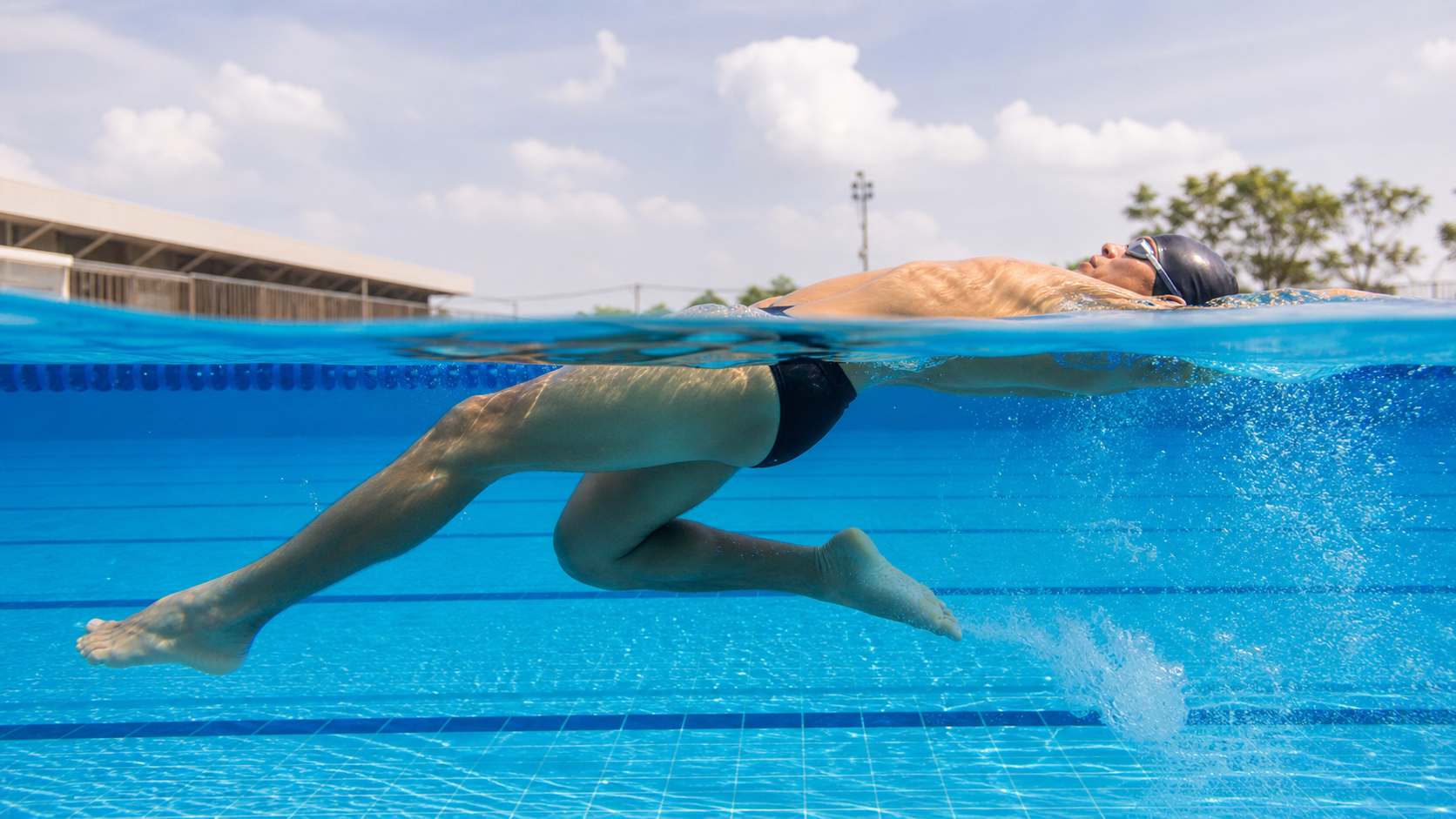
Introduction
The backstroke is less popular among swimming enthusiasts in Taiwan than freestyle or breaststroke, but it is an extremely practical skill for transition rest in triathlons, recovery laps during long-distance swimming, or simply for those who want to avoid swallowing water. The backstroke kick is similar to freestyle—both involve alternating up-and-down leg beats—but because the body is in a face-up position, many people’s kicking technique becomes even less stable. Among the factors involved, knee bend angle and ankle flexibility are the two most critical elements affecting backstroke kicking efficiency.
The Mechanical Basis of the Backstroke Kick
The propulsive force of the backstroke kick is generated primarily during the “upward push” phase of the kick. When the leg pushes water upward from below, the surface area of the instep facing the water determines the magnitude of the propulsive force.
The two phases of the kick:
- Recovery phase: The leg bends downward from an extended position; this phase should be as streamlined as possible to reduce drag
- Drive phase: The leg extends upward and pushes water; this phase is the source of propulsion
Unlike the breaststroke, the propulsive force of the backstroke kick comes mainly from the leg moving upward, whereas in freestyle, the downward kick is the primary driver. This directional difference is why many people who are strong in freestyle see a sharp drop in leg efficiency when switching to backstroke.
The Impact of Knee Bend Angle
| Knee Bend Angle | Effect | Common Issues |
|---|---|---|
| Insufficient bend (<15°) | Weak propulsion, “flat kicking” | Slow progress |
| Moderate (15°–30°) | Optimal propulsion efficiency | Requires core control support |
| Excessive bend (>45°) | High drag, knees breaking the surface | Reduced speed, poor form |
Most common mistake: knees breaking the water surface excessively
During the backstroke kick, the knees should remain below the water surface at all times. If the knees protrude prominently above the water, this not only increases air resistance but also causes the foot angle to skew during the push, significantly reducing effective propulsion. This problem is common in many community swimming classes in Taiwan, primarily due to insufficient core strength to maintain a stable posture with the hips elevated.
Drills to Improve Knee Position
Land-based bridge exercise: Lie flat with knees bent, push the hips upward, and hold for 10–15 seconds. This movement strengthens the glutes and core, helping with hip stability during the backstroke kick.
Backstroke kick with kickboard: Hold a kickboard on the abdomen with both hands, allowing the hips to sink naturally, and feel the position of the knees below the water surface.
The Critical Role of Ankle Flexibility
In the backstroke kick, the ankle’s ability to achieve “plantar flexion”—the degree to which the toes point downward—directly determines the effective surface area of the instep facing the water.
The effect of plantar flexion angle on propulsion:
- Plantar flexion below 30°: The instep cannot effectively face the water, resulting in weak propulsion
- Plantar flexion 40°–50°: Standard range, moderate propulsion
- Plantar flexion 55°+: Maximizes instep contact area, strongest propulsion
Ballet dancers and gymnasts typically have naturally excellent plantar flexion angles, which is why many elite swimmers have a dance or gymnastics background. For the average swimming enthusiast in Taiwan, systematic ankle stretching can significantly improve plantar flexion angles within 4–8 weeks.
Ankle Flexibility Training Methods
- Seated ankle circles: Sit on a chair and make large circles with the ankles, both clockwise and counterclockwise, 20 circles per set, 2–3 times daily
- Kneeling instep stretch: Kneel on the floor with the insteps flat on the ground, gently press the hips toward the heels, and feel the stretch in the insteps. Hold for 30 seconds × 3 sets
- In-water kick awareness: Slowly perform kicking movements in the water, feeling the pressure of the instep against the water. Only when there is a sense of pressure does it mean the ankle angle is correct
- Towel instep pull: Lie on your back, loop a towel around the toes, gently pull toward yourself, and resist in the opposite direction to strengthen active plantar flexion strength in the ankle
Complete Technical Points for the Backstroke Kick
- Rhythm: Kick frequency should coordinate with the arm stroke rhythm, typically a 6-beat kick paired with 2 arm strokes
- Depth: Kick amplitude should be kept within the width of the body (approximately shoulder width), avoiding excessively wide scissor kicks
- Toes: Slightly turn the toes inward (internal rotation) during the kick to increase the pressure surface area of the instep against the water
- Core stability: Slightly engage the abdomen to prevent the lower back from sinking excessively, maintaining a straight body line
Practical Advice
- Before each backstroke training session, do 5 minutes of ankle warm-up (circles + stretches)
- In Taiwan’s summer, take advantage of the beach or open water to practice backstroke; the experience of looking up at the sky can effectively relax you, making the kick more natural and fluid
- Improving ankle flexibility requires 4–8 weeks of consistent training; do not rush for quick results
- If you tend to swallow water while swimming backstroke, practice kicking in shallow water or at the pool edge first, then attempt the full stroke once you have built water feel
Conclusion
Optimizing backstroke kicking technique comes down to finding the correct knee bend angle and continuously improving ankle flexibility. These two seemingly minor technical points are the core elements that determine backstroke efficiency. For swimming enthusiasts in Taiwan, this is also the most direct way to improve backstroke speed without increasing physical training volume.
Related Reading
- The Whipping Motion of the Backstroke Kick: Speed Differences Between Hip-Driven vs Knee-Driven
- Swimming Kick Power: A Guide to Calf Flexibility Training
- Elastic Tendon Training for Swimming: The Relationship Between Ankle Flexibility and Propulsion
- Flexibility Training for Swimming: The Impact of Ankle and Shoulder Mobility on Kicking and Pulling
CT 喇低賽) 武嶺牽車 才是王道 西進牽車四小時內秘訣 攝手位置 如何判斷 防抽筋小秘訣
7 年前
一日北高/長距離團騎 常見問題補充篇 / 組團或跟團的眉角 / 壯車友容易被瘦車友慢性拉爆 / 原來屁股痛可能是這個原因...? / 風場配速法 / 公路車 / CT Yeh
2 年前
碟煞公路車 銑面器 !? 原來銑完差這麼多! 降低蹭碟機率! | TIME 公路車 保養小記錄 | CT Yeh
3 年前
如何把 GoPro 影片 翻轉 批次 轉正?
6 年前
2016/05/13 單車 冷水坑下滑
10 年前
抖肩舞 台灣x日本交流版 (台灣 vs 前橋) 赤城山登山賽 coincidance
8 年前
西進武嶺 免費訓練分析服務 Intervals | 練不夠還是練過頭?你哪一種類型選手?AI模型告訴你! | 備戰神器 | 公路車 訓練 | CT Yeh
4 年前
一日北高常見問題大集合 | 攻略 | 路線 | 訓練 | 補給 | 自行車 單車 | 一日雙城 | 雙塔 | TWB北高360 | 屁股痛
6 年前