Improving Water Resistance Posture: The Relationship Between Streamlined Body Position and Head Placement
Introduction
Water is 800 times denser than air, which means that in the water, even the slightest deviation in posture carries a far greater drag penalty than any movement on land. Many swimmers in Taiwan invest significant time in refining stroke technique or boosting fitness to get faster, yet overlook the most fundamental issue: drag caused by body position. A proper streamlined body position allows a swimmer to swim 15–30% faster with the same energy output.
Three Types of Water Resistance
Swimmers face three main types of resistance in the water:
- Form Drag: Determined by the body’s cross-sectional area. The smaller the cross-section, the lower the drag. This is the type of drag that most needs optimization.
- Wave Drag: Caused by the body disturbing the water surface near the surface, proportional to the square of swimming speed.
- Skin Friction: The friction between the body’s surface and the water. One purpose of high-tech swimsuits worn by competitive athletes is to reduce this drag.
Posture improvements primarily target form drag, which is also the area where recreational swimmers have the most room for improvement.
Head Position: The Most Overlooked Source of Drag
Head position is the single biggest factor affecting form drag. Holding the head too high (lifting the head to look forward) triggers a chain reaction of postural problems:
- Hips sink: Raising the head shifts the center of gravity forward, causing the hips and legs to drop naturally, dramatically increasing drag.
- Lower back arches: This increases the frontal cross-sectional area, raising the drag coefficient.
- Neck muscle tension: Adds unnecessary muscular effort, accelerating fatigue.
Guidelines for Correct Head Position
| Stroke | Head Position | Eye Direction | Neck State |
|---|---|---|---|
| Freestyle (normal) | Level or slightly lower | Slightly downward and forward (45° toward the pool bottom) | Naturally relaxed |
| Freestyle (breathing) | Rotated just until the mouth clears the water | Horizontal to the side | Rotates with the body |
| Backstroke | Back of the head in the water, ears half submerged | Directly upward at the ceiling | Relaxed, not tilted forward |
| Breaststroke | Head lifts until the chin clears the water when breathing | Straight ahead | Moderately lifted |
| Butterfly | Chin skims the water surface when lifting to breathe | At the horizontal line straight ahead | Lifted with minimal movement |
The Gold Standard for a Streamlined Body Position
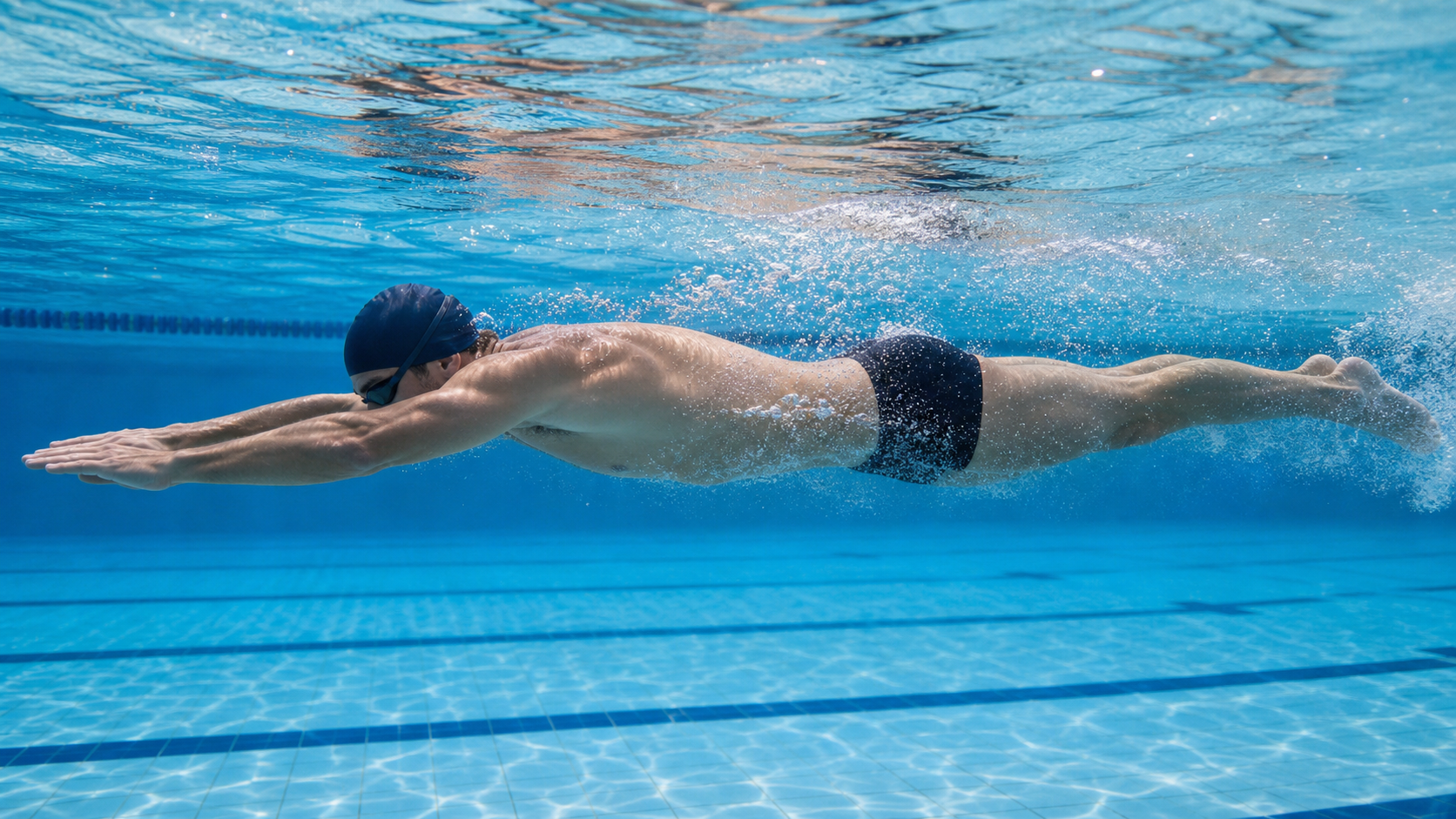
Regardless of the stroke, the core requirement of a streamlined body position is: the body forms a straight line from the crown of the head to the tips of the toes (or a natural diagonal line depending on the stroke), with no part protruding above the water or sinking excessively.
Freestyle Streamlined Body Position Checklist:
- Head in a neutral position, ears next to the upper arms (not lifted)
- Shoulders near the water surface, not rising excessively out of the water
- Hips below the surface but not sinking excessively (hip position should be roughly level with the shoulders)
- Ankles near the surface, with the kick amplitude not exceeding the depth of the body
Training Methods to Improve Body Position in the Water
Method 1: Push-and-Glide Streamline Drill
After pushing off the wall, glide in a streamlined position with both arms pressed against your ears, feeling the state of minimal resistance. The goal is to glide 7–10 meters per push-off (in a 25-meter pool). If the glide distance falls short, it means some part of your body is adding drag, and you need to identify the problem.
Common Glide Drag Issues to Check:
- Glide distance is too short → Hips or legs are sinking
- Body veers to one side → Head is tilted or arms are asymmetrical
- Speed decays quickly → Ankles are not relaxed, toes are pointing upward
Method 2: Look-Down Swimming (Modified Doggy Paddle)
While swimming, consciously press your head down until your eyes are looking at the pool bottom, and feel your hips naturally rise. Continue for 25 meters and compare the difference in resistance versus your normal swimming style.
Method 3: Body Position Training with a Pull Buoy
Place a pull buoy between your legs to let your lower body float naturally, and propel yourself with your arms only. This drill lets swimmers focus on feeling their upper-body position without worrying about their legs sinking.
Special Considerations for Taiwan’s Swimming Environment
Many swimming pools in Taiwan have very busy lanes, especially on weekends or during evening hours, where waves from other swimmers can disrupt your sense of body position. Recommendations:
- Choose early morning (within 1 hour of opening) or weekday daytime for posture training
- Pools such as the Taipei City-run pools and Kaohsiung’s Jhongjheng Swimming Pool have wider lanes, making them suitable for posture practice
- If swimming in open water at Chengcing Lake in Taichung or Liyu Lake, calm water conditions offer excellent opportunities for body-position awareness practice
Practical Tips
- Spend the first 200 meters of each session on slow posture-check swimming—don’t chase speed, just confirm head position and hip height
- Use waterproof earphones to play a metronome and swim to the beat, avoiding the temptation to sacrifice posture for speed
- Have a coach film an underwater side-view video—it’s the most direct way to confirm your body position
- Core strength is the foundation for maintaining a streamlined position; doing core exercises like planks and dead bugs twice a week can significantly improve your body position in the water
Conclusion
Improving body position in the water is the “most energy-efficient way to get faster”—it doesn’t require more strength, only better body-position control. For swimmers in Taiwan, starting with correct head position and progressively building a complete streamlined body position is the training path with the highest return on investment for swimming efficiency.
Related Reading
CT 喇低賽) 武嶺牽車 才是王道 西進牽車四小時內秘訣 攝手位置 如何判斷 防抽筋小秘訣
7 年前
一日北高/長距離團騎 常見問題補充篇 / 組團或跟團的眉角 / 壯車友容易被瘦車友慢性拉爆 / 原來屁股痛可能是這個原因...? / 風場配速法 / 公路車 / CT Yeh
2 年前
風櫃嘴 | 全台最多大砲的單車路線 | 尋寶網攝影師告訴你怎麼擺拍起來才好看 | 熱門攝影地點巡禮
6 年前
西進武嶺 免費訓練分析服務 Intervals | 練不夠還是練過頭?你哪一種類型選手?AI模型告訴你! | 備戰神器 | 公路車 訓練 | CT Yeh
4 年前
CT 喇低賽) 單車 比賽總是沒照片? 攝影師的觀點大公開 姿勢就是力量! 請加速1.25倍收看
7 年前
西進武嶺 自製新版AI配速表產生器 x 賽前攻略 抱佛腳! 沒有功率計也可以產生配速表嗎?有什麼其他眉角賽前要注意的呢? | 西進武嶺 / 東進武嶺 KOM 攻略 | 公路車 | CT Yeh
4 年前
戰略) Zwift Race 如何咬在第一集團 如何評估自己要開多少推力 (請開1.5倍速看)
7 年前
[教學] Premiere 影片 手震 修正 教學 防抖 單眼 影像 GoPro 穩定 Video Stabilization
8 年前