Introduction
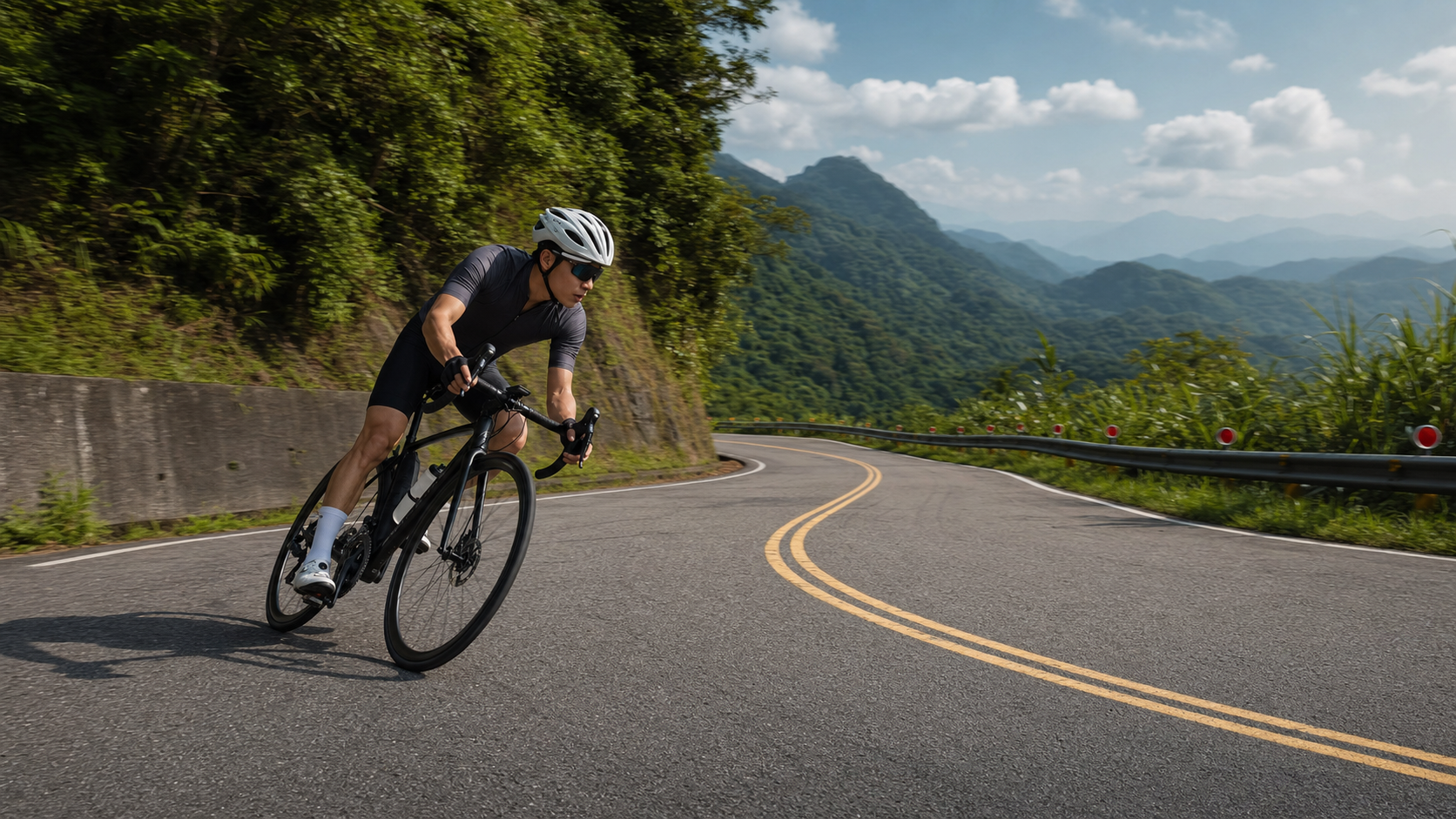
“Climbing relies on strength, descending relies on technique”—this saying is widely shared in Taiwan’s mountain riding community, yet not every rider takes it seriously. On Wuling, descending speeds can reach 60–80 km/h, and the sharp downhill corners on the Beiyi Highway are extreme tests of technical skill. Descending ability doesn’t just affect overall time; it’s directly tied to your safety. This article provides a systematic downhill technique training framework to help you descend safely and efficiently on Taiwan’s mountain routes.
The Physics of Descending
Understanding the basic physics of descending helps you make better technical decisions:
- Braking distance: Doubling your speed quadruples your braking distance (kinetic energy = ½mv²)
- Centrifugal force: The faster you corner, the more friction is required; exceeding tire grip causes a slide
- Gravity component: On a descent, gravity’s component along the slope naturally accelerates the bike, requiring active braking to control speed
Key insight: At 60 km/h, the reaction distance from spotting an obstacle to brake engagement is about 25 meters; combined with a braking distance of over 30 meters, total stopping distance can exceed 55 meters.
A Systematic Approach to Braking Point Judgment
Visual Management: Where to Look?
Where your eyes point while descending directly determines your reaction capability:
| Where you look | Effect | Recommendation |
|---|---|---|
| Ground directly ahead | Only see road conditions 3–5 seconds ahead | Beginners tend to do this, but it’s dangerous |
| Far exit point of the corner | Can anticipate the turn in advance | Standard technical requirement |
| Direction of the next corner | Most efficient on consecutive corners | Advanced technique |
Principle: Your eyes should always be 2–3 corners ahead of the bike, giving your brain time to calculate braking strategy.
Three Reference Indicators for Braking Timing
- Fixed landmark method: On routes you ride regularly (such as Beiyi or Wuling), pick fixed objects like roadside utility poles or signs as braking point references, and start braking from the same position every time
- Visual angle method: When the corner exit angle exceeds 90 degrees as you see it (i.e., you can’t see the exit), you must begin braking
- Speed sensation method: Through training, build muscle memory for “at this speed and this corner curvature, braking needs to start at this distance”
Core Techniques for Weight Transfer
Standard Descending Posture
Correct descending posture lets you maintain maximum control at high speed:
- Weight shifted back: Push your hips slightly rearward, don’t sit at the very front of the saddle, letting the rear wheel carry more weight
- Pedals level: Keep both pedals at the 3 o’clock and 9 o’clock positions (horizontal) to lower your center of gravity
- Elbows slightly bent: Don’t lock your elbows; retain room for shock absorption
- Vision forward: Look far ahead, don’t stare at the ground nearby
Dynamic Weight Adjustment When Cornering
Outside foot pressure (outside pedal down) technique:
- Before entering the corner, push the outside foot down to the lowest point (6 o’clock position)
- Apply downward force with the outside foot, using that force to lean the bike
- Keep the inside foot at the highest point to prevent the pedal from striking the ground
- Slide your hips slightly outward on the saddle, keeping your upper body relatively upright
Line Selection: Finding the Optimal Cornering Trajectory
The correct cornering line lets you get through a turn at the same speed with greater safety:
Racing line basic principles:
- Slow in, fast out: Brake sufficiently before the corner, then accelerate out after the apex
- Outside–inside–outside trajectory: Enter from the outside of the corner, approach the inside at the apex, and return to the outside when exiting
- Vision guidance: Look toward the apex, then shift to the exit point; your body will naturally follow
Special considerations for Taiwan’s mountain roads:
- Oncoming traffic: You must not use racing lines that cross the center line; corner conservatively within your own lane
- Blind spots: On corners where you can’t see oncoming conditions, speed must be controlled so you can come to a complete stop within your visible range
Progressive Downhill Training Plan
- Weeks 1–2: On familiar gentle slopes (4–6% grade), practice weight shifting rearward and outside foot pressure techniques, keeping speed at 30–40 km/h
- Weeks 3–4: Increase the grade (6–10%), practice judging fixed braking points, and raise speed to 40–50 km/h
- Weeks 5–6: Conduct integrated training on a full mountain route (such as Beiyi), deliberately applying the learned techniques at every corner
Practical Advice
- Before descending, check tire pressure (5–10 psi lower than climbing pressure to increase contact patch) and brake pad thickness
- At high-speed descents, placing your hands on the drops (the lower curved section of a drop bar) increases stability and gives stronger braking leverage
- On long descents, alternate between front and rear brakes to let the brake pads cool and avoid overheating fade
- In rain or wet conditions, reduce speed by 30–40% because braking distance increases significantly
- The first time you ride a downhill route, do a slow reconnaissance pass to familiarize yourself with each corner’s characteristics before picking up speed
Conclusion
Downhill technique is a skill that requires deliberate practice; it won’t improve automatically with riding time. Through systematic braking point training and weight control drills, you can conquer every mountain descent in Taiwan more smoothly while staying safe. Remember: speed is the result of skill, not the goal; safety is the most important factor that lets you keep enjoying riding.
Related Reading
- Downhill Technique After Climbing: Safe Riding with Brake Control and Cornering Lines
- The Complete Downhill Skills Guide: Weight Control, Vision Guidance, the Physics of Braking Timing, and Progressive Practice Methods
- Descent Safety and Technique: The Right Downhill Strategy After Reaching the Summit
- Downhill Technique and Braking After Climbing: Making Descents as Worth Training as Climbs
大禹嶺 到 武嶺牌樓 全程前後實況錄影 | 北進武嶺 | 東進武嶺 | KOM | 訓練台 | 坡度分析 | Taiwan KOM Last 10 km HARD | 公路車
6 年前
CT 喇低賽) 武嶺牽車 才是王道 西進牽車四小時內秘訣 攝手位置 如何判斷 防抽筋小秘訣
7 年前
FTL 與 SYB 車隊專訪 西進武嶺 實用攻略分享! 2小時 如何練?!你不知道的眉角!新手準備武嶺必看 EP1 | 實力派女車友 | 精華版 | 公路車 | CTYeh
4 年前
公路車 爬坡 破PR 紀錄 小技巧 分享
6 年前
單車 梅山36灣 坡度介紹 路段介紹 空拍 (相關遊記影片,請參考說明或我的頻道喔,歡迎訂閱)
6 年前
西進武嶺 免費訓練分析服務 Intervals | 練不夠還是練過頭?你哪一種類型選手?AI模型告訴你! | 備戰神器 | 公路車 訓練 | CT Yeh
4 年前
東進武嶺 西進武嶺 AI 配速 上線囉 公路車
5 年前
風櫃嘴時間 預測西進武嶺時間?13000名車友統計數據分析告訴你 !
5 年前