Introduction
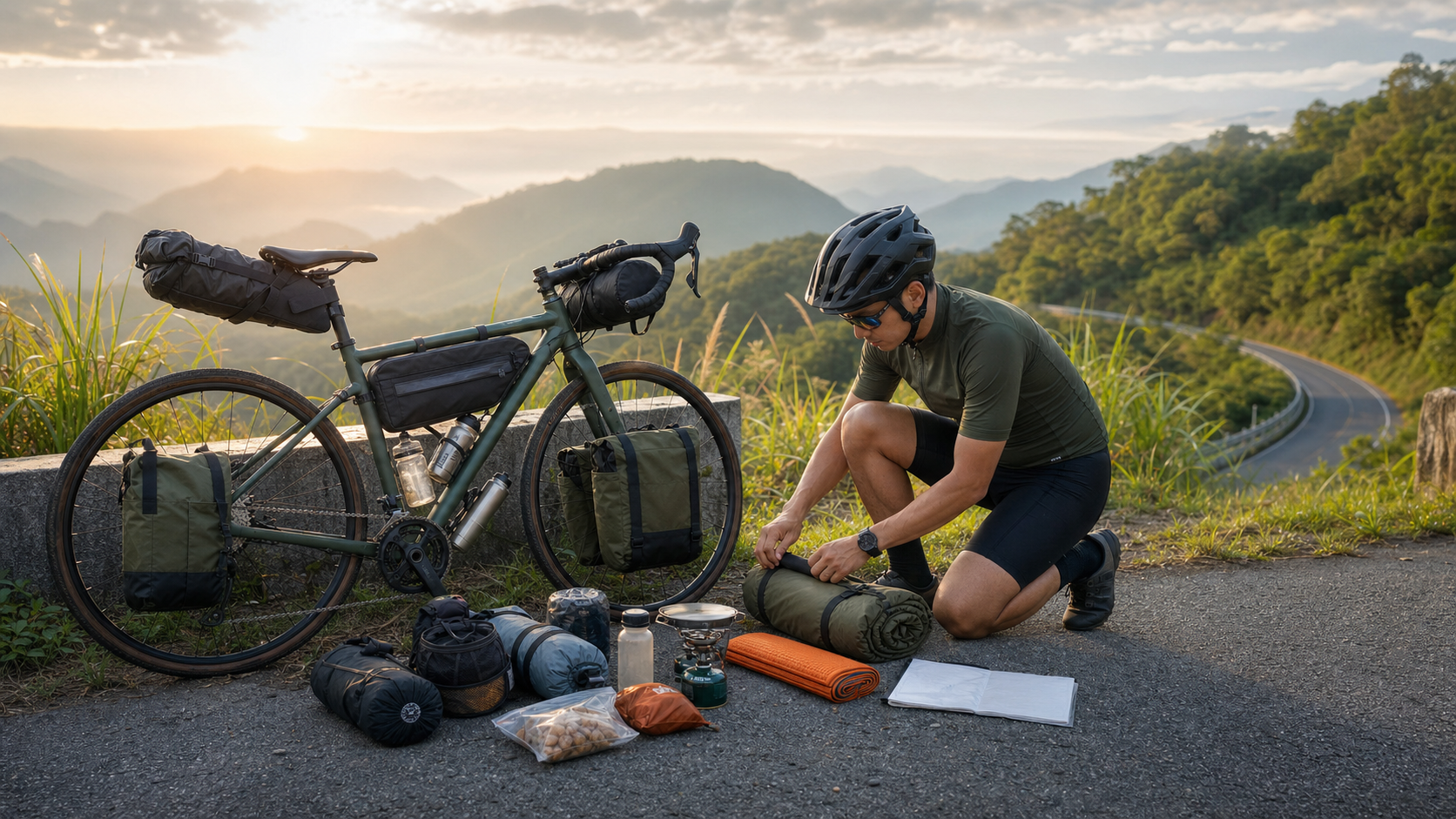
Bicycle touring with camping (also known as bikepacking) has become increasingly popular in Taiwan in recent years. Loading a tent, sleeping bag, and cooking gear onto your bike—without relying on hotels or public transport, exploring Taiwan entirely on your own legs and a single bicycle—this style of travel offers an unparalleled sense of freedom. However, the biggest difference from regular bicycle touring lies in gear weight management—an extra 10 kg of luggage has a huge impact on climbing difficulty and daily riding distance. This article provides a systematic calculation framework to help you plan the perfect bicycle camping trip.
Gear Weight Calculation Framework
Gear Categories and Recommended Weights
| Gear Category | Essential Items | Recommended Total Weight |
|---|---|---|
| Sleeping System | Tent (or tarp), sleeping bag, sleeping pad | 1.5–3 kg |
| Cooking Gear | Stove, cookware, lighter, utensils | 0.5–1 kg |
| Personal Clothing | Cycling jersey ×2, casual clothes ×1, rain jacket, spare socks | 1–2 kg |
| Repair Tools | Spare tube, chain quick link, hex wrenches, pump | 0.5–0.8 kg |
| Electronics | Phone, power bank, charging cables, GPS computer | 0.5–0.8 kg |
| Food and Water | Replenished daily before departure, approx. 1–2 kg/day | Variable |
| Miscellaneous | First-aid kit, toiletries, tissues, sunscreen | 0.5 kg |
Recommended total gear weight: keep base luggage (excluding food and water) within 5–8 kg, with food and water adding another 1–2 kg.
The Impact of Weight on Riding Speed
Based on real-world data from long-distance cyclists, for every additional 5 kg of gear:
- Flat-road speed drops by approximately 1–2 km/h
- Climbing efficiency drops by approximately 10–15%
- Time required for the same distance increases by approximately 10–20%
Therefore, lightweight packing is the core principle of bicycle camping—more gear does not mean safer.
How to Calculate Daily Distance
Calculating a reasonable daily distance requires considering the following factors:
Basic Formula
Daily riding time × Effective speed = Actual distance

Effective speed = Average riding speed × Efficiency factor
Efficiency factor reference values:
- Flat routes: 0.80–0.85
- Rolling routes: 0.65–0.75
- Mountain routes: 0.50–0.60
Example calculation:
7 kg of gear, average riding speed 18 km/h, efficiency factor 0.70 (rolling route), 6 hours of riding per day:
Daily distance = 6 × 18 × 0.70 = 75.6 km
It is recommended to set the first day’s actual distance at 70–80% of the calculated value to let your body adapt to loaded riding.
Trip Duration Planning Method
Using a Taiwan round-island tour as an example (total distance approximately 1,000 km):
- Speed-focused (minimal gear): 120 km per day, approximately 8–9 days
- Standard (camping gear): 80–90 km per day, approximately 11–13 days
- Leisurely (full camping + sightseeing): 50–70 km per day, approximately 15–20 days
Trip duration calculation formula:
Trip duration = Total distance ÷ Daily distance × Adjustment factor

Adjustment factor = 1 + (Number of rest days ÷ Total riding days)
It is recommended to schedule a half rest day every 3–4 days (riding no more than 40 km) to allow full physical recovery.
Choosing Campsites in Taiwan
The following types of accommodation are available for bicycle camping in Taiwan:
- Legal campgrounds: The blog “Taiwan Campsite Map” has a complete list; reservation required, NT$200–500 per night
- Bicycle rest stations: Some county and city governments provide free camping spots along bike paths, with facilities including restrooms, drinking water, and power outlets
- Temple corridors: Taiwan traditionally welcomes travelers to rest in temple corridors; be sure to politely ask the caretaker
- Public land (leave-no-trace camping): Strict adherence to LNT (Leave No Trace) principles is required
Gear Packing Position Allocation
Weight distribution directly affects riding stability. Here is the recommended allocation:
- Handlebar Bag: Light and bulky items (sleeping bag, clothing)
- Rear Panniers: Heavy items at the bottom, keeping weight concentrated low
- Frame Bag: Tools, electronics, and other frequently accessed items
- Saddle Bag: Light spare items
Practical Tips
- Do a “loaded test ride” before departure (ride 50–60 km with all your gear) to confirm the weight is acceptable
- Convenience stores are plentiful in Taiwan, so you can carry less food and significantly reduce luggage weight
- Titanium cookware is more than 50% lighter than stainless steel, making it the highest-return investment for weight reduction
- When choosing a tent, Taiwan’s warm climate means you don’t need a four-season tent—a lightweight three-season model is sufficient
- Nighttime temperatures in Taiwan’s mountain areas can drop suddenly by 10–15°C, so pack a warm layer even in summer
Conclusion
Bicycle camping is a travel art that requires systematic planning. By precisely calculating gear weight, reasonably setting daily distances, and carefully choosing campsites, you can create a cycling experience of complete physical and mental freedom across Taiwan. When night falls, you pitch your tent under the open sky, and as cooking smoke rises, that sense of the most direct connection with the land of Taiwan is a luxury no hotel can provide. Pack your gear and set out to explore.
Related Reading
- Bicycle Camping for Beginners: Bikepacking Gear Checklist and Recommended Taiwan Routes
- Bicycle Touring Gear Checklist: The Packing Philosophy of a Week of Bikepacking Luggage
- Bicycle Camping (Bikepacking) for Beginners: Lightweight Gear and Taiwan Route Recommendations
- Packing for Bicycle Travel: Lightweight Techniques for Long-Distance Cycling Tours
單車 一日北高 ( 雙城 ) 肥宅雙人瘋狂行 紀錄片 REACTO
10 年前
靠單車減肥35公斤 心得分享與整理
7 年前
單車賞雪 裝備準備及注意事項分享 | 公路車
5 年前
#公路車 #Fitting 靠人工智慧APP 幫你調整單車
6 年前
大家都在開箱的...單車用藍芽對講耳機真的有幫助嗎? SENA BiKom 20 長距離旅遊 & 海鷗繞圈賽 實際體驗心得 / 公路車 / CT Yeh
9 個月前
南竿 單車 | 老婆公路車首航 | 偽出國體驗 | 4K 高畫質 | 綠色騎跡低碳輕旅遊 | #公路車
5 年前
半日 小台灣 極限單車路線挑戰實錄
7 年前
北宜騎車⋯好刺激 差點被🐒尻 / 露營單車旅 / 公路車後背攜車架開箱!/ 百人大團露 / YAKIMA 設備開箱儀式感都來了 / 公路車 / CT Yeh
12 個月前